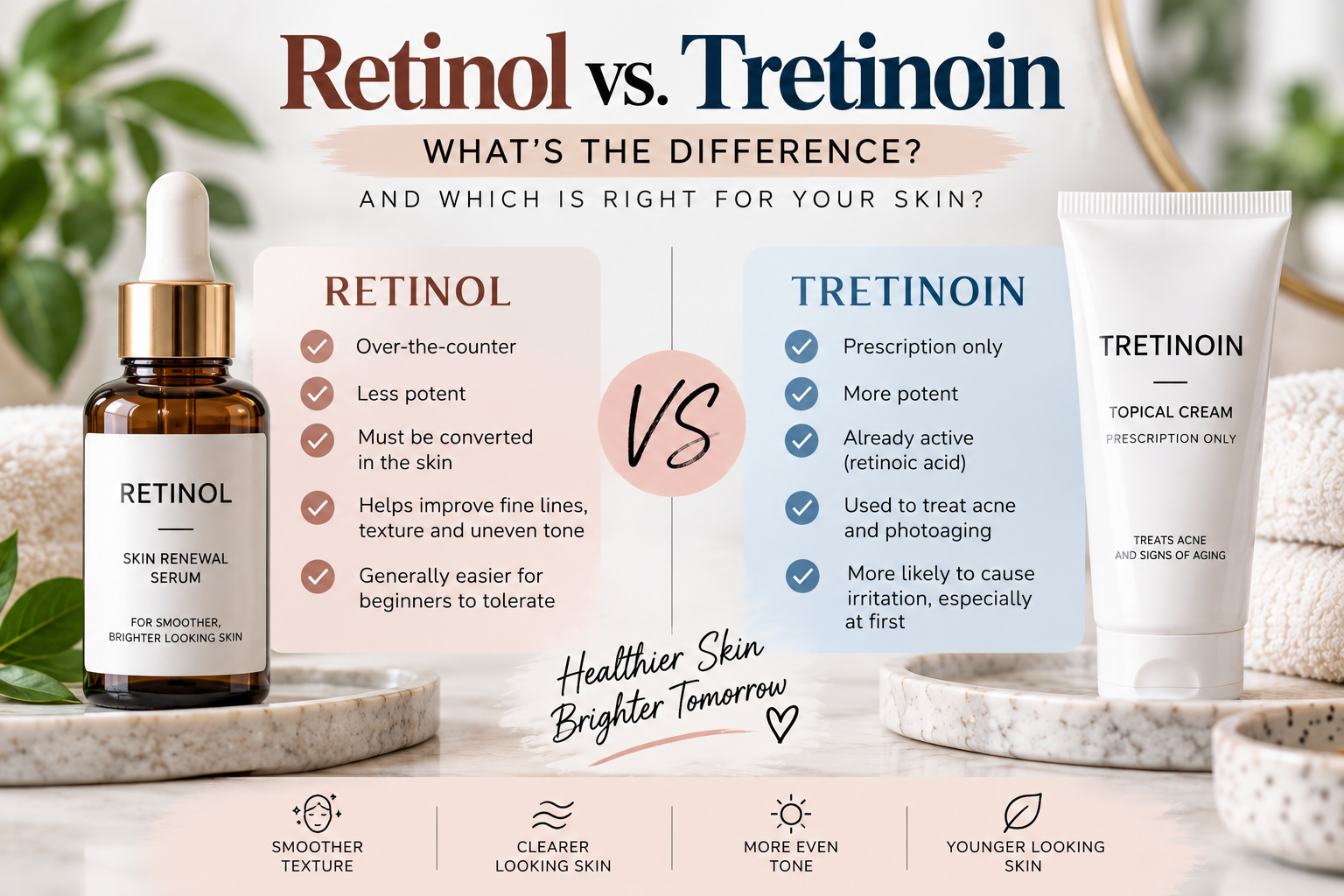
If you’re trying to improve acne, fine lines, uneven skin tone, or skin texture, you’ve probably come across retinol and tretinoin. Both belong to the retinoid family, but they are not the same thing.
The retinol vs. tretinoin comparison mainly comes down to strength, how quickly each ingredient becomes active in the skin, availability, potential irritation, and the skin concerns they’re commonly used to address.
Retinol is widely available in over-the-counter skincare products in the United States. Tretinoin, also known as retinoic acid, is a prescription medication in the U.S. and has decades of use in dermatology.
So, what is the difference between retinol and tretinoin, and which one makes sense for your skincare routine?
Let’s break it down.
Retinol vs. Tretinoin: Quick Comparison
| Retinol | Tretinoin |
|---|---|
| Over-the-counter cosmetic retinoid | Prescription topical retinoid in the U.S. |
| Must be converted into active retinoic acid in the skin | Already retinoic acid |
| Generally less potent | More potent |
| Often easier for beginners to tolerate | More likely to cause irritation, especially initially |
| Used for signs of aging and skin texture | Used to treat acne and photoaging |
| Available in many serums and creams | Requires a prescription in the U.S. |
Both can have a place in skincare, but tretinoin is not simply a stronger cosmetic retinol serum. It is a medication and should be used according to your healthcare professional’s instructions.
What Is Retinol?
Retinol is a type of retinoid, a family of compounds related to vitamin A.
It is commonly found in over-the-counter:
- Serums
- Creams
- Night treatments
- Eye products
- Moisturizers
When topical retinol is applied, it must undergo conversion steps in the skin before becoming retinoic acid, the biologically active form.
This indirect conversion is one reason retinol is generally less potent than tretinoin.
What Does Retinol Do for Skin?
Depending on the formulation and consistent use, retinol may help improve the appearance of:
- Fine lines
- Uneven texture
- Uneven skin tone
- Signs of sun-related skin aging
Retinol can still cause dryness, peeling, redness, and irritation, particularly when you first introduce it.
If you have never used a retinoid before, see our Retinol for Beginners guide before building your routine.
What Is Tretinoin?
Tretinoin is also a retinoid, but unlike retinol, tretinoin itself is retinoic acid.
It does not need the same conversion process as retinol before interacting with retinoic acid receptors in the skin.
In the United States, topical tretinoin is a prescription medication.
Dermatologists may prescribe tretinoin for conditions including acne, and certain formulations are also indicated for reducing the appearance of fine facial wrinkles as part of a broader skin-care and sun-avoidance program.
What Does Tretinoin Do for Skin?
Depending on why it has been prescribed, tretinoin may be used to address:
- Acne
- Comedones
- Fine facial wrinkles associated with photoaging
- Certain changes in skin texture or pigmentation associated with sun damage
Your healthcare professional determines whether tretinoin is appropriate and which formulation and strength to use.
Retinol vs. Tretinoin: What’s the Main Difference?
The biggest difference between retinol and tretinoin is how directly they act as retinoic acid.
Retinol requires conversion:
Retinol → Retinaldehyde → Retinoic Acid
Tretinoin is already:
Retinoic Acid
This helps explain why tretinoin has stronger pharmacologic activity and is available by prescription in the U.S.
But stronger does not automatically mean better for every person.
Your skin concern, sensitivity, current routine, medical history, and ability to tolerate treatment all matter.
Retinol vs. Tretinoin for Acne
When comparing tretinoin vs. retinol for acne, tretinoin has an established role as a prescription acne medication.
Topical retinoids can help prevent follicles from becoming clogged, which makes them useful for comedonal acne.
Retinol-containing cosmetics shouldn’t automatically be treated as substitutes for prescription acne therapy.
If you’re dealing with persistent, painful, scarring, or moderate-to-severe acne, seeing a dermatologist is preferable to simply buying increasingly strong skincare products.
You may also want to read our Salicylic Acid vs. Benzoyl Peroxidhttps://skineza.com/salicylic-acid-vs-benzoyl-peroxide/e guide to understand two other commonly used acne ingredients.
Retinol vs. Tretinoin for Wrinkles
Another popular comparison is retinol vs. tretinoin for wrinkles.
Both are associated with skincare routines targeting signs of aging, but the evidence, formulations, concentrations, and regulatory status differ.
Prescription tretinoin has been extensively studied for photoaged skin. Certain tretinoin products are indicated as an adjunct for reducing fine facial wrinkles when used alongside comprehensive skincare and sun protection.
Retinol is widely used in cosmetic anti-aging products and may improve the appearance of fine lines with consistent use.
Neither should be viewed as a replacement for sun protection.
Retinol vs. Tretinoin for Hyperpigmentation
Retinoids may also be incorporated into routines targeting uneven-looking pigmentation.
Tretinoin is sometimes used by dermatologists as part of treatment plans for pigmentary concerns, depending on the diagnosis.
Retinol products may gradually improve the appearance of uneven skin tone.
However, hyperpigmentation has different causes, and not every dark spot should be treated in the same way.
Sun protection is particularly important when managing pigmentation.
Is Tretinoin Stronger Than Retinol?
Yes, tretinoin has more direct and potent retinoid activity than retinol because tretinoin is already retinoic acid.
However, comparing percentages directly can be misleading.
For example, you shouldn’t assume that a certain percentage of retinol is equivalent to a particular percentage of tretinoin.
They are different ingredients with different pharmacology and formulations.
Your dermatologist may prescribe tretinoin in different concentrations based on the condition being treated and your individual circumstances.
Does Tretinoin Work Faster Than Retinol?
Because tretinoin is already in its active retinoic acid form, its biological activity is more direct.
But that doesn’t mean everyone will see dramatic results immediately.
Both acne and photoaging treatments require consistent use over time.
Tretinoin can also cause significant irritation during the early stages of treatment, which may require adjustments directed by your healthcare professional.
Don’t increase the amount or frequency simply to try to get faster results.
Retinol vs. Tretinoin Side Effects
Both retinoids can irritate the skin.
Possible Retinol Side Effects
Retinol may cause:
- Dryness
- Redness
- Peeling
- Flaking
- Stinging
- Increased sensitivity
The risk varies with concentration, formulation, frequency, and the rest of your routine.
Possible Tretinoin Side Effects
Tretinoin may cause:
- Dryness
- Peeling
- Redness
- Burning or stinging
- Irritation
- Increased sensitivity of treated skin
Your prescriber can help you manage side effects and decide whether the treatment should be adjusted.
Retinol vs. Tretinoin for Sensitive Skin
If you have sensitive skin, neither ingredient should be treated casually.
Retinol is often used as a more gradual introduction to retinoids because it generally has lower potency than tretinoin.
However, even an over-the-counter retinol can irritate sensitive skin.
Tretinoin should be used exactly as prescribed.
Keeping the rest of your routine simple—with a gentle cleanser, moisturizer, and sunscreen—may make retinoid use easier to tolerate.
How to Use Retinol
If you’re starting an over-the-counter retinol, read the directions for your specific product.
A simple nighttime routine might be:
Step 1: Gentle cleanser
Step 2: Retinol product
Step 3: Moisturizer
Beginners may prefer introducing retinol gradually rather than using it every night immediately.
Avoid piling multiple potentially irritating active ingredients into the same routine when you’re first starting.
How to Use Tretinoin
Use tretinoin exactly as prescribed.
Instructions can vary depending on your medication, formulation, condition, and dermatologist’s treatment plan.
A typical routine may involve cleansing, allowing the skin to dry as directed, applying the prescribed amount of tretinoin, and using moisturizer.
Do not apply more tretinoin than prescribed in an attempt to speed up your results.
More medication can mean more irritation rather than faster improvement.
Can You Use Retinol and Tretinoin Together?
Generally, there is little reason to independently layer an over-the-counter retinol with prescription tretinoin.
They are both retinoids, and combining them may increase irritation without providing a clear additional benefit.
If you have been prescribed tretinoin, ask your prescriber before adding other retinoids or strong active ingredients.
Can You Use Tretinoin With Salicylic Acid?
Some treatment plans may contain both a retinoid and salicylic acid, but combining irritating ingredients can increase dryness and irritation.
Don’t assume that because two ingredients are good for acne, using them together will produce better results.
If you’re using prescription tretinoin, discuss other acne treatments with your healthcare professional.
Can You Use Niacinamide With Retinol or Tretinoin?
Niacinamide is commonly included in skincare routines because it can support skin-barrier function.
It can generally coexist in routines containing retinoids, depending on the formulations.
If you’re using prescription tretinoin, your dermatologist’s instructions should take priority.
Read our Niacinamide for Skin guide if you want to learn more about this ingredient.
Retinol, Retinal and Tretinoin: What’s the Difference?
These three ingredients belong to the retinoid family but differ in their conversion pathways.
A simplified pathway is:
Retinol → Retinal (Retinaldehyde) → Retinoic Acid (Tretinoin)
Retinal requires fewer conversion steps than retinol before becoming retinoic acid.
Tretinoin requires no conversion because it is already retinoic acid.
This doesn’t mean you should simply choose the product closest to retinoic acid. Tolerability and the reason you’re using a retinoid are important considerations.
Retinol vs. Tretinoin: Which Is Better for Beginners?
For someone interested primarily in cosmetic skincare who has never used retinoids, an over-the-counter retinol may offer a more approachable introduction.
Prescription tretinoin may be appropriate when there is a medical indication and a healthcare professional recommends it.
Rather than thinking:
“Which one is strongest?”
Think:
“Which treatment is appropriate for my skin concern?”
Those aren’t always the same question.
How to Reduce Retinoid Irritation
Whether you’re using retinol or prescribed tretinoin, a few habits may help keep your routine manageable:
- Use a gentle cleanser.
- Avoid aggressive physical scrubs.
- Keep your routine simple.
- Moisturize consistently.
- Don’t introduce several strong actives simultaneously.
- Follow your product or prescription directions.
- Protect your skin from the sun.
- Don’t pick peeling or flaky skin.
If irritation becomes severe or persistent, stop experimenting and contact your healthcare professional.
Retinol and Tretinoin During Pregnancy
This is an important safety consideration.
Topical tretinoin labeling includes pregnancy-related warnings, and retinoids are generally avoided during pregnancy.
If you are pregnant, planning a pregnancy, or think you may be pregnant, discuss retinoid use with your healthcare professional rather than starting or continuing retinol or tretinoin on your own.
Breastfeeding questions should also be discussed with a healthcare professional.
Sunscreen Is Essential With a Retinoid Routine
Sun protection should be part of your routine whether you’re using retinol or tretinoin.
Use a broad-spectrum, water-resistant sunscreen with SPF 30 or higher on exposed skin and follow other sun-protective measures.
This is especially important if you’re treating signs of photoaging or hyperpigmentation.
Retinol vs. Tretinoin: Which One Should You Choose?
The choice depends on why you’re using a retinoid.
Retinol may make sense if you:
- Want an over-the-counter skincare option.
- Are primarily targeting the appearance of fine lines or texture.
- Are new to retinoids.
- Prefer to begin with a generally less potent option.
Tretinoin may be considered if you:
- Have acne requiring prescription treatment.
- Have concerns a dermatologist believes would benefit from tretinoin.
- Need a prescription-strength retinoid.
- Can use it under appropriate medical guidance.
The right option isn’t necessarily the strongest one—it is the one appropriate for your skin and treatment goals.
Frequently Asked Questions
Is tretinoin the same as retinol?
No. Both are retinoids, but retinol must undergo conversion in the skin to become retinoic acid. Tretinoin is retinoic acid and is a prescription medication in the United States.
Is tretinoin stronger than retinol?
Yes. Tretinoin has more direct retinoid activity because it is already retinoic acid.
Is retinol or tretinoin better for acne?
Tretinoin is an established prescription acne treatment. Retinol cosmetics aren’t direct substitutes for prescription acne medication.
Is retinol or tretinoin better for wrinkles?
Both are used in routines targeting signs of aging, but prescription tretinoin has substantial clinical research for photoaging. Retinol is an over-the-counter cosmetic option that may improve the appearance of fine lines over time.
Can I switch from retinol to tretinoin?
If you want to switch to tretinoin, speak with a healthcare professional because tretinoin requires a prescription in the U.S.
Can I use tretinoin every night?
Use tretinoin at the frequency prescribed by your healthcare professional. Don’t increase frequency without medical guidance.
Can I use retinol and tretinoin together?
Using two retinoids together may unnecessarily increase irritation. If you use prescription tretinoin, discuss other retinoid products with your prescriber.
Does tretinoin permanently thin the skin?
Tretinoin should not simply be characterized as permanently thinning healthy skin. It can cause temporary dryness, peeling, and irritation, especially early in treatment. If you’re experiencing persistent skin changes while using tretinoin, speak with your prescriber.
Final Thoughts
When comparing retinol vs. tretinoin, both belong to the retinoid family, but there are important differences.
Retinol is an over-the-counter cosmetic ingredient that must be converted into retinoic acid in the skin. Tretinoin is retinoic acid itself and is a prescription medication in the United States.
For beginners interested in improving the appearance of fine lines and texture, retinol may offer a more gradual starting point. For conditions such as acne, a dermatologist may recommend prescription tretinoin when appropriate.
Whichever retinoid you use, consistency, moisturizer, sun protection, and avoiding an overly aggressive routine are important.