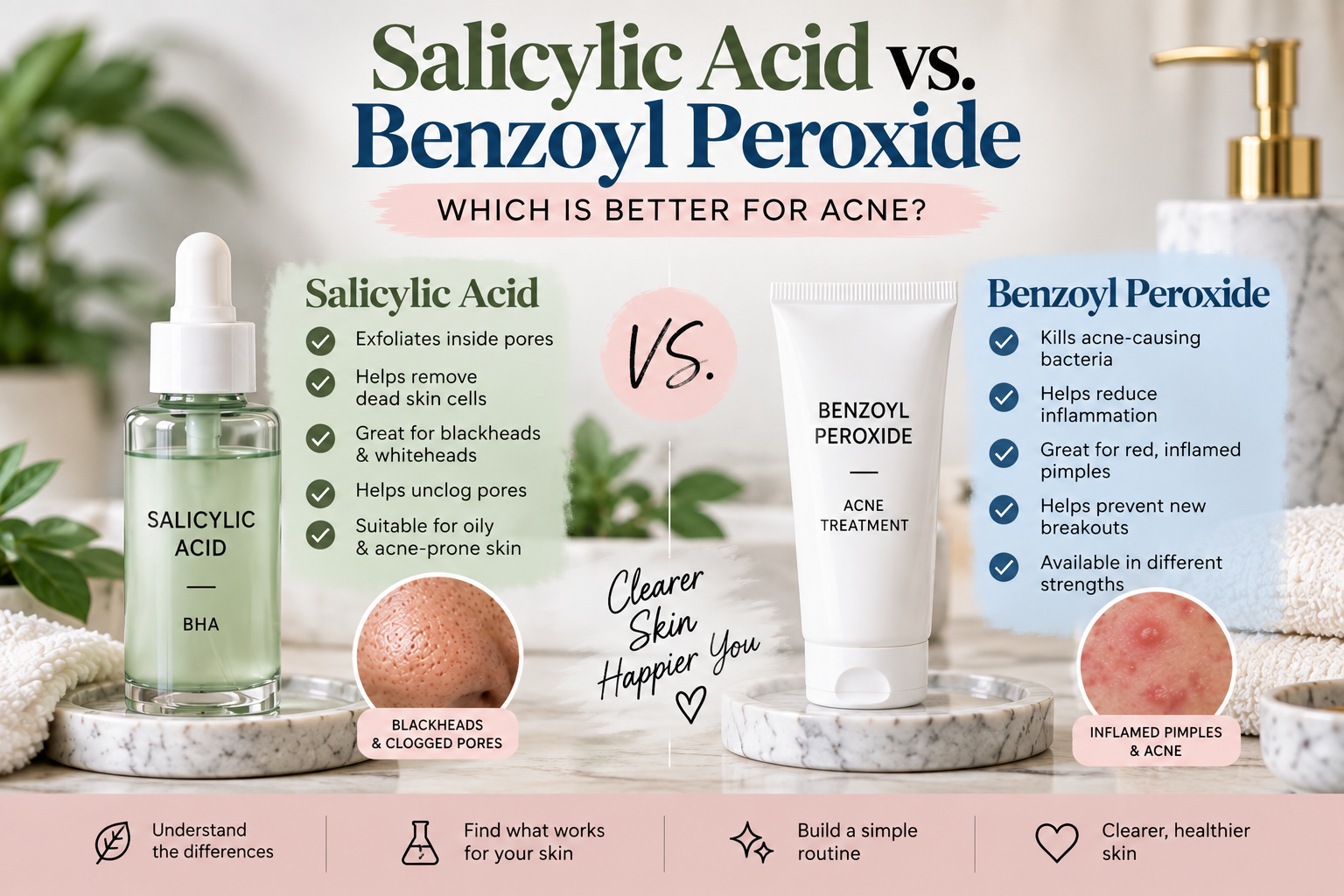
When you’re dealing with breakouts, two ingredients appear again and again: salicylic acid and benzoyl peroxide.
Both are widely used in over-the-counter acne products, but they don’t work in exactly the same way. Salicylic acid is especially useful for clogged pores, blackheads, and whiteheads, while benzoyl peroxide targets acne-causing bacteria and is commonly used for inflammatory pimples.
So, when comparing salicylic acid vs. benzoyl peroxide, which one should you choose?
The answer depends on the type of acne you have, your skin’s sensitivity, and the rest of your skincare routine.
Here’s what you need to know before adding either ingredient to your routine.
Salicylic Acid vs. Benzoyl Peroxide: Quick Comparison
| Salicylic Acid | Benzoyl Peroxide |
|---|---|
| Beta hydroxy acid (BHA) | Acne medication |
| Helps exfoliate inside pores | Helps reduce acne-causing bacteria |
| Often used for blackheads and whiteheads | Often used for inflammatory pimples |
| May help with clogged pores | May help with red, inflamed acne |
| Can cause dryness or irritation | Can cause dryness, peeling, or irritation |
| Does not bleach fabrics | Can bleach towels, clothing, and bedding |
Both ingredients can be effective, but choosing the right one starts with understanding how each works.
What Is Salicylic Acid?
Salicylic acid is a beta hydroxy acid (BHA) commonly found in acne cleansers, toners, serums, pads, and spot treatments.
Unlike many water-soluble exfoliating acids, salicylic acid is oil-soluble. This allows it to work in oily areas of the follicle and help loosen accumulated dead skin cells.
Because of this, salicylic acid is commonly used for:
- Blackheads
- Whiteheads
- Clogged pores
- Oily skin
- Mild acne
- Rough or congested-looking skin
If clogged pores are one of your main concerns, salicylic acid may be a particularly useful ingredient to consider.
How Does Salicylic Acid Work?
Acne can develop when dead skin cells and sebum accumulate inside hair follicles. Salicylic acid is a BHA that can help exfoliate inside pores. Learn more about the difference between AHA vs. BHA and which exfoliant may suit your skin.
Salicylic acid helps exfoliate dead skin cells and can reduce follicular plugging.
Over time, this may help keep pores clearer and reduce the formation of comedones such as blackheads and whiteheads.
Salicylic acid can still cause irritation, however, especially when combined with several other exfoliating or drying products.
What Is Benzoyl Peroxide?
Benzoyl peroxide is a topical acne medication available in products such as cleansers, gels, creams, and spot treatments.
It works differently from salicylic acid.
One of its main benefits is reducing Cutibacterium acnes (C. acnes), a bacterium involved in acne development.
Benzoyl peroxide can also help reduce excess oil and remove dead skin cells.
It is commonly used for:
- Inflamed pimples
- Papules
- Pustules
- Mild-to-moderate inflammatory acne
One practical downside is that benzoyl peroxide can bleach fabrics, including towels, pillowcases, clothing, and sometimes hair.
Salicylic Acid vs. Benzoyl Peroxide for Acne
Neither ingredient is universally better.
The more useful question is: What type of acne are you trying to treat?
For Blackheads: Salicylic Acid
If blackheads are your primary concern, salicylic acid is often a logical option.
Blackheads develop when a follicle becomes clogged but remains open at the surface.
Salicylic acid’s exfoliating properties can help reduce the dead skin cells contributing to these plugs.
Remember that some small dots around the nose may actually be sebaceous filaments, which are normal skin structures rather than blackheads.
For Whiteheads: Salicylic Acid
Salicylic acid may also be useful for whiteheads.
Whiteheads are closed comedones created when material accumulates inside a follicle and the opening remains closed.
Regular use of an appropriate salicylic acid product may help prevent and manage this type of congestion.
For Red, Inflamed Pimples: Benzoyl Peroxide
Benzoyl peroxide may be particularly useful when your acne includes red, inflamed pimples.
Its antimicrobial action against C. acnes is one reason benzoyl peroxide is widely used in acne treatment.
It is also frequently combined with other acne medications under medical guidance.
For Clogged Pores: Salicylic Acid
If your skin feels bumpy and congested and you’re regularly dealing with clogged pores, salicylic acid may fit your concern more directly.
You can also read our complete guide on how to get rid of clogged pores for more tips on building a gentle routine.
For Inflammatory Acne: Benzoyl Peroxide
For acne dominated by inflammatory lesions rather than blackheads and whiteheads, benzoyl peroxide may be useful.
However, moderate or severe inflammatory acne should not necessarily be managed through endless experimentation with over-the-counter products.
A dermatologist can help determine whether prescription treatment is appropriate.
Salicylic Acid vs. Benzoyl Peroxide for Sensitive Skin
Both ingredients have the potential to irritate sensitive skin.
Salicylic acid may cause:
- Dryness
- Stinging
- Peeling
- Redness
- Irritation
Benzoyl peroxide may cause:
- Dryness
- Peeling
- Burning or stinging
- Redness
- Irritation
The concentration, formulation, frequency of application, and other products in your routine all influence how well your skin tolerates an ingredient.
If you have sensitive skin, introduce new acne treatments gradually and avoid starting several strong active ingredients simultaneously. if your skin seems to break out after starting a new active ingredient, understanding skin purging vs. breakout can help you recognize the difference.
Can You Use Salicylic Acid and Benzoyl Peroxide Together?
They can sometimes be used within the same overall acne routine, but that doesn’t mean everyone needs both—or that you should immediately layer them together.
Using multiple drying or irritating treatments can increase irritation.
A simple approach might be to use one ingredient first and see how your skin responds before adding another.
Some people may use:
Morning: Benzoyl peroxide product → moisturizer → sunscreen
Night: Gentle cleanser → salicylic acid product → moisturizer
However, this is only an example, not a routine everyone needs to follow.
If your skin is sensitive, you’re using prescription acne medications, or you’re unsure how to combine treatments, ask a dermatologist or other qualified healthcare professional.
How to Use Salicylic Acid
Salicylic acid appears in several types of products.
Salicylic Acid Cleanser
A cleanser may be an easy introduction because the product is rinsed from the skin.
Follow the directions on the specific product rather than assuming more frequent use will produce faster results.
Leave-On Salicylic Acid
Toners, serums, pads, and other leave-on treatments remain on the skin longer.
If you’re new to exfoliating acids, introduce them gradually and monitor for excessive dryness or irritation.
Moisturize Afterwards
A moisturizer can help support your skin barrier while you’re using potentially drying acne treatments.
Choose a texture appropriate for your skin type.
How to Use Benzoyl Peroxide
Benzoyl peroxide is available in different strengths and formulations.
Start Conservatively
Higher concentration doesn’t automatically mean better results for every person.
Using too much benzoyl peroxide can make irritation more likely.
Follow the directions provided with your specific product or instructions from your dermatologist.
Apply to Acne-Prone Areas as Directed
Depending on the product and your treatment plan, benzoyl peroxide may be used over acne-prone areas rather than exclusively on individual visible pimples.
Follow the product directions.
Use Moisturizer
If your skin becomes dry, an appropriate non-comedogenic moisturizer can make your routine more comfortable.
Protect Your Fabrics
Allow benzoyl peroxide products to dry before your skin touches fabric, and be aware that bleaching can still occur.
White towels and pillowcases may be easier to manage while using benzoyl peroxide.
What Percentage of Salicylic Acid Should You Use?
Over-the-counter acne products in the U.S. commonly contain salicylic acid in concentrations up to 2%.
But concentration alone doesn’t determine whether a product is appropriate for you.
A cleanser containing salicylic acid behaves differently from a leave-on treatment because the amount of time it remains on your skin differs.
If you’re a beginner, you don’t need to automatically choose the strongest product available.
What Percentage of Benzoyl Peroxide Should You Use?
Over-the-counter benzoyl peroxide acne products are available in multiple strengths.
Lower-strength products may be sufficient for some people while potentially causing less irritation than stronger formulations.
Instead of assuming a higher percentage will clear acne faster, follow the product directions and consider starting conservatively.
If you’re unsure which concentration is appropriate, a dermatologist can help.
Side Effects of Salicylic Acid
Salicylic acid is generally well tolerated when used appropriately, but possible side effects include:
- Dryness
- Peeling
- Redness
- Stinging
- Irritation
Using salicylic acid alongside multiple exfoliating acids, retinoids, scrubs, or other irritating treatments can make these effects worse.
If your skin becomes painful, severely irritated, swollen, blistered, or develops another significant reaction, stop using the product and seek medical advice.
Side Effects of Benzoyl Peroxide
Benzoyl peroxide may cause:
- Dryness
- Peeling
- Redness
- Burning or stinging
- Irritation
A small amount of irritation can occur when beginning acne treatment, but significant reactions shouldn’t simply be ignored.
Rarely, serious allergic reactions can occur with topical acne products. Stop using the product and seek urgent medical care if you develop symptoms such as difficulty breathing or swelling of the face, lips, tongue, or throat.
Common Mistakes to Avoid
Acne treatments often fail because routines become unnecessarily aggressive.
Try to avoid:
- Using too much product
- Starting several active ingredients simultaneously
- Scrubbing acne aggressively
- Picking or squeezing pimples
- Skipping moisturizer because you have oily skin
- Changing your routine every few days
- Using stronger concentrations simply because they sound more effective
- Forgetting daily sun protection
A simple routine you can consistently follow is often easier to evaluate than a complicated routine containing numerous active ingredients.
Simple Acne Skincare Routine
You don’t need a shelf full of products to start caring for acne-prone skin.
Morning
1. Gentle cleanser
Wash away excess oil and sweat without aggressively scrubbing.
2. Acne treatment
Use salicylic acid or benzoyl peroxide according to your chosen product and skin needs.
3. Moisturizer
Choose a non-comedogenic moisturizer appropriate for your skin.
4. Sunscreen
Use a broad-spectrum, water-resistant sunscreen with SPF 30 or higher on exposed skin.
Night
1. Remove makeup and sunscreen
Make sure your skin is properly cleansed before bed.
2. Gentle cleanser
Avoid harsh physical scrubs.
3. Treatment
Use your acne treatment according to the product directions or your dermatologist’s recommendations.
4. Moisturizer
Finish with a moisturizer your skin tolerates well.
Salicylic Acid vs. Benzoyl Peroxide: Which Should You Choose?
A simple way to think about the difference is:
Choose salicylic acid when your main concerns are:
Blackheads, whiteheads, clogged pores, and mild congestion.
Consider benzoyl peroxide when your main concerns are:
Red, inflamed acne lesions such as papules and pustules.
But acne isn’t always one type.
Many people experience both clogged pores and inflammatory pimples, which is why acne routines sometimes include more than one treatment.
If you’re experiencing painful, deep, widespread, or persistent acne, professional treatment is worth considering rather than simply adding more over-the-counter ingredients.
When Should You See a Dermatologist?
Consider seeing a board-certified dermatologist if:
- Your acne is painful or severe.
- You’re developing nodules or cysts.
- Acne is causing scars.
- Breakouts leave significant dark marks.
- Over-the-counter treatments aren’t helping.
- Your acne is affecting your quality of life.
- You’re unsure whether your bumps are actually acne.
Earlier treatment can sometimes help reduce the risk of persistent acne scarring.
Frequently Asked Questions
Is salicylic acid or benzoyl peroxide better for acne?
It depends on the type of acne. Salicylic acid is commonly used for blackheads, whiteheads, and clogged pores, while benzoyl peroxide is particularly useful for inflammatory acne because it reduces acne-causing bacteria.
Is benzoyl peroxide good for blackheads?
Benzoyl peroxide can be part of an acne routine, but salicylic acid is generally more directly suited to blackheads and clogged pores because of its exfoliating action within oily follicles.
Can I use salicylic acid and benzoyl peroxide on the same day?
Some people can use both within the same routine or on the same day, but doing so can increase dryness and irritation. Introduce acne treatments carefully and seek professional advice if you’re unsure.
Which is better for oily skin?
Both can be useful depending on the type of acne accompanying the oiliness. Salicylic acid is commonly used when excess oil occurs alongside clogged pores and blackheads.
Can benzoyl peroxide make acne worse at first?
Benzoyl peroxide can cause dryness and irritation, particularly when treatment begins. If your acne appears significantly worse or your skin becomes very irritated, don’t automatically assume it’s a normal “purge.” Reduce or stop the irritating product as appropriate and seek professional advice if necessary.
Can I use moisturizer with salicylic acid or benzoyl peroxide?
Yes. Moisturizer can be especially helpful because both ingredients may dry or irritate the skin.
How quickly do acne treatments work?
Acne treatment generally requires consistency and patience. The timeline varies depending on acne severity, the treatment being used, and your individual skin.
Final Thoughts
When comparing salicylic acid vs. benzoyl peroxide, there isn’t one ingredient that is best for every type of acne.
Salicylic acid is particularly useful for clogged pores, blackheads, and whiteheads, while benzoyl peroxide is especially useful for inflammatory acne and reducing acne-causing bacteria.
Whichever ingredient you choose, start with a simple routine, follow the product instructions, moisturize, and avoid overwhelming your skin with too many treatments at once.
Persistent, painful, or scarring acne deserves professional evaluation from a dermatologist.
1 thought on “Salicylic Acid vs. Benzoyl Peroxide: Which Is Better for Acne?”