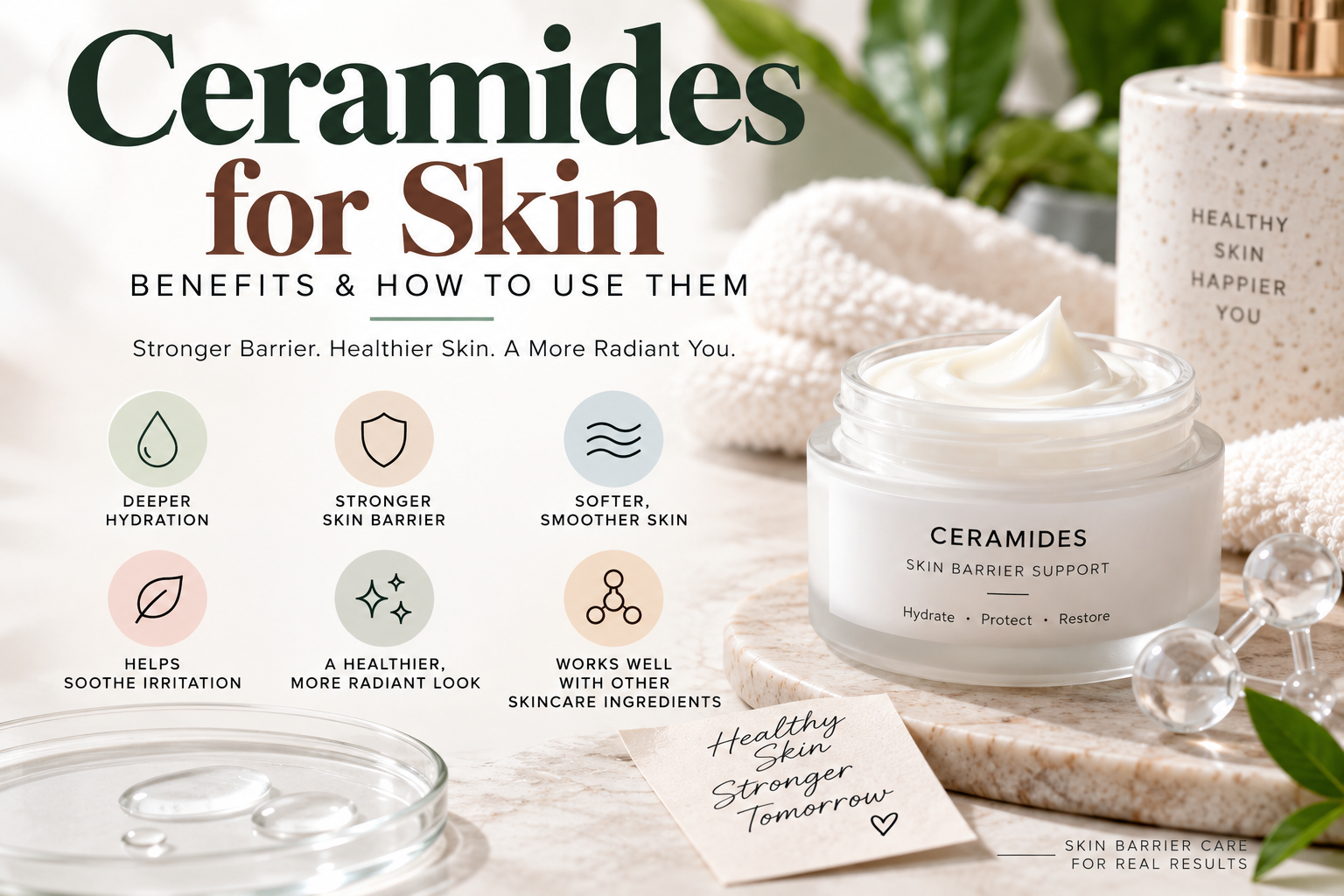
If your skin often feels dry, tight, rough, or easily irritated, ceramides for skin may be worth adding to your skincare routine.
Ceramides are naturally occurring lipids, or fats, that make up an important part of the skin barrier. They help the outermost layer of your skin retain moisture and protect against environmental stressors.
Although your skin naturally contains ceramides, factors such as aging, environmental exposure, harsh cleansing, and certain skincare habits can affect the skin barrier.
Using ceramides in skincare may help support that barrier and improve hydration, softness, and overall skin comfort.
In this guide, we’ll explore the major ceramide benefits for skin, how ceramides work, who may benefit from them, and how to use ceramides correctly in your skincare routine.
What Are Ceramides?
Ceramides are lipids naturally found in the outermost layer of your skin, known as the stratum corneum.
An easy way to understand them is to imagine your skin barrier as a brick wall.
The skin cells are the bricks, while lipids—including ceramides, cholesterol, and fatty acids—help form the material between those bricks.
Together, these components help create a protective barrier that limits water loss and helps protect your skin from the external environment.
This is why ceramides for skin barrier support have become so common in modern moisturizers, creams, cleansers, and serums.
7 Ceramide Benefits for Skin
1. Ceramides Help Support the Skin Barrier
One of the most important ceramide benefits for skin is supporting normal skin-barrier function.
Your skin barrier helps separate your body from the outside environment while reducing excessive water loss.
When the barrier isn’t functioning optimally, your skin may feel:
- Dry
- Tight
- Rough
- Flaky
- Sensitive
- Uncomfortable
Skincare products containing ceramides can help replenish lipids in the outer layer of the skin and support its barrier function.
If your barrier already feels compromised, read our guide on how to repair a damaged skin https://skineza.com/how-to-repair-a-damaged-skin-barrier/barrier.
2. Ceramides Help Reduce Moisture Loss
Healthy skin needs to hold onto water.
The outer skin barrier helps limit transepidermal water loss (TEWL)—the movement of water from inside the body through the skin and into the surrounding environment.
Because ceramides are important components of the skin barrier, ceramides in skincare can help support moisture retention.
This makes them particularly useful in products designed for dry or dehydrated skin.
3. Ceramides Can Help Dry Skin Feel Softer
If your skin frequently feels rough, flaky, or tight, a ceramide moisturizer may be useful.
Ceramide-containing moisturizers are often formulated with other hydrating and barrier-supporting ingredients, such as:
- Glycerin
- Hyaluronic acid
- Fatty acids
- Cholesterol
- Squalane
Together, these ingredients may help improve hydration and make dry skin feel smoother and more comfortable.
4. Ceramides Can Support Sensitive Skin
Sensitive-feeling skin often benefits from a simple routine focused on hydration and barrier support rather than numerous active ingredients.
A fragrance-free ceramide cream or moisturizer may be a useful option for some people with sensitive skin.
However, ceramides themselves aren’t a guarantee that a product will be suitable for sensitive skin.
Always consider the entire ingredient list, especially if you know you’re sensitive to fragrance or particular botanical ingredients.
5. Ceramides Can Complement Active Ingredients
Ingredients such as retinoids, exfoliating acids, and certain acne treatments can sometimes cause dryness or irritation.
A moisturizer containing ceramides may help support your skin barrier while you’re using these treatments.
For example, ceramides and retinol can exist within the same skincare routine.
If you’re beginning retinol, adding a simple moisturizer may help keep your routine more comfortable.
Ceramides do not eliminate the possibility of retinoid irritation, however.
6. Ceramides May Improve the Appearance of Dry, Rough Skin
Dryness can make skin texture and fine dehydration lines look more noticeable.
By supporting hydration and the skin barrier, a ceramide moisturizer may help skin look:
- Smoother
- Softer
- More hydrated
- Less visibly flaky
Ceramides shouldn’t be viewed as a treatment that permanently removes wrinkles.
Their primary role is supporting the skin barrier and moisture retention.
7. Ceramides Work With Many Skin Types
Another advantage of ceramides for skin is that they aren’t limited to one skin type.
Ceramide-containing products can be incorporated into routines for:
- Dry skin
- Sensitive skin
- Normal skin
- Combination skin
- Oily skin
- Acne-prone skin
- Mature skin
The key is choosing the right overall formulation and texture for your individual skin.
Ceramides for Skin Barrier Repair
You’ll often see people talk about using ceramides for skin barrier repair.
It’s useful to understand what that means.
Your skin barrier naturally contains ceramides. When your skin is dry or your barrier has been disrupted, using products containing skin-identical or barrier-supporting lipids may help restore some of the components of the outer layer.
However, repairing an irritated skin barrier usually involves more than simply buying a ceramide serum.
You may also need to temporarily reduce:
- Strong exfoliating acids
- Physical scrubs
- Frequent peels
- Excessive cleansing
- Multiple irritating active ingredients
A simple routine built around gentle cleansing, moisturizing, and sun protection can often be more appropriate while your skin recovers.
Ceramides for Dry Skin
Ceramides for dry skin are particularly popular because dry skin often needs support with both hydration and moisture retention.
If you have dry skin, consider a richer ceramide cream containing a combination of:
Humectants – ingredients such as glycerin that attract water.
Emollients – ingredients that help smooth and soften the skin.
Occlusives – ingredients that help reduce water loss.
Barrier lipids – such as ceramides, cholesterol, and fatty acids.
A well-formulated moisturizer can combine several of these functions in one product.
Ceramides for Oily Skin
Yes, oily skin can use ceramides too.
Having oily skin doesn’t mean your skin barrier doesn’t need support.
If heavy creams feel uncomfortable, look for a lightweight ceramide moisturizer for oily skin, such as a lotion or gel-cream formulation.
People using salicylic acid, benzoyl peroxide, or retinoids for acne may particularly appreciate a lightweight moisturizer if their treatments cause dryness.
Ceramides for Acne-Prone Skin
Ceramides for acne-prone skin don’t directly treat acne.
They aren’t substitutes for established acne ingredients such as benzoyl peroxide, salicylic acid, or prescription retinoids.
However, acne treatments can sometimes cause dryness and irritation.
Using an appropriate moisturizer containing ceramides may help support the skin barrier while you continue your acne treatment.
If you’re acne-prone, consider a product labeled non-comedogenic and choose a texture that feels comfortable on your skin.
Ceramides for Sensitive Skin
A compromised or easily irritated skin barrier can make skin feel more sensitive.
A simple ceramide moisturizer for sensitive skin may help provide hydration and barrier support without adding another strong active ingredient.
Look for formulas with relatively simple ingredient lists and consider fragrance-free options if fragrance tends to irritate your skin.
If you experience persistent burning, itching, rashes, or significant redness, speak with a dermatologist rather than assuming you simply have a damaged skin barrier.
Ceramide Moisturizer vs. Ceramide Serum
Ceramides are available in several types of skincare products.
Ceramide Moisturizer
For most people, a ceramide moisturizer is probably the simplest way to introduce ceramides.
Moisturizers can combine ceramides with other ingredients that provide hydration and reduce moisture loss.
They’re also easy to incorporate into both morning and nighttime routines.
Ceramide Serum
A ceramide serum tends to have a lighter texture and may contain ceramides alongside humectants and other skincare ingredients.
You can follow a serum with moisturizer if your skin needs additional hydration.
However, you don’t necessarily need both a ceramide serum and a ceramide moisturizer.
More products don’t automatically mean better results.
Ceramide Cream vs. Moisturizer
A ceramide cream is generally richer than a lotion or gel moisturizer.
Creams may be especially appealing for:
- Dry skin
- Very dry areas
- Winter skincare
- Nighttime routines
A lighter ceramide lotion may feel more comfortable for oily or combination skin.
Choose based on your skin’s needs rather than assuming the richest product is always the most effective.
How to Use Ceramides
Learning how to use ceramides is easy because they generally fit into skincare routines without requiring complicated scheduling.
Morning Routine With Ceramides
A simple morning routine could look like:
Step 1: Gentle Cleanser
Cleanse your face without excessive scrubbing.
Step 2: Treatment or Serum
Apply any appropriate treatment products according to their directions.
Step 3: Ceramide Moisturizer
Apply your ceramide moisturizer to help hydrate and support the skin barrier.
Step 4: Sunscreen
Finish with broad-spectrum, water-resistant sunscreen with SPF 30 or higher on exposed skin.
Night Routine With Ceramides
At night:
Step 1: Remove makeup and sunscreen.
Step 2: Cleanse gently.
Step 3: Apply your treatment products if you use them.
Step 4: Finish with a ceramide moisturizer or cream.
The exact order can vary depending on your products and prescription treatments.
Can You Use Ceramides Every Day?
For many people, yes.
Ceramides are naturally present in the skin, and moisturizers containing ceramides are commonly formulated for daily use.
Depending on your product, you may use ceramides in your skincare routine both morning and night.
Always follow the instructions provided with the individual product.
Can You Use Ceramides With Retinol?
Yes, ceramides and retinol can generally be used in the same skincare routine.
In fact, a ceramide moisturizer may be particularly useful because retinol can cause dryness and irritation.
A simple nighttime routine could be:
Cleanser → Retinol → Ceramide Moisturizer
Some people with sensitive skin use moisturizer before and/or after a retinoid, but how you use a prescription retinoid should follow your healthcare professional’s instructions.
Can You Use Ceramides With Tretinoin?
Ceramide moisturizers can generally be incorporated into routines containing prescription tretinoin.
Because tretinoin can cause dryness, peeling, and irritation, moisturization is often an important part of a tretinoin routine.
If you’ve been prescribed tretinoin, follow your prescriber’s instructions regarding product order and frequency.
You can also read our guide comparing retinol vs. tretinoin to understand how these two retinoids differ.
Can You Use Ceramides With Niacinamide?
Yes, ceramides and niacinamide are commonly found together in skincare products.
Both ingredients are often included in products designed to support the skin barrier.
Niacinamide has additional functions beyond moisturization, while ceramides help replenish lipids within the outer skin barrier.
Read our complete guide to niacinamide for skin if you’d like to learn more.
Can You Use Ceramides With Hyaluronic Acid?
Yes.
Ceramides and hyaluronic acid perform complementary functions.
Hyaluronic acid acts primarily as a humectant, helping attract water.
Ceramides help support the lipid barrier involved in retaining moisture.
Some moisturizers contain both ingredients, which means you may not need separate products.
Can You Use Ceramides With Vitamin C?
Ceramides can generally be used within a routine containing topical vitamin C.
For example:
Morning: Cleanser → Vitamin C product → Ceramide moisturizer → Sunscreen
The ideal order can vary depending on the formulation and texture of your products.
Can You Use Ceramides With Salicylic Acid?
Yes, a ceramide moisturizer can be especially useful in a routine containing salicylic acid because exfoliating products may cause dryness or irritation.
For example:
Cleanser → Salicylic Acid → Ceramide Moisturizer
You don’t need to use salicylic acid simply because you’re using ceramides. Each ingredient should address an actual skin concern.
Ceramides vs. Hyaluronic Acid
People sometimes compare ceramides vs. hyaluronic acid, but they don’t perform exactly the same function.
Ceramides
Primarily help support the skin’s lipid barrier and moisture retention.
Hyaluronic Acid
Primarily acts as a humectant that helps attract water.
You can use both.
In fact, combining humectants with barrier-supporting lipids can make sense in a moisturizer designed for dry or dehydrated skin.
Ceramides vs. Niacinamide
Another common comparison is ceramides vs. niacinamide.
Again, one isn’t necessarily better.
Ceramides: naturally occurring skin lipids that support the barrier.
Niacinamide: a form of vitamin B3 used in skincare for several purposes, including supporting barrier function.
Products can contain both.
How to Choose a Ceramide Moisturizer
When shopping for the best ceramide moisturizer for your skin, don’t focus only on whether “ceramides” appears on the front label.
Look at the complete formulation.
For Dry Skin
Consider richer creams containing ceramides alongside humectants, emollients, and occlusives.
For Oily Skin
Choose lightweight lotions or gel-creams that don’t feel excessively heavy.
For Acne-Prone Skin
Consider non-comedogenic formulations designed for acne-prone skin.
For Sensitive Skin
Simple, fragrance-free formulations may be preferable if fragrance tends to cause irritation.
Common Mistakes When Using Ceramides
Ceramides are relatively straightforward, but a few misconceptions are worth avoiding.
Expecting Ceramides to Treat Acne
Ceramides support the skin barrier but don’t replace acne medication.
Using Too Many Barrier Products
You don’t necessarily need a ceramide cleanser, serum, essence, moisturizer, and mask.
One well-formulated moisturizer may be enough.
Ignoring Other Irritating Products
A ceramide moisturizer can’t completely compensate for aggressively exfoliating your skin every day.
If your barrier is irritated, consider the entire routine.
Skipping Sunscreen
Supporting your skin barrier doesn’t replace sun protection.
Expecting Instant Results
A moisturizer can make skin feel more comfortable relatively quickly, but improving persistent dryness or irritation can require consistent skincare and addressing the underlying cause.
Do Ceramides Have Side Effects?
Ceramides themselves are generally well tolerated in topical skincare.
However, any skincare product can potentially cause:
- Redness
- Itching
- Burning
- Breakouts
- Irritation
The reaction may come from another ingredient in the formulation rather than the ceramides themselves.
Stop using a product if you experience significant irritation and seek medical advice for severe or persistent reactions.
Frequently Asked Questions
What do ceramides do for skin?
Ceramides are naturally occurring lipids that help support the skin barrier and reduce excessive moisture loss.
Are ceramides good for dry skin?
Ceramide-containing moisturizers can be particularly useful for dry skin because they help support the lipid barrier involved in retaining moisture.
Are ceramides good for acne?
Ceramides don’t directly treat acne, but ceramide moisturizers can help support the skin barrier when acne treatments cause dryness.
Can I use ceramides every day?
Many ceramide moisturizers are designed for daily use and can be applied morning and night according to product directions.
Can I use ceramides with retinol?
Yes. A ceramide moisturizer can generally be used alongside retinol and may help manage some of the dryness associated with retinoid use.
Should I use ceramides before or after hyaluronic acid?
If you’re using a separate hyaluronic acid serum and ceramide moisturizer, the serum will typically go before the moisturizer. Follow the directions for your individual products.
Do ceramides clog pores?
Ceramides themselves shouldn’t automatically be considered pore-clogging. Whether a product works for acne-prone skin depends on its complete formulation.
Which is better: ceramides or hyaluronic acid?
They serve different purposes. Hyaluronic acid primarily attracts water, while ceramides help support the lipid barrier responsible for retaining moisture. They can be used together.
Final Thoughts
Ceramides for skin can be a valuable addition to a simple skincare routine, particularly if you’re dealing with dryness, dehydration, sensitivity, or irritation from active ingredients.
The biggest ceramide benefits for skin involve supporting the skin barrier, helping reduce moisture loss, and keeping skin feeling softer and more comfortable.
You also don’t need a complicated routine to use them.
For many people, a well-formulated ceramide moisturizer used after cleansing or treatment products is enough.
And because ceramides in skincare generally work well alongside ingredients such as niacinamide, hyaluronic acid, retinol, and salicylic acid, they can easily fit into an existing routine.
1 thought on “Ceramides for Skin: Benefits & How to Use Them”