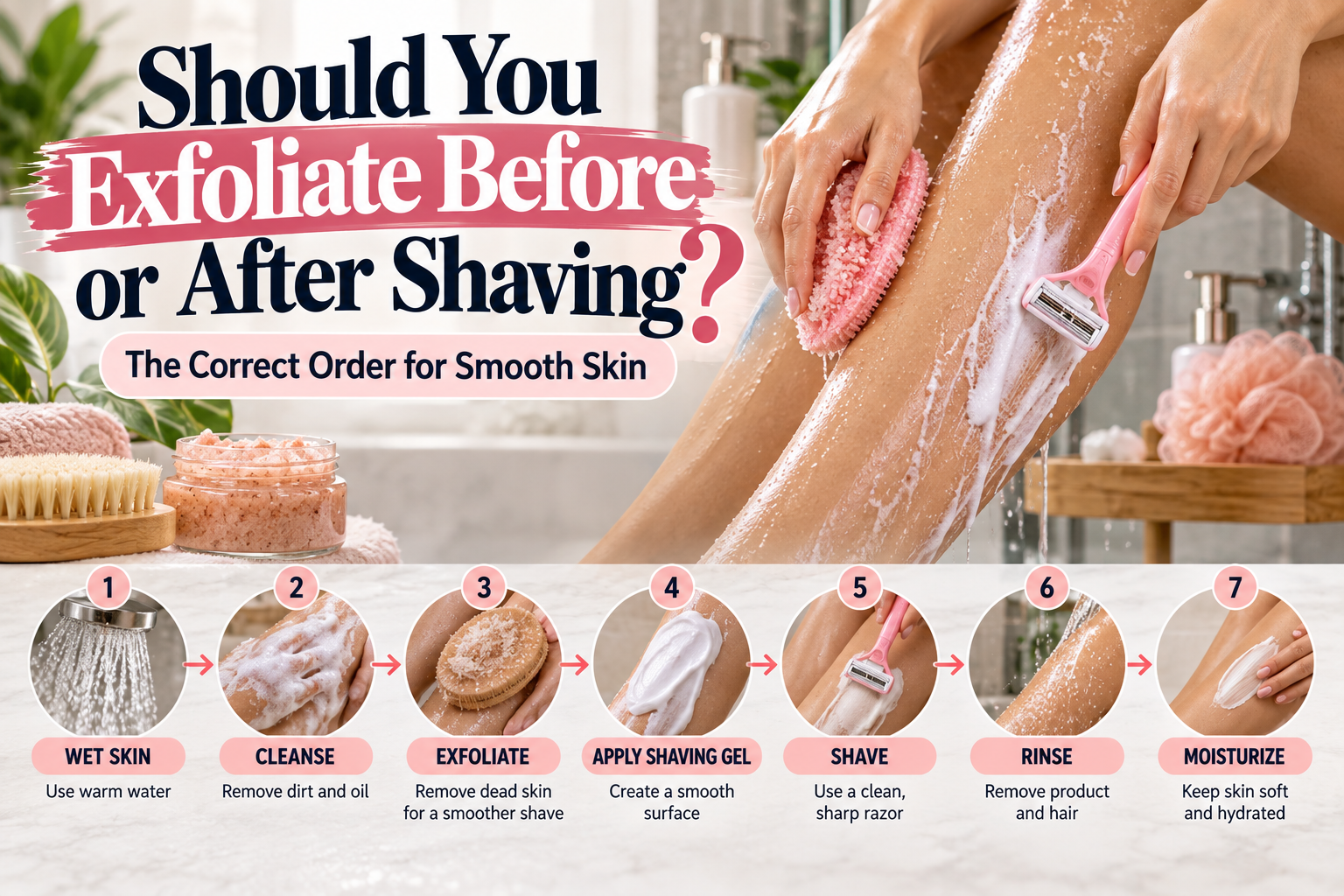
Should you exfoliate before or after shaving? In most cases, gentle exfoliation is best done before shaving, because it can remove excess dead skin cells and help free hairs that may otherwise become trapped beneath the skin. Understanding whether to exfoliate before or after shaving can make your body-care routine easier and may help reduce unnecessary irritation.
However, that doesn’t mean you should aggressively scrub immediately before picking up your razor. The type of exfoliation you use, your skin sensitivity, and whether you’re prone to razor bumps or ingrown hairs all matter.
If you want smoother-looking legs while reducing unnecessary irritation, here’s how to exfoliate and shave in the right order.
Should You Exfoliate Before or After Shaving?
For most people, the simple order is:
Cleanse → Gently exfoliate → Apply shaving cream → Shave → Rinse → Moisturize
Exfoliating before shaving can help remove dead surface skin and buildup around hair follicles. This may allow the razor to move more smoothly across the skin.
Shaving itself also provides some physical exfoliation because the razor removes hair along with some surface skin cells.
For that reason, aggressively exfoliating immediately after shaving can be irritating, particularly if you’re using acids or abrasive scrubs.
Why Should You Exfoliate Before Shaving?
There are several reasons to consider exfoliating first. If shaving leaves visible dark dots or rough-looking follicles, read our guide on how to get rid of strawberry legs.
1. It Removes Excess Dead Skin
Dead skin cells can accumulate on the surface and contribute to rough-looking texture.
Gentle exfoliation helps remove some of this buildup before shaving.
2. It May Help With Ingrown Hairs
An ingrown hair occurs when hair grows back into or underneath the skin.
Removing excess dead skin around follicles may help reduce the chance of hairs becoming trapped, although exfoliation cannot prevent every ingrown hair.
3. It Can Create a Smoother Shaving Surface
A smoother skin surface may allow your razor to glide more easily.
However, the goal is gentle exfoliation, not scrubbing until your skin feels raw.
4. It Can Help With Rough-Looking Legs
If you have dry, flaky skin, appropriate exfoliation can improve texture.
If you also notice small dark dots after shaving, read our guide on how to get rid of strawberry legs.
What Happens if You Exfoliate After Shaving?
Your skin may be more sensitive immediately after shaving. The question of whether to exfoliate before or after shaving becomes especially important if your skin tends to sting or become red after hair removal.
Running a razor across your skin can create friction and minor irritation. Applying a strong exfoliating acid or rough body scrub immediately afterward may increase:
- Stinging
- Burning
- Redness
- Dryness
- Irritation
This doesn’t mean you can never exfoliate after shaving.
Instead, consider separating stronger exfoliating treatments from shaving—especially if you have sensitive skin.
For example, you might exfoliate on a non-shaving day rather than trying to fit both treatments into the same shower.
How to Exfoliate Before Shaving: Step-by-Step
Here’s a simple routine you can use for areas such as your legs.
Step 1: Wet Your Skin
Start with comfortably warm water.
Allow your skin and hair to become wet before shaving.
Avoid extremely hot water, particularly if your skin is dry or sensitive.
Step 2: Cleanse Your Skin
Use a gentle body cleanser to remove sweat, oil, and surface debris.
You don’t need a harsh cleanser to prepare your skin for shaving.
Step 3: Exfoliate Gently
Choose either an appropriate physical or chemical exfoliant.
Physical Exfoliation
Examples include:
- A soft washcloth
- A gentle body scrub
- An appropriate exfoliating tool
Use light pressure rather than aggressively scrubbing.
Chemical Exfoliation
Chemical exfoliants may contain ingredients such as:
- Salicylic acid
- Lactic acid
- Glycolic acid
If you’re already using a chemical exfoliant regularly, you may not need a separate body scrub.
Not sure which acid does what? Read our AHA vs. BHA guide.
Step 4: Apply Shaving Cream or Gel
Don’t shave dry skin if you can avoid it.
Apply a shaving cream, gel, or another product specifically intended to provide lubrication during shaving.
This reduces friction between the razor and your skin.
Step 5: Use a Clean, Sharp Razor
A dull blade may tug at the hair and require more passes over the same area.
Use gentle pressure and avoid repeatedly shaving one spot.
If you’re particularly prone to ingrown hairs, shaving in the direction of hair growth may reduce irritation for some people, although it may not give the closest possible shave.
Step 6: Rinse
Once you’ve finished shaving, rinse away remaining shaving product and loose hairs.
Use comfortable water rather than extremely hot water.
Step 7: Pat Your Skin Dry
Don’t aggressively rub freshly shaved skin with a towel.
Gently pat it dry instead.
Step 8: Moisturize
Finish with a fragrance-free or gentle moisturizer if your skin is easily irritated.
Ingredients such as these can be useful in body moisturizers:
- Ceramides
- Glycerin
- Hyaluronic acid
- Squalane
If you’d like to understand ceramides better, read our guide to ceramides for skin.
Physical vs. Chemical Exfoliation Before Shaving
Both approaches can exfoliate your skin, but they work differently.
Physical Exfoliation
Physical exfoliation manually removes surface skin cells.
It can provide immediate smoothness, but excessive pressure or frequent scrubbing can irritate the skin.
Chemical Exfoliation
Chemical exfoliants use ingredients such as AHAs or BHAs to loosen dead skin cells.
They can be particularly useful when dealing with rough or clogged-looking skin.
However, stronger isn’t necessarily better.
If you’re using acids, follow the product directions rather than assuming they should always be applied immediately before shaving.
Should You Exfoliate and Shave on the Same Day?
You can, particularly if you’re using very gentle physical exfoliation and your skin tolerates it.
But you don’t have to. You can exfoliate before or after shaving on the same day, but sensitive skin may benefit from keeping exfoliation and shaving on separate days.
If your skin is sensitive or you’re using stronger chemical exfoliants, you may prefer:
Day 1: Exfoliate
Day 2: Shave
This reduces the number of potentially irritating processes you’re performing on your skin at once.
Pay attention to how your own skin responds.
Should You Exfoliate Before or After Shaving Your Legs?
If you’re wondering whether to exfoliate before or after shaving your legs, gentle exfoliation before shaving is usually the more practical order.
Try:
Warm water → Cleanse → Gentle exfoliation → Shaving gel → Shave → Rinse → Moisturize
Your legs shouldn’t burn or feel raw afterward.
If they do, you may be exfoliating too aggressively, shaving too closely, using irritating products, or combining too many treatments.
Should You Exfoliate Before or After Shaving to Prevent Ingrown Hairs?
Gentle exfoliation can help remove dead skin buildup around follicles and may reduce some ingrown hairs.
However, your shaving technique matters too.
To help reduce ingrown hairs:
- Use a clean, sharp razor.
- Lubricate the skin before shaving.
- Avoid excessive pressure.
- Limit repeated passes.
- Consider shaving with the direction of hair growth.
- Don’t pick at existing ingrown hairs.
- Moisturize regularly.
If you frequently experience painful or inflamed ingrown hairs, consider speaking with a dermatologist.
Should You Exfoliate Before or After Shaving for Strawberry Legs?
If you experience strawberry legs, gentle exfoliation may help when dead skin buildup or clogged-looking follicles contribute to the appearance.
But strawberry legs can have several causes, including:
- Visible hair follicles
- Shaving irritation
- Ingrown hairs
- Keratosis pilaris
- Folliculitis
That means exfoliation isn’t a universal cure.
See our complete strawberry legs guide for more information.
What About Keratosis Pilaris?
If the small bumps on your legs or arms feel persistently rough and resemble “chicken skin,” you may be dealing with keratosis pilaris rather than ordinary shaving bumps.
Keratosis pilaris involves keratin buildup around hair follicles.
Ingredients such as lactic acid, salicylic acid, and urea may help improve its texture, but aggressive scrubbing can make irritation worse.
Learn more in our keratosis pilaris guide.
Can You Use Salicylic Acid Before Shaving?
Salicylic acid is a beta hydroxy acid (BHA) commonly used to exfoliate skin and help with clogged follicles.
But whether you should use it immediately before shaving depends on the formulation and your skin’s tolerance.
If salicylic acid combined with shaving causes burning, redness, or excessive dryness, separate the two.
For example:
Exfoliation day: Salicylic acid treatment
Shaving day: Gentle cleanse + shave + moisturizer
This can be particularly helpful for sensitive skin.
Can You Use Glycolic Acid Before Shaving?
Glycolic acid is an AHA that exfoliates the skin’s surface.
While it may help improve rough texture, applying a strong glycolic acid product immediately before shaving may be too irritating for some people.
Follow the instructions for your particular product.
If you’re new to glycolic acid, don’t introduce it at the same time as several other exfoliating products.
Can You Use Lactic Acid Before Shaving?
Lactic acid is another AHA frequently found in body lotions designed for rough or dry skin.
Like other chemical exfoliants, it doesn’t necessarily need to be used immediately before shaving to provide benefits.
Using it regularly on non-shaving days may be a more comfortable approach if you’re prone to irritation.
How Often Should You Exfoliate if You Shave?
There isn’t one correct frequency.
It depends on:
- Your skin type
- The exfoliating ingredient
- Product strength
- How frequently you shave
- Your sensitivity
- Other active products you’re using
Follow the instructions on your exfoliating product.
If you notice persistent redness, stinging, peeling, or increased sensitivity, reduce your exfoliation frequency.
Exfoliating Before Shaving for Sensitive Skin
If you have sensitive skin, keep things particularly simple.
You may want to:
- Skip aggressive scrubs.
- Avoid combining several acids.
- Exfoliate on a different day from shaving.
- Use a fragrance-free shaving product if fragrance irritates you.
- Use a clean, sharp razor.
- Apply a gentle moisturizer afterward.
If your skin barrier already feels irritated, consider pausing exfoliation until your skin feels comfortable again.
Our guide on how to repair a damaged skin barrier explains the signs of an irritated barrier and how to simplify your routine.
Where Does Shaving Fit Into an Everything Shower?
If you’re doing a longer body-care routine, shaving generally comes after your skin has had some time in warm water.
A practical order is:
Hair care → Body cleanse → Gentle exfoliation → Shave → Final rinse → Moisturize
For the complete sequence, see our Everything Shower Routine.
Common Exfoliating and Shaving Mistakes
Scrubbing Too Hard
Your skin doesn’t need to become red for exfoliation to work.
Exfoliating Immediately After Shaving
Freshly shaved skin may be more sensitive, making strong exfoliation uncomfortable.
Using Too Many Exfoliants
A body scrub, exfoliating glove, glycolic acid, and salicylic acid in one routine can be excessive.
Shaving Without Lubrication
Shaving dry skin can increase friction.
Using a Dull Razor
Old blades may tug and require additional passes.
Picking at Ingrown Hairs
Picking can increase inflammation, dark marks, infection risk, and scarring.
Forgetting Moisturizer
Shaving and exfoliating can both leave skin feeling dry, making post-shave moisturizing particularly useful.
Exfoliating and Shaving Routine
For an easy reference, here’s the order:
Before Shaving
1. Wet your skin
2. Cleanse
3. Gently exfoliate if appropriate
During Shaving
4. Apply shaving cream or gel
5. Use a clean, sharp razor
6. Shave gently
After Shaving
7. Rinse
8. Pat dry
9. Apply moisturizer
For sensitive skin, consider moving Step 3 to a different day.
Frequently Asked Questions
Should you exfoliate before or after shaving?
In most cases, gentle exfoliation before shaving is preferable. It can remove excess dead skin and create a smoother surface, while exfoliating freshly shaved skin may cause irritation.
How long before shaving should you exfoliate?
There isn’t one required waiting period. Gentle physical exfoliation may be tolerated in the same shower, while stronger chemical exfoliants may be better used on a separate day if your skin becomes irritated.
Should you exfoliate before shaving your legs?
Generally, yes. Gentle exfoliation before shaving can remove excess dead skin and may help create a smoother shaving surface.
Can I exfoliate immediately after shaving?
It’s usually better to avoid strong exfoliation immediately after shaving, particularly if your skin is sensitive or irritated.
Does exfoliating prevent razor bumps?
Exfoliation may help reduce dead skin buildup around follicles, but it cannot guarantee that razor bumps or ingrown hairs won’t occur.
Is it better to exfoliate the day before shaving?
For sensitive skin or when using chemical exfoliants, exfoliating on the day before shaving can be a useful way to reduce potential irritation.
Should I moisturize after shaving?
Yes. A gentle body moisturizer can help reduce dryness and support the skin barrier after shaving.
Final Thoughts
So, should you exfoliate before or after shaving?
For most people, gentle exfoliation before shaving is the better approach. It can help remove excess dead skin cells, improve rough texture, and prepare the skin for shaving.
But don’t assume that more exfoliation means smoother skin.
If you use stronger acids or have sensitive skin, exfoliating on a different day from shaving may be more comfortable.
A simple routine is often enough:
Cleanse → Gently exfoliate → Shaving cream → Shave → Rinse → Moisturize
Your goal should be comfortable, healthy-looking skin—not an aggressive routine that leaves your legs red or irritated. Ultimately, knowing whether to exfoliate before or after shaving is only one part of getting a comfortable shave—your razor, shaving technique, exfoliation frequency, and moisturizer also matter.