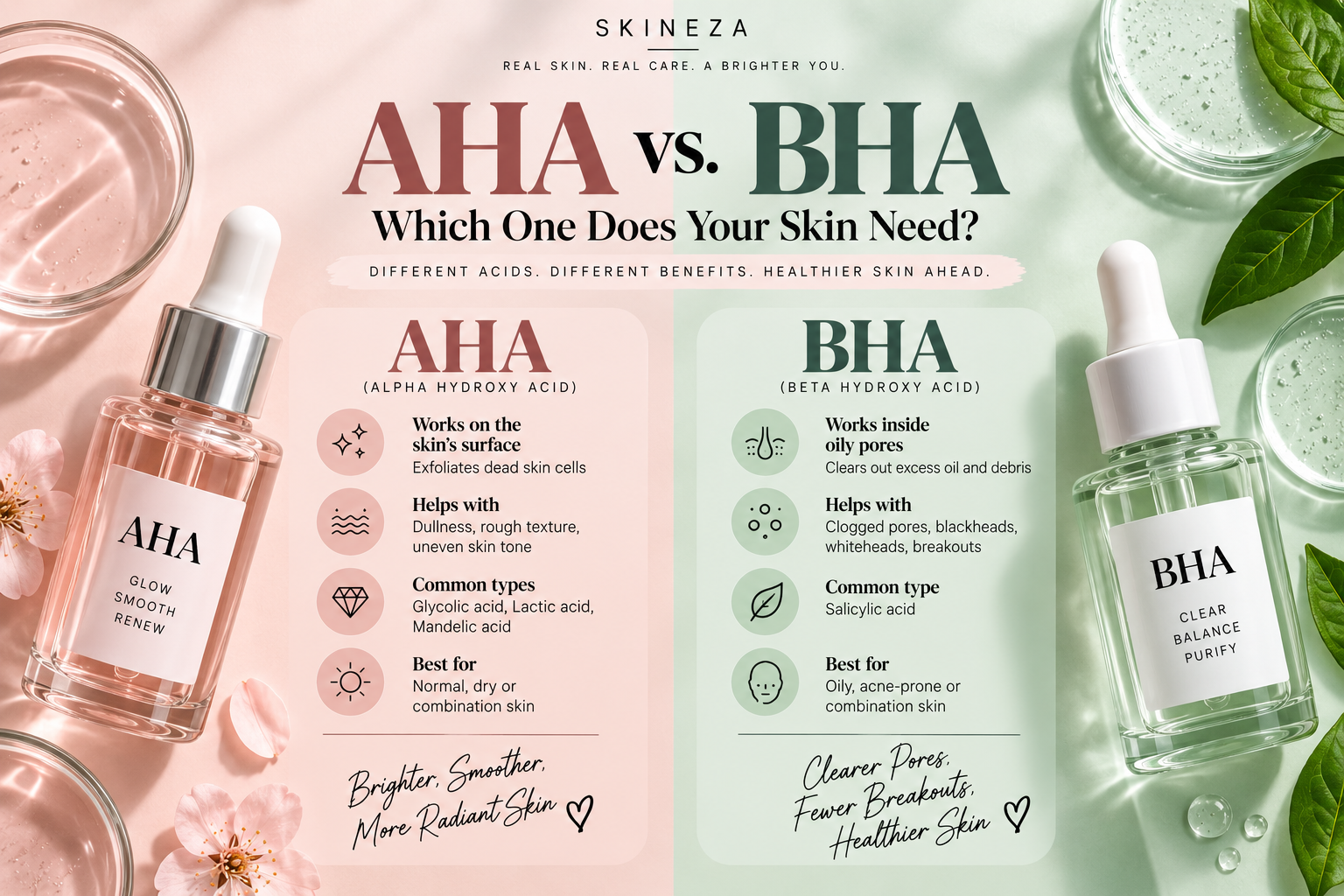
If you’re trying to improve dullness, clogged pores, uneven texture, or breakouts, you’ve probably come across two popular skincare ingredients: AHA and BHA.
Both are chemical exfoliants, but they don’t work in exactly the same way. AHAs primarily exfoliate the skin’s surface, while BHA—most commonly salicylic acid—is oil-soluble and can work within oily pores.
So, when comparing AHA vs. BHA, which one should you choose?
The answer depends on your skin type, concerns, and how well your skin tolerates exfoliation.
What Is AHA?
AHA stands for alpha hydroxy acid. AHAs are water-soluble acids commonly used to exfoliate the surface of the skin.
They help loosen the bonds between dead skin cells, allowing them to shed more easily.
Common AHAs include:
- Glycolic acid
- Lactic acid
- Mandelic acid
- Citric acid
AHAs are commonly found in toners, serums, cleansers, masks, and chemical peels.
What Does AHA Do for Your Skin?
Depending on the product and concentration, AHAs may help improve the appearance of:
- Dull skin
- Rough texture
- Uneven-looking skin tone
- Fine lines
- Dry, flaky surface skin
- Post-acne discoloration
Because AHAs primarily work on the skin’s surface, they’re often chosen by people whose main concerns are texture, dullness, and uneven-looking tone.
What Is BHA?
BHA stands for beta hydroxy acid.
In skincare, the BHA you’ll encounter most often is salicylic acid.
Unlike AHAs, salicylic acid is oil-soluble. This allows it to work within oily pores as well as exfoliate the skin.
What Does BHA Do for Your Skin?
BHA may be particularly useful for people concerned about:
- Clogged pores
- Blackheads
- Whiteheads
- Oily skin
- Acne-prone skin
- Uneven texture
This is why salicylic acid is commonly included in products designed for oily and acne-prone skin.
AHA vs. BHA: What’s the Difference?
Here’s a simple comparison:
| AHA | BHA | |
|---|---|---|
| Full name | Alpha Hydroxy Acid | Beta Hydroxy Acid |
| Solubility | Water-soluble | Oil-soluble |
| Where it works | Primarily skin surface | Surface and within oily pores |
| Common example | Glycolic/lactic acid | Salicylic acid |
| Often used for | Dullness and texture | Clogged pores and oiliness |
| Dry skin | May be suitable | Can be used carefully |
| Oily skin | Can be used | Often particularly useful |
| Blackheads | May help exfoliation | Often preferred |
| Sun sensitivity | AHAs can increase sensitivity | Sunscreen remains essential |
Neither category is automatically “better.” They simply have different strengths.
AHA vs. BHA for Different Skin Concerns
For Dull Skin: Consider AHA
If your complexion looks dull or rough, an AHA may be worth considering.
By exfoliating accumulated dead skin cells from the surface, AHAs can help skin appear smoother and brighter.
Glycolic and lactic acid are two popular options.
For Clogged Pores: Consider BHA
If your primary problem is clogged pores, salicylic acid may make more sense.
Because it is oil-soluble, it can penetrate into oily pores and help exfoliate within them.
This makes BHA popular for:
Blackheads + whiteheads + clogged pores + oily skin.
For Blackheads: BHA May Be More Useful
Blackheads form when pores become clogged with oil and dead skin cells.
Because salicylic acid can work within oily pores, it is commonly used for blackheads.
However, stubborn blackheads may require more than one skincare ingredient.
For Dry Skin: AHA May Be an Option
People with dry skin sometimes prefer AHAs such as lactic acid, but dry skin can also be sensitive to exfoliation.
If your skin is already flaky, tight, irritated, or burning, adding an exfoliating acid may make things worse.
Address your skin barrier first.
You can also read our guide to why skin can remain dry even after moisturizing.
For Oily Skin: BHA Is Often a Practical Choice
Salicylic acid is widely used in oily-skin products because of its ability to work in oily pores.
But having oily skin doesn’t mean you should exfoliate every day.
Over-exfoliating oily skin can still cause irritation.
For Acne-Prone Skin: BHA May Help
Salicylic acid is an established topical acne ingredient.
It can help keep pores clear and may be useful for mild comedonal acne, including blackheads and whiteheads.
More persistent, inflammatory, painful, or scarring acne may need treatment from a dermatologist rather than relying on cosmetic exfoliation alone.
For Uneven-Looking Skin Tone: Consider AHA
AHAs may help improve the appearance of uneven tone by encouraging exfoliation at the skin’s surface.
However, sunscreen is especially important when you’re trying to improve discoloration.
Without adequate sun protection, dark spots can become more noticeable.
Glycolic Acid vs. Salicylic Acid
This is one of the most common AHA vs. BHA comparisons.
Glycolic Acid
Glycolic acid is an AHA commonly used for:
- Dullness
- Rough texture
- Uneven-looking tone
- Fine lines
It has a relatively small molecular size compared with some other AHAs, which can make it effective but potentially irritating for some people.
Salicylic Acid
Salicylic acid is a BHA commonly used for:
- Blackheads
- Whiteheads
- Clogged pores
- Oiliness
- Acne-prone skin
If your main concern is surface texture and dullness, you may lean toward glycolic acid.
If clogged pores and oiliness are your primary concerns, salicylic acid may be more relevant.
Lactic Acid vs. Salicylic Acid
Lactic acid is another AHA.
Compared with glycolic acid, lactic acid is often found in products marketed as gentler exfoliating options.
If you have dry-looking, dull skin, lactic acid may be worth considering.
Salicylic acid remains more targeted toward oily and clogged pores.
Can You Use AHA and BHA Together?
Yes, some people can—but you don’t necessarily need to.
Using multiple exfoliating acids can increase your risk of:
- Dryness
- Redness
- Burning
- Stinging
- Peeling
- Skin barrier irritation
Some products are specifically formulated with both AHA and BHA at appropriate concentrations.
That’s different from layering several strong exfoliating products yourself.
If you’re a beginner, introducing one exfoliant at a time makes it easier to see how your skin responds.
How Often Should You Use AHA or BHA?
There’s no single schedule that works for every product or person.
Concentration, formulation, skin type, and other products in your routine all matter.
If you’re new to exfoliating acids, a conservative approach is usually better than immediately using them every day.
Always follow the directions on your specific product.
If your skin becomes persistently red, painful, flaky, or irritated, reduce use or stop and reassess your routine.
How to Add AHA or BHA to Your Skincare Routine
Keep everything else relatively simple when introducing an exfoliating acid.
Simple Morning Routine
Gentle cleanser → Hydrating serum (optional) → Moisturizer → Sunscreen
Simple Exfoliation Night
Gentle cleanser → AHA or BHA product → Moisturizer
The exact order may vary depending on the formulation, so follow the product directions.
For more help, read our correct order to apply skincare products guide.
Should You Use AHA or BHA in the Morning or at Night?
Many people prefer exfoliating acids at night because it keeps routines simple and makes it easier to separate potentially irritating active ingredients.
However, some products are formulated for daytime use.
Follow the product’s instructions.
Regardless of timing, daily sun protection is important, particularly when using AHAs.
Can You Use AHA or BHA With Retinol?
This combination requires caution.
Retinol and exfoliating acids can both irritate the skin, especially when you’re new to them.
Rather than layering them together immediately, beginners may find it easier to use them on different nights.
For example:
Monday: Retinol
Tuesday: Basic moisturizing routine
Wednesday: AHA or BHA
Thursday: Basic moisturizing routine
This is only an example—not a required schedule.
If you’re new to retinol, read our Retinol for Beginners guide first.
Can You Use AHA or BHA With Niacinamide?
Niacinamide can generally be incorporated into routines containing exfoliating acids.
A simple routine could look like:
Cleanser → AHA/BHA → Niacinamide serum → Moisturizer
However, formulation matters, and sensitive skin may prefer using the products at different times.
Learn more in our Niacinamide for Skin guide.
Can AHA or BHA Cause Purging?
Because exfoliating acids influence the shedding of skin cells and clogged pores, some people report an initial increase in visible blemishes after starting them.
However, not every breakout is skin purging.
If you develop significant burning, itching, swelling, persistent redness, or breakouts in unusual areas, don’t automatically assume the product is “working.”
Read our guide to skin purging vs. breakout to understand the differences.
Signs You May Be Over-Exfoliating
More exfoliation doesn’t necessarily mean better skin.
Watch for:
- Persistent redness
- Burning or stinging
- Excessive peeling
- Tightness
- Increased sensitivity
- Unusual dryness
- Products suddenly stinging
- Skin feeling raw
These symptoms can indicate irritation.
If this happens, consider stopping exfoliating products temporarily and simplifying your routine.
You may also want to read our guide on how to repair a damaged skin barrier.
AHA vs. BHA: Which One Should You Choose?
Here’s the easiest way to think about it:
Consider AHA if your main concerns are:
Dullness • Rough texture • Uneven-looking tone • Surface dryness
Consider BHA if your main concerns are:
Clogged pores • Blackheads • Whiteheads • Oiliness • Acne-prone skin
But your skin type isn’t the only factor.
Sensitive skin may tolerate neither particularly well when used too frequently.
Start slowly and judge your skin’s response rather than assuming you need stronger products.
Common AHA and BHA Mistakes
Using Them Too Frequently
Daily exfoliation isn’t necessary for everyone.
More frequent use can increase irritation without necessarily improving results.
Using Multiple Exfoliants at Once
An exfoliating cleanser + acid toner + peeling serum + retinol can quickly become too much.
Check your entire routine for overlapping active ingredients.
Applying Them to Already-Irritated Skin
If your skin is burning, peeling, or extremely sensitive, adding another acid isn’t likely to solve the problem.
Skipping Moisturizer
Exfoliation doesn’t replace hydration or moisturization.
Forgetting Sunscreen
Sun protection should be part of your daily routine, particularly when using exfoliating ingredients.
Frequently Asked Questions
Is AHA or BHA Better for Beginners?
Neither is automatically better for beginners.
Choose based on your primary concern and start with a product appropriate for your skin type.
Is AHA or BHA Better for Blackheads?
BHA, particularly salicylic acid, is commonly chosen for blackheads because it can work within oily pores.
Is AHA or BHA Better for Dry Skin?
An AHA such as lactic acid may suit some people with dry skin, but irritated or severely dry skin may need barrier-supportive care before exfoliation.
Is AHA or BHA Better for Oily Skin?
BHA is commonly used for oily and clogged pores because salicylic acid is oil-soluble.
Can I Use AHA and BHA Every Day?
Some formulations are designed for frequent use, but daily exfoliation isn’t appropriate or necessary for everyone.
Follow your product instructions and monitor for irritation.
Can I Use AHA and BHA Together?
Potentially, but combining them can increase irritation. Beginners generally don’t need to start with both simultaneously.
Do I Need Both AHA and BHA?
No.
Many people can build an effective skincare routine using only the exfoliant that best addresses their concerns.
Final Thoughts
When comparing AHA vs. BHA, there isn’t one universal winner.
AHA primarily targets the skin’s surface, making it useful for concerns such as dullness, rough texture, and uneven-looking tone.
BHA—usually salicylic acid—is oil-soluble, making it particularly useful when clogged pores, blackheads, whiteheads, and oiliness are your main concerns.
Whichever you choose, start carefully.
Exfoliation should improve your routine—not leave your skin constantly burning, peeling, or irritated.