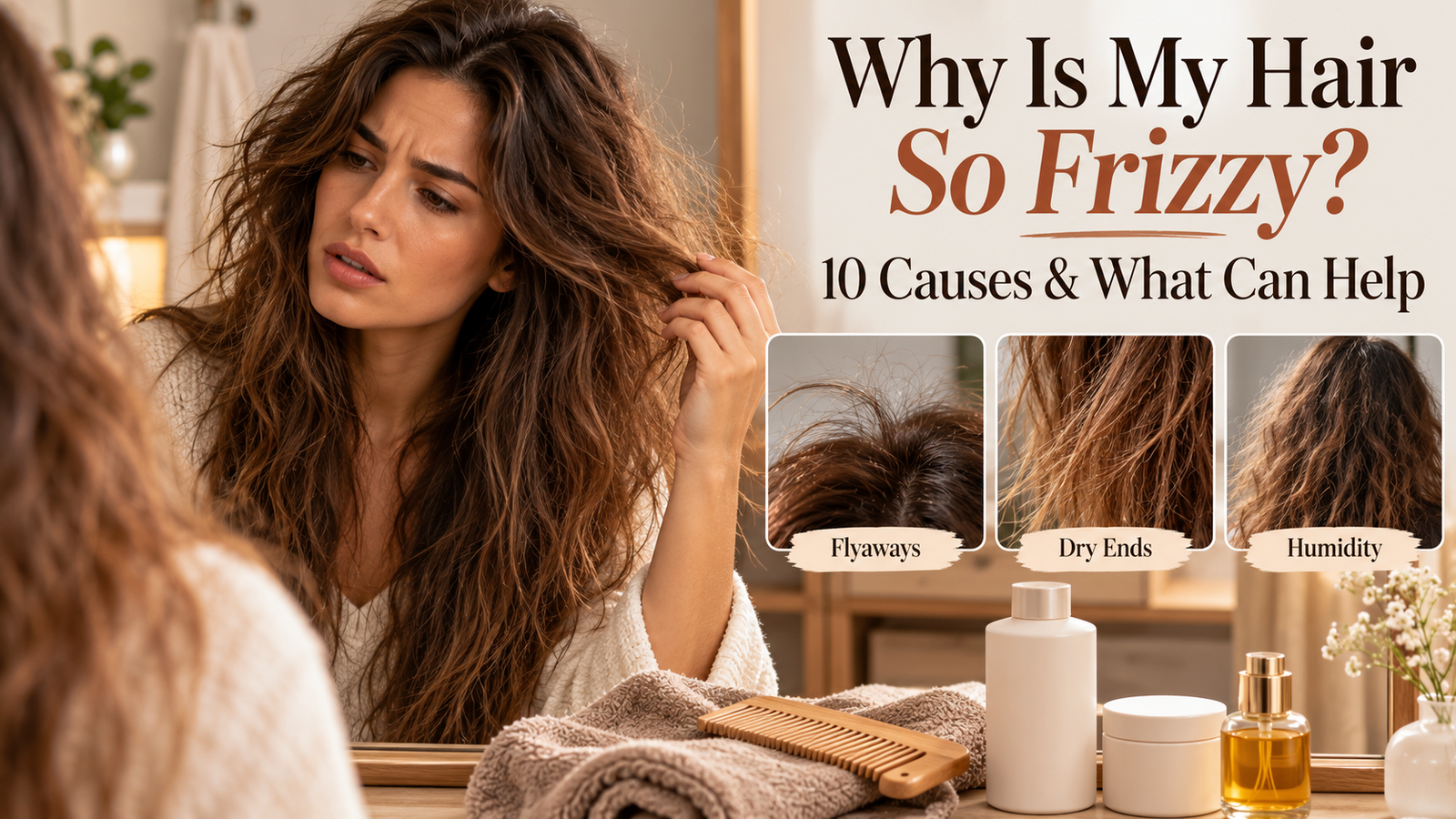
Why is my hair so frizzy? If you’ve ever styled your hair only to watch it become fluffy, rough, or full of flyaways a few hours later, you’re definitely not alone.
Frizz can happen to straight, wavy, curly, and coily hair. Sometimes humidity is responsible, but your washing routine, heat styling, chemical treatments, hair damage, and even the way you dry your hair can also affect how smooth it looks.
The good news is that you don’t necessarily need a complicated routine. Understanding what’s contributing to your frizz can help you make a few changes that leave your hair looking smoother, softer, and more manageable.
Below are 10 common causes of frizzy hair and what may help.
What Is Frizzy Hair?
Frizz describes hair strands that don’t lie smoothly with the rest of your hair.
It can appear as:
- Flyaways around the top of your head
- Puffy or fluffy-looking hair
- Rough-feeling lengths
- Fuzzy ends
- Undefined curls or waves
- Hair that becomes bigger in humid weather
Frizz itself isn’t necessarily a sign that something is wrong with your hair.
Your natural hair texture plays a role, and some degree of frizz is completely normal—especially with curly and wavy hair.
However, excessive dryness or damage can make frizz more noticeable.
1. Your Hair May Be Dry
Dryness and frizz often appear together.
When hair feels dry and rough, individual strands may not sit as smoothly against one another, making flyaways and frizz more noticeable.
Dry hair can be associated with overwashing, heat styling, chemical processing, environmental exposure, or a hair-care routine that isn’t providing enough conditioning.
If your hair feels rough even when humidity is low, dryness may be contributing to the problem.
What May Help
Use a moisturizing conditioner after shampooing and consider a deeper conditioning treatment when your hair needs additional softness.
Try to avoid unnecessarily stripping your hair with excessive washing or harsh cleansing.
If dryness is your biggest concern, read our guide on Why Is My Hair So Dry?
2. Humidity Can Make Hair Frizzier
Ever notice your hair looking smooth indoors and suddenly becoming frizzy when you step outside?
Humidity may be responsible.
Hair can interact with moisture in the surrounding air, which can affect the arrangement of bonds within the hair fiber. This can alter the shape of individual strands and make hair appear puffier or less smooth.
People with naturally wavy or curly hair may notice this particularly easily.
What May Help
Try using a leave-in conditioner or styling product designed to help control frizz.
Once your hairstyle is finished, avoid repeatedly touching or brushing it throughout the day.
3. You May Be Washing Your Hair Too Often
There’s no universal rule for how often everyone should wash their hair.
However, washing more frequently than your hair and scalp need may leave some people with lengths that feel dry or rough.
This can be especially noticeable if you have curly, chemically treated, bleached, or naturally dry hair.
What May Help
Adjust your wash schedule based on your scalp, hair texture, activity level, and oil production rather than following a fixed rule.
If your scalp becomes oily quickly, you may still need frequent cleansing. Focus conditioner mainly on the mid-lengths and ends.
4. Your Shampoo May Be Too Cleansing for Your Hair
Not every shampoo works equally well for every hair type.
A strong cleansing shampoo can be useful when you need to remove buildup, but using a formula that leaves your hair feeling extremely stripped after every wash may contribute to dryness and roughness.
What May Help
If your hair consistently feels rough immediately after shampooing, consider trying a gentler shampoo appropriate for your scalp and hair type.
You don’t necessarily need to avoid sulfates entirely. How well a shampoo works depends on the complete formulation and your individual hair needs.
5. Hot Tools May Be Contributing to Damage
Flat irons, curling irons, blow-dryers, and other heated styling tools can help create a smooth hairstyle—but frequent or excessive heat can damage the hair fiber.
Damaged hair may feel rougher, break more easily, and become harder to style smoothly.
Using extremely high temperatures every day can make the problem worse.
What May Help
Try:
- Reducing the temperature of your styling tools
- Using heat only when necessary
- Applying a heat-protectant product before styling
- Avoiding repeatedly passing a hot tool over the same section
- Giving your hair occasional heat-free days
A higher temperature doesn’t automatically mean a better result.
6. Bleaching and Chemical Treatments Can Increase Frizz
Hair color can look beautiful, but bleaching, highlighting, relaxing, perming, and other chemical processes can alter the structure of the hair fiber.
Repeated or aggressive processing can leave hair more porous and fragile.
You may notice that previously processed sections of your hair are frizzier than your natural growth.
What May Help
Space out chemical services when possible and talk with your stylist about the condition of your hair before additional processing.
Conditioning treatments can temporarily improve softness and manageability, although they can’t biologically restore severely damaged hair to its original condition.
If you color your hair regularly, reducing unnecessary heat styling may also help limit additional damage.
7. Rubbing Your Hair With a Towel Can Make It Look Frizzier
How you handle wet hair matters.
Aggressively rubbing wet hair with a rough towel can create friction and tangling. Wet hair is also more vulnerable to mechanical damage.
What May Help
Instead of rubbing, gently squeeze excess water from your hair.
You can then blot or wrap it using a soft microfiber towel or smooth cotton T-shirt.
The goal isn’t to make your hair completely dry with the towel—just remove excess water without excessive friction.
8. You May Be Brushing Your Hair at the Wrong Time
Brushing can help detangle straight hair, but brushing naturally curly or wavy hair once it’s dry can separate curl clumps and create a fluffy, frizzy appearance.
At the same time, aggressive detangling can cause unnecessary breakage regardless of your hair type.
What May Help
For curly or wavy hair, consider detangling while the hair is damp and has enough conditioner or slip.
Use your fingers or an appropriate wide-tooth comb and work gradually from the ends upward.
If you have straight hair, gentle brushing may work well, but avoid repeatedly brushing simply to control flyaways.
9. You May Not Be Using Enough Conditioner
Shampoo and conditioner perform different jobs.
Shampoo primarily cleanses the scalp and hair, while conditioner can help improve softness, lubrication, detangling, and manageability.
Skipping conditioner may leave some hair types feeling rough or difficult to style.
What May Help
Apply conditioner mainly through the mid-lengths and ends after shampooing.
If your hair remains dry or frizzy, you could experiment with a leave-in conditioner after washing.
Start with a small amount, particularly if you have fine hair, because too much product can leave hair looking flat or greasy.
10. Your Hair May Have Buildup
Interestingly, adding more products isn’t always the answer to frizzy hair.
Dry shampoo, styling cream, oils, silicone-containing products, hairspray, and other styling products can accumulate on the hair depending on the products you use and how effectively they’re removed.
Minerals from hard water can also affect how hair feels for some people.
Hair with significant buildup may feel dull, coated, heavy, or difficult to style.
What May Help
If you use many styling products, occasional more thorough cleansing may be useful.
How frequently you need it depends on your hair, scalp, water, and products.
Avoid overusing clarifying shampoos if they leave your hair excessively dry.
Why Is My Hair Frizzy After Washing?
If your hair looks particularly frizzy immediately after washing, look at what happens during and after your shower.
Possible contributors include:
Using very hot water: Extremely hot showers may leave some hair feeling drier.
Skipping conditioner: Shampooing without conditioning may make the lengths harder to manage.
Rough towel drying: Excessive friction can increase tangling and disrupt your natural texture.
Brushing curls when dry: This can separate curl clumps and create a fluffy appearance.
Using too much heat: Immediately blow-drying at high heat can add additional stress to already fragile hair.
Try changing one part of your routine at a time so you can see what actually makes a difference.
How to Reduce Frizz: A Simple Hair Routine
You don’t need 10 different products to manage frizz.
A basic routine could look like this:
Step 1: Shampoo Your Scalp
Concentrate shampoo primarily on your scalp, where oil, sweat, and buildup tend to accumulate.
Allow the lather to move through your lengths while rinsing rather than aggressively scrubbing the ends.
Step 2: Condition Your Lengths
Apply conditioner primarily from the mid-lengths to the ends.
Allow it to sit according to the product instructions before rinsing.
Step 3: Remove Water Gently
Avoid aggressively rubbing your hair with a towel.
Gently squeeze out water and use a microfiber towel or soft cotton T-shirt if you prefer.
Step 4: Apply a Leave-In Product
A lightweight leave-in conditioner may help with detangling and manageability.
Curly or wavy hair may benefit from a curl cream or gel depending on the desired finish.
Step 5: Use Heat Protectant
If you’re blow-drying, straightening, or curling your hair, apply a heat-protectant product according to its directions.
Step 6: Finish With a Small Amount of Serum or Oil
A small amount of serum or hair oil applied mainly to the ends can help create a smoother-looking finish.
Start small. Adding too much can make fine hair look greasy.
Dry Hair vs. Frizzy Hair: What’s the Difference?
Dryness and frizz are related, but they’re not exactly the same thing.
Dry hair describes hair that lacks softness, flexibility, or a conditioned feel and may appear dull or rough.
Frizz describes strands that don’t lie smoothly with the surrounding hair.
You can have dry hair without significant frizz, and naturally curly or wavy hair can become frizzy even when it doesn’t feel extremely dry.
If your hair is both rough and frizzy, addressing dryness and minimizing damage may help improve its overall appearance.
Can Hair Oil Fix Frizzy Hair?
Hair oil can make hair look smoother and shinier, but it isn’t a permanent repair for damaged hair.
Oils and serums can coat the hair fiber, improve lubrication, and temporarily reduce the appearance of roughness or flyaways.
Use only a small amount and concentrate it on the mid-lengths and ends.
If your hair is extremely dry or damaged, relying on oil alone may not be enough. Your shampoo, conditioner, heat habits, and chemical treatments matter too.
Does Sleeping on a Silk Pillowcase Help With Frizz?
Silk or satin surfaces may create less friction than some rougher fabrics, which could help reduce tangling and friction while you sleep.
However, switching your pillowcase isn’t a magic solution for frizz.
Your overall hair routine—including conditioning, heat exposure, chemical processing, and styling habits—is likely to matter more.
When Should You See a Dermatologist?
Frizz alone usually isn’t a medical concern.
However, consider speaking with a dermatologist or healthcare professional if changes in your hair occur alongside:
- Sudden or significant hair loss
- Noticeable thinning
- Bald patches
- Persistent scalp itching
- Pain or burning
- Significant flaking or scaling
- Sores or inflammation on the scalp
- Hair breaking extensively without an obvious explanation
These symptoms may need more than a change in hair-care products.
Frequently Asked Questions
Why is my hair so frizzy all of a sudden?
Changes in humidity, heat styling, chemical treatments, product buildup, dryness, or changes in your hair-care routine may make frizz suddenly more noticeable. If the change is accompanied by significant hair loss or scalp symptoms, consider getting professional advice.
How do I stop my hair from being so frizzy?
There’s no single solution for everyone. Gentle cleansing, regular conditioning, careful towel drying, reduced heat exposure, leave-in products, and styling techniques suited to your natural texture may help reduce the appearance of frizz.
Why is my hair frizzy even after conditioner?
Your conditioner may not provide enough conditioning for your hair type, or factors such as humidity, heat damage, chemical processing, rough drying, or styling habits may still be contributing.
Is frizzy hair damaged hair?
Not necessarily. Natural texture and humidity can cause frizz even in relatively healthy hair. However, damaged and overly dry hair can also appear more frizzy.
Should I use oil or serum for frizzy hair?
Both can be useful depending on your hair type and the formulation. A lightweight serum may help create a smoother finish, while a small amount of oil can add shine and reduce the appearance of dry ends.
Why does my hair get frizzy when it’s humid?
Hair can interact with moisture in humid air, which can affect its shape and make strands appear less smooth. This effect can be especially noticeable in naturally wavy or curly hair.
Dry Hair vs. Frizzy Hair: What’s the Difference?
Dry hair and frizzy hair can look similar, but they aren’t exactly the same thing. You can have dry hair without much frizz, and you can also have frizzy hair that doesn’t feel particularly dry.
Here’s an easy way to tell the difference:
| Dry Hair | Frizzy Hair |
|---|---|
| Often feels rough or brittle | Often looks fluffy, fuzzy, or uneven |
| May appear dull and lack shine | Individual strands may stick away from the rest of the hair |
| Ends may feel especially dry | Flyaways are often noticeable around the crown |
| Can be associated with overwashing, heat, chemical processing, or insufficient conditioning | Can be influenced by humidity, natural texture, dryness, damage, or styling habits |
| May tangle easily | May become puffier in humid weather |
| Usually describes how the hair feels and its condition | Usually describes how the hair looks or behaves |
How Can You Tell Which One You Have?
Try paying attention to both the feel and appearance of your hair.
If your hair feels rough, brittle, dull, or unusually dry even when it’s lying relatively smooth, dryness may be the bigger concern.
If your hair feels reasonably soft but you notice flyaways, puffiness, fuzzy strands, or loss of curl definition—especially when the weather is humid—you’re probably dealing more with frizz.
And it’s completely possible to have dry and frizzy hair at the same time.
Does Dry Hair Cause Frizz?
Dryness can make frizz more noticeable, but not all frizz is caused by dry hair.
Natural waves and curls, humidity, brushing techniques, heat styling, chemical processing, and friction can all affect how frizzy your hair appears.
That’s why simply applying more hair oil isn’t always the solution.
If your hair feels particularly rough and dry in addition to being frizzy, read our guide: Why Is My Hair So Dry? 10 Causes & What Can Help.
Final Thoughts
If you’ve been wondering why is my hair so frizzy, there may be more than one factor involved.
Humidity, dryness, overwashing, aggressive cleansing, heat styling, chemical treatments, towel friction, brushing habits, insufficient conditioning, and buildup can all influence how smooth your hair looks and feels.
Instead of changing your entire routine overnight, start with the most likely cause. Gentle handling, appropriate conditioning, less unnecessary heat, and styling products suited to your hair type may make frizz easier to manage.
Quick Tip
Dry + rough + dull → focus on conditioning and reducing damage.
Soft + fluffy + flyaways → focus on frizz-control and styling techniques.
Dry + fluffy + rough → you may need to address both dryness and frizz.
And remember: perfectly frizz-free hair doesn’t need to be the goal. Some frizz is a completely normal part of natural hair texture.