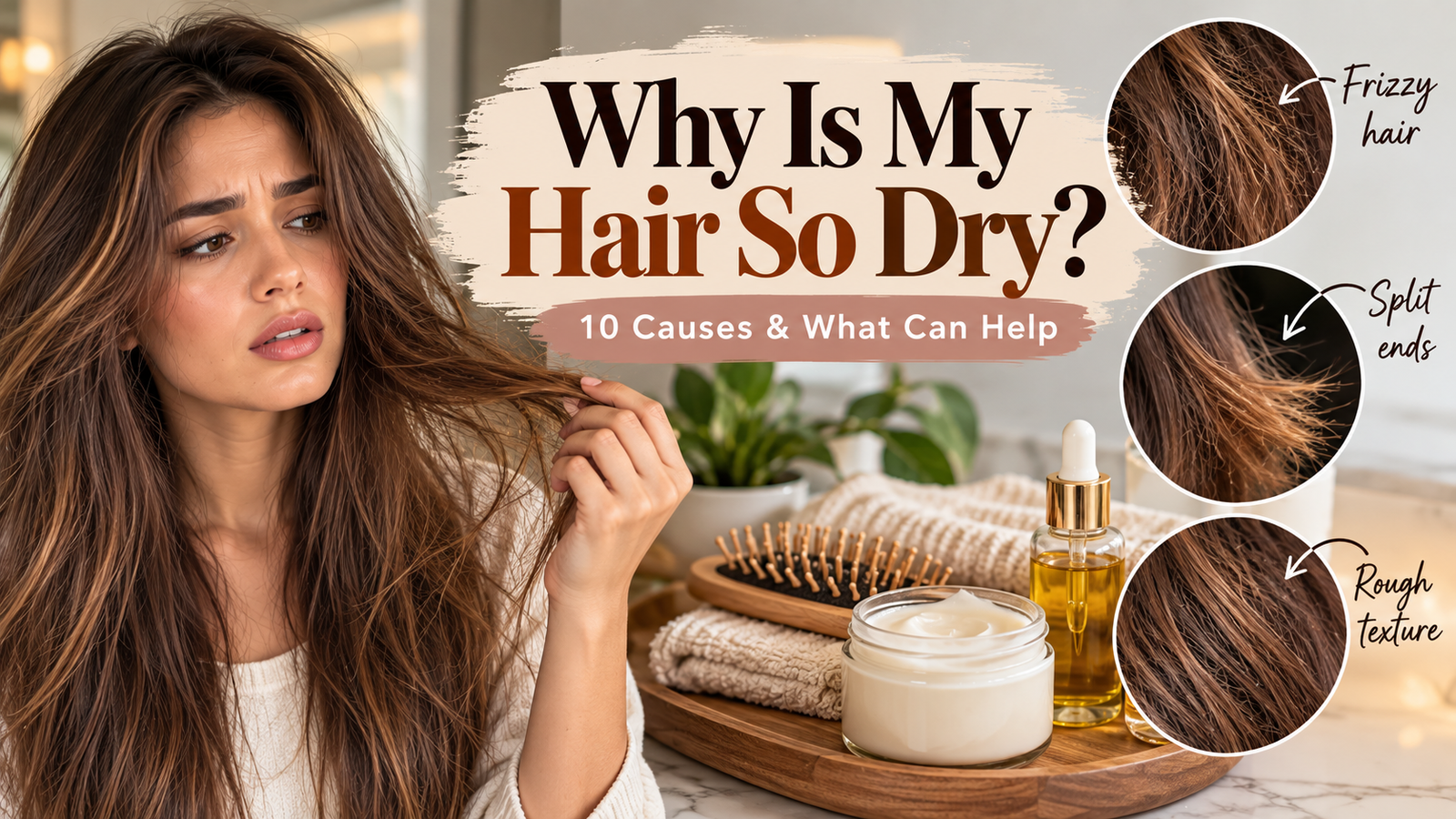
Why is my hair so dry? If your hair suddenly feels rough, brittle, frizzy, or difficult to manage, your everyday hair-care habits may be playing a bigger role than you realize.
Hair can become dry when it doesn’t retain enough moisture or when the outer protective layer of the hair shaft becomes damaged. Frequent heat styling, chemical treatments, harsh cleansing, environmental exposure, and even the way you handle wet hair can contribute.
The good news is that you may not need an entirely new collection of products. Understanding what’s causing the dryness can help you make smarter changes to your routine.
Below are 10 common reasons your hair may feel dry and what may help.
Why Is My Hair So Dry?
Before changing your entire hair-care routine, it’s useful to understand what dry hair actually means.
The hair shaft doesn’t produce its own oil. Natural oils produced by your scalp can coat the hair, but they don’t always travel evenly down the lengths—particularly with longer, thicker, curly, or textured hair.
Damage to the hair’s outer cuticle can also make strands feel rougher and more prone to tangling and breakage.
Here are some common factors that may contribute.
1. You’re Washing Your Hair Too Often
Shampoo is designed to remove oil, sweat, dirt, and product buildup.
But cleansing more frequently than your hair needs may leave the lengths feeling dry, especially if you’re using a strong shampoo.
This doesn’t mean everyone should wash their hair less frequently. Someone with an oily scalp may need a very different schedule from someone with dry, curly hair.
What Can Help?
Pay attention to your scalp and hair rather than following a universal washing schedule.
If your scalp feels clean but your lengths consistently feel stripped after shampooing, consider:
- Using a gentler shampoo
- Concentrating shampoo primarily on your scalp
- Conditioning the mid-lengths and ends
- Adjusting wash frequency if appropriate for your hair
2. Your Shampoo May Be Too Harsh
Sometimes the problem isn’t how often you’re washing—it’s what you’re washing with.
Clarifying and deep-cleansing shampoos can be useful for removing buildup, but using them too frequently may leave some hair types feeling rough or dry.
What Can Help?
Choose a shampoo appropriate for your scalp and hair type.
If your lengths are dry but your scalp gets oily, you don’t necessarily need to coat all your hair heavily with shampoo. Focus cleansing primarily on the scalp and allow the lather to rinse through the lengths.
Clarifying shampoo can still have a place in your routine, but it doesn’t necessarily need to be your everyday shampoo.
3. You’re Using Too Much Heat
Blow-dryers, flat irons, curling irons, and hot brushes can make styling easier, but frequent high-temperature exposure can contribute to hair damage.
Over time, your hair may begin to look:
- Dry
- Rough
- Frizzy
- Dull
- Brittle
- More prone to split ends
What Can Help?
You don’t necessarily have to stop heat styling completely.
Instead:
- Use the lowest effective temperature
- Apply a heat-protecting product
- Avoid repeatedly passing a hot tool over the same section
- Give your hair occasional heat-free days
- Avoid using flat irons or curling irons on wet hair unless the tool is specifically designed for that purpose
4. Your Hair Has Been Bleached or Chemically Treated
If you’re wondering why is my hair so dry after changing your color, chemical processing may be contributing.
Bleaching and other chemical treatments alter the hair structure. Repeated processing can leave strands more porous, fragile, and prone to dryness.
This doesn’t mean you can’t color your hair, but chemically treated hair often requires additional care.
What Can Help?
Consider:
- Using products formulated for color-treated or damaged hair
- Conditioning consistently
- Limiting unnecessary overlapping of bleach
- Reducing excessive heat styling
- Discussing bond-building or conditioning treatments with your stylist
- Trimming severely damaged ends when necessary
If you’re planning a color change, browse our chocolate brown hair ideas before your next salon appointment.
5. You’re Skipping Conditioner
Shampoo and conditioner serve different purposes.
While shampoo primarily cleanses, conditioner helps improve softness, manageability, and lubrication of the hair.
Skipping conditioner may make already-dry hair feel rougher and more tangled.
What Can Help?
Apply conditioner mainly through the mid-lengths and ends.
Let it sit according to the product instructions before rinsing.
If your hair is particularly dry, you may also benefit from an occasional conditioning mask, depending on your hair type and product preferences.
6. You’re Rough With Wet Hair
Hair can be more vulnerable to mechanical damage when wet.
Aggressive towel drying, brushing through stubborn tangles, or pulling wet hair into tight hairstyles can contribute to breakage.
And breakage can make already-dry hair look even rougher.
What Can Help?
Handle wet hair gently.
Try:
- Squeezing out excess water rather than aggressively rubbing
- Using a microfiber towel or soft cotton T-shirt
- Detangling carefully
- Starting at the ends and gradually working upward
- Using conditioner or a detangling product for additional slip
7. You’re Not Protecting Your Hair From the Environment
Your hair is exposed to more than styling products.
Sunlight, wind, dry weather, salt water, and chlorinated swimming pools can all affect how hair looks and feels.
What Can Help?
When appropriate:
- Wear a hat during prolonged sun exposure
- Rinse hair after swimming
- Condition regularly
- Protect hair from excessive wind and friction
- Use hair products designed to support moisture and manageability
If you swim frequently, consider discussing a suitable cleansing routine with your stylist, particularly if you have color-treated hair.
8. Your Ends Are Damaged
Sometimes the dryness isn’t equally distributed throughout your hair.
Your roots may look healthy while your ends appear dry, thin, frizzy, or split.
That’s understandable: your ends are the oldest part of your hair and have experienced more washing, brushing, heat, friction, sunlight, and chemical processing.
What Can Help?
Condition your ends consistently and reduce unnecessary heat exposure.
Products may temporarily improve the appearance and feel of split ends, but they cannot permanently fuse severely split hair back together.
Regular trims can remove damaged ends and help the overall hairstyle look healthier.
9. Your Hair Needs More Than Oil
A common response to dry hair is applying more and more oil.
Hair oils can help improve shine, reduce friction, and make the surface feel smoother, but oil alone doesn’t necessarily address every reason hair feels dry or damaged.
What Can Help?
Think about your entire routine.
A balanced dry-hair routine might include:
Shampoo → Conditioner → Leave-in product → Heat protectant → Optional finishing oil
You don’t need every product at every wash.
Choose products based on how your hair responds rather than assuming more layers always mean more hydration.
10. Your Hair-Care Routine Doesn’t Match Your Hair Type
The same routine won’t work equally well for everyone.
Fine, straight hair may become weighed down by rich products, while thick, curly, coarse, or chemically processed hair may need more conditioning.
That’s why copying another person’s routine doesn’t always solve dryness.
What Can Help?
Consider your:
- Hair texture
- Strand thickness
- Density
- Scalp oiliness
- Chemical-processing history
- Heat-styling habits
- Length
- Climate
Then adjust your products and frequency accordingly.
Simple Hair-Care Routine for Dry Hair
If your routine has become complicated, start with the basics.
Wash Day
Step 1: Shampoo your scalp
Massage shampoo gently into your scalp rather than aggressively scrubbing the lengths.
Step 2: Condition
Apply conditioner through the mid-lengths and ends.
Step 3: Detangle carefully
Use your fingers or an appropriate detangling tool without aggressively pulling through knots.
Step 4: Apply a leave-in product if needed
This can improve softness and manageability for hair types that benefit from additional conditioning.
Step 5: Apply heat protectant
Do this before using heat-styling tools.
Step 6: Style gently
Use the lowest effective heat setting and avoid repeatedly heating the same sections.
Ingredients Commonly Found in Products for Dry Hair
You don’t need to buy products based on one “miracle” ingredient.
Well-formulated hair products often combine several types of conditioning ingredients.
You may see ingredients such as:
Conditioning Agents
Ingredients such as cationic conditioning agents can help improve softness and detangling.
Silicones
Certain silicones can coat the hair shaft, reduce friction, improve shine, and make damaged hair feel smoother.
Despite what you may see on social media, silicones aren’t automatically “bad” for hair.
Fatty Alcohols
Ingredients such as cetyl alcohol and cetearyl alcohol are commonly used in conditioners. Despite having “alcohol” in their names, these are fatty alcohols and generally function differently from drying alcohols.
Oils
Coconut, argan, jojoba, and other oils are commonly used in hair products to improve lubrication, shine, and manageability.
The overall product formulation matters more than choosing a product simply because it contains one fashionable ingredient.
Dry Hair vs. Damaged Hair: What’s the Difference?
Dryness and damage can overlap, but they aren’t necessarily identical.
Dry hair may feel rough, dull, frizzy, or difficult to manage.
Damaged hair may additionally show signs such as:
- Excessive breakage
- Split ends
- Loss of elasticity
- Significant roughness
- Increased tangling
- Damage following bleaching or repeated high-heat styling
Conditioning products can improve the feel and appearance of damaged hair, but severely damaged strands cannot biologically “heal” because the visible hair shaft is not living tissue.
In some cases, trimming damaged sections is the most practical solution.
Common Dry Hair Mistakes
If you’re constantly asking why is my hair so dry, check whether you’re doing any of these:
- Washing more frequently than your hair needs
- Using very hot water
- Skipping conditioner
- Using clarifying shampoo too often
- Flat-ironing at unnecessarily high temperatures
- Heat styling without protection
- Bleaching already compromised hair
- Roughly towel-drying wet hair
- Brushing aggressively
- Ignoring split ends
- Assuming hair oil alone will fix damage
Fixing one or two habits may make more difference than buying several new products.
When Should You See a Professional?
Sometimes a sudden change in hair quality isn’t simply a cosmetic hair-care issue.
Consider talking with a dermatologist or healthcare professional if your dryness is accompanied by:
- Significant or sudden hair loss
- Noticeable thinning
- Bald patches
- Persistent scalp itching
- Scaling or inflammation
- Scalp sores
- Sudden changes in hair texture
- Other unexplained symptoms
A professional can help determine whether an underlying scalp or health condition needs evaluation.
Frequently Asked Questions
Why is my hair so dry all of a sudden?
A sudden change may be related to a new shampoo, increased heat styling, chemical processing, environmental changes, or changes in your hair-care routine. If the change is severe or accompanied by hair loss or scalp symptoms, consider professional evaluation.
Why is my hair so dry even after using conditioner?
Your conditioner may not be enough to offset frequent heat styling, bleaching, harsh cleansing, or mechanical damage. The product may also simply not be a good match for your hair type.
Can dry hair become healthy again?
You can improve the softness, manageability, shine, and appearance of dry hair through conditioning and gentler hair-care practices. However, severely damaged portions of the hair shaft cannot biologically repair themselves.
Does hair oil fix dry hair?
Hair oils can improve lubrication, smoothness, and shine, but they aren’t a universal solution for dryness or structural damage.
How often should I wash dry hair?
There’s no single schedule that works for everyone. Wash frequency should take your scalp oiliness, hair texture, lifestyle, and product use into account.
Why are my ends so dry but my roots are oily?
Sebum is produced by your scalp, so the roots naturally receive more oil. The ends are older and may have accumulated more heat, chemical, environmental, and mechanical damage.
Final Thoughts
If you’ve been wondering why is my hair so dry, don’t assume the solution is simply adding more oil or buying a more expensive shampoo.
Look at your routine as a whole.
Frequent heat styling, chemical treatments, harsh cleansing, skipping conditioner, rough handling, and environmental exposure can all contribute to hair that feels dry or damaged.
Start by reducing unnecessary sources of damage, condition consistently, protect your hair when using heat, and choose products that suit your actual hair type.
Small changes made consistently can often improve how your hair looks, feels, and behaves.
4 thoughts on “Why Is My Hair So Dry? 10 Causes & What Can Help”