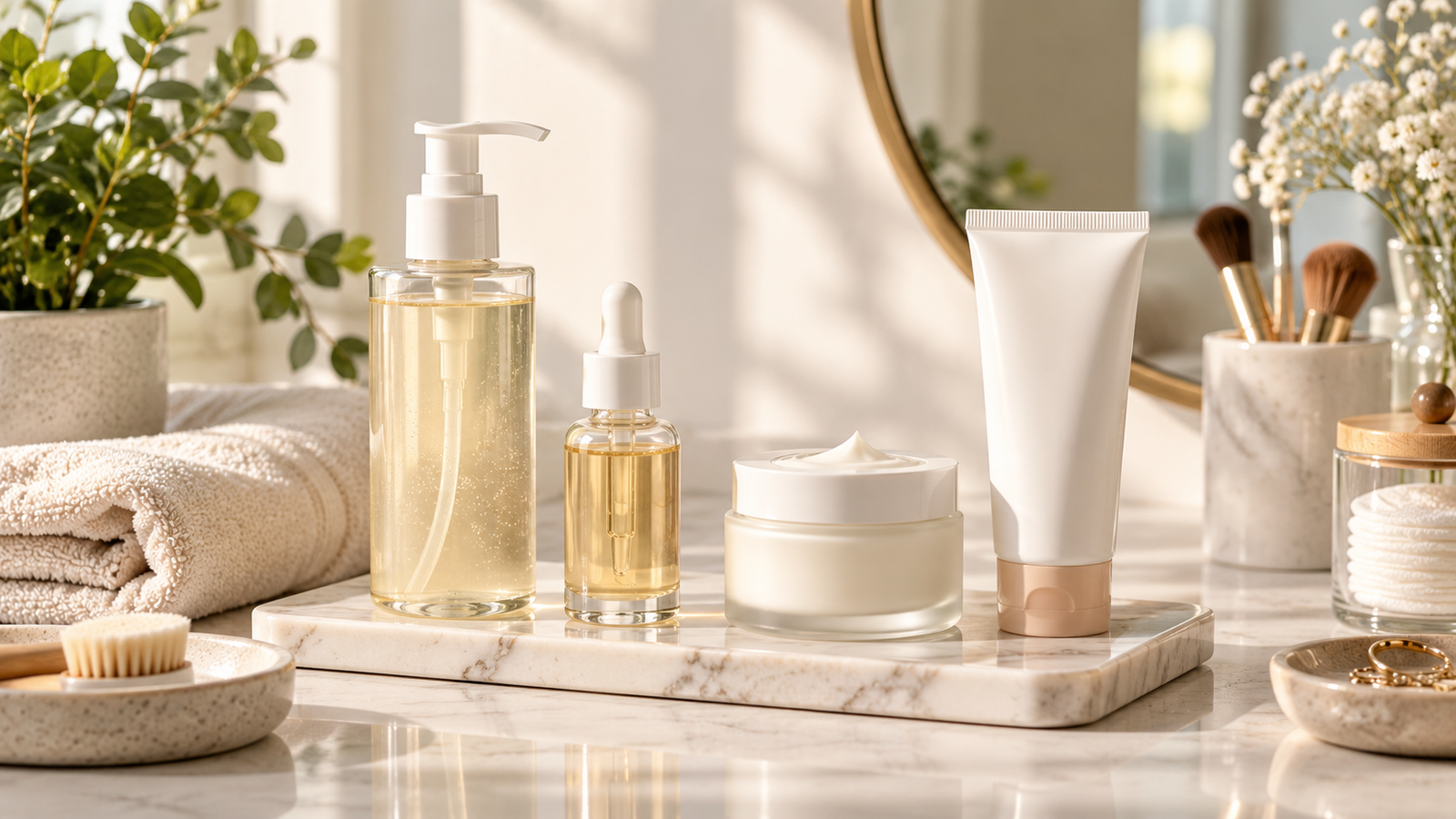
A skincare routine for your skin type can make it easier to choose the right products and avoid unnecessary irritation. Whether you have oily, dry, combination, or sensitive skin, building a simple routine starts with understanding what your skin actually needs.
The good news is that an effective skincare routine doesn’t need ten different products.
For most people, the best place to start is with a few basic products chosen according to their skin type and concerns.
In this beginner-friendly guide, we’ll explain how to identify your skin type, the correct order to apply skincare products, and how to build simple morning and nighttime routines without overwhelming your skin.
Step 1: Understand Your Skin Type
Before buying new skincare products, it helps to understand how your skin naturally behaves. A simple skincare routine for your skin type is often easier to follow consistently than a complicated routine with too many products.
Oily Skin
Oily skin tends to produce more sebum and may appear shiny, particularly around the forehead, nose, and chin.
People with oily skin may also experience clogged pores and breakouts.
Look for lightweight, non-comedogenic products that don’t feel excessively heavy on the skin.
Dry Skin
Dry skin may feel tight, rough, flaky, or uncomfortable, particularly after cleansing.
A routine for dry skin should focus on gentle cleansing and maintaining hydration.
Ingredients such as ceramides, glycerin, and hyaluronic acid are commonly found in moisturizing products.
Combination Skin
Combination skin usually has characteristics of both oily and dry skin.
For example, your forehead and nose may become oily while your cheeks remain normal or dry.
A balanced routine using gentle products is often a good starting point.
Sensitive Skin
Sensitive skin may react more easily to certain products or ingredients.
If your skin is sensitive, introduce new products gradually and consider fragrance-free, gentle formulas.
Patch testing a new product before applying it widely can also help identify potential irritation.
The Basic Skincare Routine Everyone Should Start With
You don’t need an overflowing bathroom shelf to start caring for your skin.
A beginner routine can be surprisingly simple.
Your three essentials are:
Cleanser → Moisturizer → Sunscreen
Once your skin is comfortable with these basics, you can consider adding targeted products for concerns such as acne, uneven-looking tone, dryness, or signs of aging. Choosing a skincare routine for your skin type can help you select products that better match your skin’s needs while keeping your daily routine simple and manageable.
Morning Skincare Routine
Your morning routine should prepare your skin for the day and, importantly, protect it from sun exposure.
Step 1: Cleanser
Start with a gentle facial cleanser appropriate for your skin type.
Cleansing helps remove oil, sweat, and residue that may accumulate overnight.
Avoid assuming that a cleanser needs to leave your face feeling extremely tight to be effective.
Step 2: Treatment or Serum — Optional
Beginners don’t necessarily need a serum.
However, once you have established your basic routine, you may choose a product designed for a particular skin concern.
For example, vitamin C is commonly incorporated into morning skincare routines, while niacinamide is another popular skincare ingredient.
Introduce one new product at a time so it’s easier to tell how your skin responds.
Step 3: Moisturizer
Even oily skin can benefit from moisturizer.
The key is choosing an appropriate texture.
Oily skin may prefer a lightweight gel or lotion, while dry skin may benefit from a richer cream.
Step 4: Sunscreen
Sunscreen is one of the most important steps in a daytime skincare routine.
Choose a broad-spectrum SPF 30 or higher and apply it to exposed skin.
Remember that sunscreen isn’t only for beach days. UV exposure can occur during normal everyday activities as well. According to the American Academy of Dermatology, choosing a broad-spectrum sunscreen with SPF 30 or higher is an important part of protecting your skin from the sun.
Simple Nighttime Skincare Routine
Nighttime is a good opportunity to cleanse your skin and use products targeted toward your particular concerns.
Step 1: Remove Makeup and Sunscreen
If you’re wearing makeup or water-resistant sunscreen, thoroughly remove it before bed.
Some people prefer double cleansing, beginning with an oil-based cleanser or cleansing balm and following with a gentle water-based cleanser.
However, double cleansing isn’t mandatory for everyone.
Step 2: Cleanse
Use your regular gentle cleanser to remove remaining dirt, oil, and residue.
Step 3: Treatment — Optional
This is where targeted ingredients such as retinoids or exfoliating acids may eventually fit into your routine.
But don’t introduce several strong active ingredients at the same time.
More skincare isn’t necessarily better skincare.
Step 4: Moisturizer
Finish with moisturizer to help maintain your skin’s hydration and barrier.
Skincare Routine for Oily Skin
If you have oily skin, your routine might look like:
Morning:
Gentle cleanser → lightweight moisturizer → SPF 30+
Night:
Cleanser → targeted treatment if needed → lightweight moisturizer
Avoid trying to completely strip oil from your skin with excessively harsh cleansing.
Skincare Routine for Dry Skin
Dry skin generally benefits from a hydration-focused approach.
Morning:
Gentle cleanser → moisturizer → SPF 30+
Night:
Gentle cleanser → hydrating product if desired → richer moisturizer
Look for moisturizing ingredients such as ceramides, glycerin, and hyaluronic acid.
Skincare Routine for Combination Skin
Combination skin can be confusing because different areas of your face behave differently.
Start with:
Morning:
Gentle cleanser → lightweight moisturizer → sunscreen
Night:
Cleanser → treatment when necessary → moisturizer
You don’t necessarily need a completely different product for every part of your face.
Skincare Routine for Sensitive Skin
With sensitive skin, simplicity can be especially useful.
Start with a gentle cleanser, moisturizer, and sunscreen.
Avoid introducing multiple active ingredients simultaneously.
When trying something new, patch test first and gradually incorporate it into your routine.
If you experience persistent burning, swelling, severe irritation, or another concerning reaction, stop using the product and consider speaking with a dermatologist.
What Order Should You Apply Skincare Products?
A typical routine might look like this:
Morning:
Cleanser → Toner (optional) → Serum (optional) → Moisturizer → Sunscreen
Night:
Makeup remover → Cleanser → Treatment/Serum → Moisturizer
You don’t need every step simply because it appears on this list.
A three-product routine can be perfectly reasonable for a beginner.
7 Common Skincare Mistakes Beginners Make
1. Starting too many products at once
If you introduce five products simultaneously and irritation develops, identifying the cause becomes difficult.
2. Skipping sunscreen
An elaborate skincare routine doesn’t replace daily sun protection.
3. Over-exfoliating
Using exfoliating products too frequently can irritate the skin.
4. Assuming oily skin doesn’t need moisturizer
Oil production and skin hydration aren’t the same thing.
5. Copying someone else’s entire routine
A product that works beautifully for one person’s skin may not be appropriate for another.
6. Changing products too quickly
Some products need consistent use before you can properly evaluate how they fit into your routine.
7. Thinking expensive means better
Price alone doesn’t determine whether a skincare product is suitable for your skin.
How to Start Your Routine This Week
If you’re completely new to skincare, don’t buy ten products today.
Start with:
Week 1: Gentle cleanser + moisturizer + sunscreen.
Use these consistently and observe how your skin responds.
After you’ve established the basics, consider adding one targeted product at a time based on what you actually want to address.
This makes your routine easier to follow and makes it much easier to identify products your skin doesn’t tolerate well.
Frequently Asked Questions
What is the best skincare routine for beginners?
A simple routine consisting of a gentle cleanser, moisturizer, and broad-spectrum SPF 30+ is a good starting point. Additional products can be introduced according to your skin concerns.
Do I need a 10-step skincare routine?
No. More steps don’t automatically produce better results. A consistent routine containing products appropriate for your skin can be more practical.
Should I use skincare every day?
Basic skincare products are generally designed for regular use, although individual products and active ingredients can have different usage instructions. Follow the directions on each product.
Can oily skin use moisturizer?
Yes. Look for a moisturizer with a texture and formulation suitable for oily or acne-prone skin.
How do I know my skin type?
Observe how your skin behaves after cleansing and throughout the day. Persistent oiliness, dryness, sensitivity, or a mixture of oily and dry areas can provide clues. A dermatologist can help if you’re unsure or experiencing ongoing skin problems.
Final Thoughts
As you learn more about your skin, you can gradually adjust your skincare routine for your skin type by adding products that address specific concerns. A good skincare routine doesn’t have to be complicated.
Start by understanding your skin type and establish the three fundamentals: cleansing, moisturizing, and daytime sun protection.
Once you’ve built that foundation, you can gradually introduce products targeting specific concerns.
Consistency—and choosing products that your skin tolerates—is usually more useful than constantly chasing the newest skincare trend.
1 thought on “How to Build a Skincare Routine for Your Skin Type”