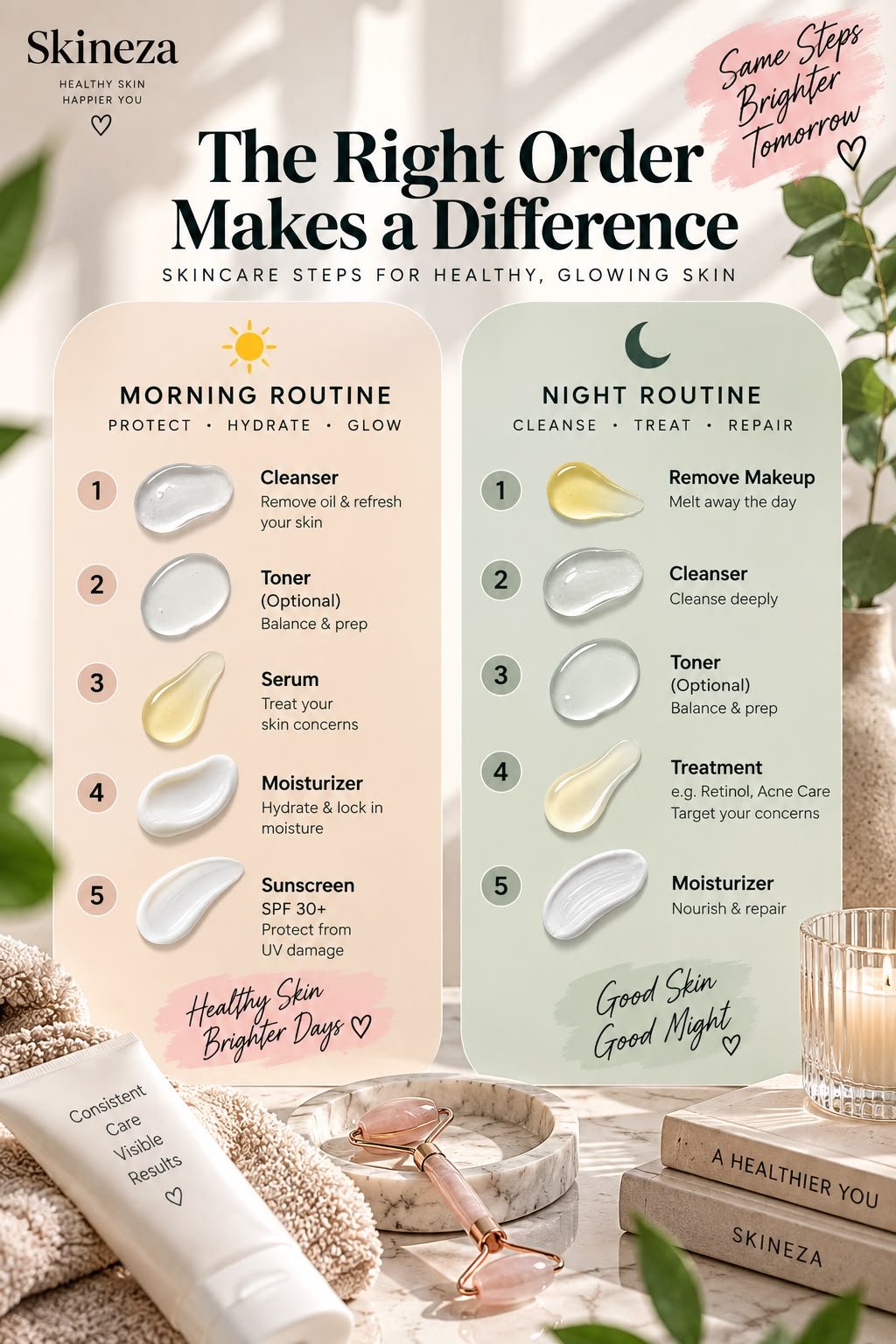
Knowing the correct order to apply skincare products can make your routine simpler and help you use each product more effectively. With cleansers, toners, serums, moisturizers, retinol, face oils, and sunscreen available, it is easy to wonder what should go first.
Fortunately, your skincare routine does not have to be complicated.
A useful general rule is to apply products from lighter, thinner textures to heavier, richer textures, while also following the directions for each individual product.
Below, we’ll break down a simple morning and nighttime skincare order for beginners.
Why Does Skincare Product Order Matter?
The order of your skincare routine matters because different products have different purposes and textures.
Lightweight products, such as many serums, are generally applied before heavier creams and oils. Your routine should also account for products that have a specific role at a particular time of day.
For example, sunscreen belongs at the end of your morning skincare routine.
You also don’t need every skincare category you see online. A basic routine built around cleansing, moisturizing, and sun protection can be a perfectly reasonable starting point.
Following the correct order to apply skincare products can help each product fit properly into your routine.
Morning Skincare Routine Order
Your morning routine should focus on keeping your skin comfortable and protecting it during the day.
Here’s a simple order to apply skincare products in the morning.
Step 1: Cleanser
Start with a gentle cleanser appropriate for your skin type.
Cleansing can remove excess oil, sweat, and residue that may have accumulated overnight.
Avoid choosing an overly harsh cleanser simply because it leaves your face feeling extremely “clean.” Your skin shouldn’t necessarily feel tight or uncomfortable after cleansing.
Step 2: Toner — Optional
Toner isn’t essential for everyone.
If you enjoy using one, apply it after cleansing and before your treatment products.
Look for a formula suited to your skin’s needs rather than adding toner simply because you think every routine requires one.
Step 3: Treatment or Serum
Next comes your serum or targeted treatment.
Depending on your routine, this might include a hydrating serum, antioxidant product, or another treatment recommended for your particular skin concerns.
If you’re using several active ingredients, don’t automatically combine everything at once. More products do not necessarily mean better results.
Step 4: Moisturizer
Follow with moisturizer.
Moisturizers help support hydration and can make the skin feel softer and more comfortable.
People with oily skin may prefer lightweight gel or lotion textures, while people with dry skin may prefer richer creams.
Step 5: Sunscreen
Your morning order to apply skincare products should usually finish with sunscreen.
The American Academy of Dermatology recommends using a broad-spectrum, water-resistant sunscreen with an SPF of 30 or higher to help protect your skin from the sun.
Sunscreen is particularly important because UV exposure can contribute to premature skin aging and skin damage.
Nighttime Skincare Routine Order
At night, you don’t need sunscreen, so your routine can focus more on cleansing, moisturizing, and any treatments you choose to use. Following the correct order to apply skincare products can help each product fit properly into your routine.
Step 1: Remove Makeup and Sunscreen
If you’ve worn makeup or water-resistant sunscreen during the day, remove it thoroughly before bed.
Some people prefer using micellar water, cleansing balm, or cleansing oil before their regular cleanser.
Step 2: Cleanser
Follow with a gentle facial cleanser.
If one cleanse adequately removes everything from your skin, you don’t necessarily need to double cleanse every night.
Step 3: Toner — Optional
If toner is part of your routine, this is generally where you would use it.
Again, toner is optional rather than a requirement for healthy-looking skin.
Step 4: Treatment Products
Your treatment step will depend on your skin concerns and the products you’re using.
This could include products containing ingredients such as retinoids or exfoliating acids.
However, active ingredients can cause irritation for some people, particularly when several are introduced simultaneously.
Start gradually and follow the instructions for your particular product.
Step 5: Moisturizer
Apply moisturizer to finish a simple nighttime routine.
If your skin tends to be dry, you may prefer a richer moisturizer at night than you use during the day.
Where Does Retinol Go in a Skincare Routine?
This is one of the most common skincare-order questions.
Retinol products are generally used during a nighttime routine, but exact application instructions can vary depending on the formulation.
A basic routine may look like:
Cleanser → Retinol product → Moisturizer
If you’re new to retinoids, introduce them gradually rather than immediately using them every night.
Retinoids can increase irritation and sun sensitivity, so daytime sun protection is particularly important.
Pregnant or breastfeeding people should speak with a healthcare professional before using retinoid products.
Where Does Vitamin C Go?
Vitamin C products are commonly used during a morning routine.
A simple order could be:
Cleanser → Vitamin C serum → Moisturizer → Sunscreen
However, formulation matters, so always follow the directions provided with your specific product.
When Should You Apply Hyaluronic Acid?
Hyaluronic acid is commonly found in hydrating serums and moisturizers.
If you’re using a lightweight hyaluronic acid serum, it will generally go after cleansing and before moisturizer.
For example:
Cleanser → Hydrating serum → Moisturizer → Sunscreen
You may not need a separate hyaluronic acid serum if your moisturizer already contains hydrating ingredients that work well for your skin.
What About Face Oil?
Face oils generally come toward the end of a nighttime routine because they tend to have heavier textures.
A simple example is:
Cleanser → Serum → Moisturizer → Face oil
But always check the instructions for your specific product.
5 Skincare Layering Mistakes to Avoid
Using Too Many Products at Once
A complicated 10-product routine isn’t automatically more effective than a simple one.
Starting with fewer products also makes it easier to identify what your skin likes—or what is causing irritation.
Introducing Multiple Active Ingredients Together
Starting retinol, exfoliating acids, and several treatment serums simultaneously can make it difficult to identify the cause if your skin becomes irritated.
Introduce new products gradually.
Applying Sunscreen Too Early
Sunscreen should generally be the final skincare step in your morning routine before makeup.
Ignoring Product Instructions
General layering rules are helpful, but the manufacturer’s instructions for a specific formulation matter.
Changing Your Routine Constantly
Skincare trends move quickly.
Your routine doesn’t need to change every time a new ingredient becomes popular.
Consistency with products your skin tolerates is usually more useful than constantly replacing your routine.
Simple Skincare Order for Beginners
If you’re overwhelmed by everything above, start here.
Morning:
Cleanser → Moisturizer → Sunscreen
Night:
Cleanser → Moisturizer
Once you’ve established those basics, you can decide whether your skin actually needs additional products.
Frequently Asked Questions
Do I apply serum or moisturizer first?
Lightweight serums are generally applied before moisturizer.
Does sunscreen go before or after moisturizer?
Sunscreen generally goes after moisturizer as the final step of your morning skincare routine.
Should I use toner before serum?
If you’re using toner, it generally goes after cleansing and before serum.
Can I use multiple serums?
It depends on their ingredients and your skin. Using several serums isn’t necessary for everyone, and combining active ingredients can sometimes increase irritation.
How long should I wait between skincare products?
There isn’t one universal waiting time required between every skincare step. Follow the directions for products that specify a waiting period and allow products to settle enough for comfortable application.
Final Thoughts
Learning the correct order to apply skincare products doesn’t mean you need a complicated routine.
For beginners, focus on the essentials: cleanse gently, moisturize appropriately, and protect your skin from the sun during the day.
Once you’ve established a routine that works for you, you can gradually introduce targeted products based on your skin concerns.
And remember: the best skincare routine isn’t necessarily the one with the most products. It’s one you can follow consistently and that your skin tolerates well.
Once you understand the order to apply skincare products’ it becomes much easier to build a routine that is simple , effective, and easy to follow everyday.
New to skincare? Read our beginner skincare routine for your skin type to learn how to choose products that match your skin’s needs.