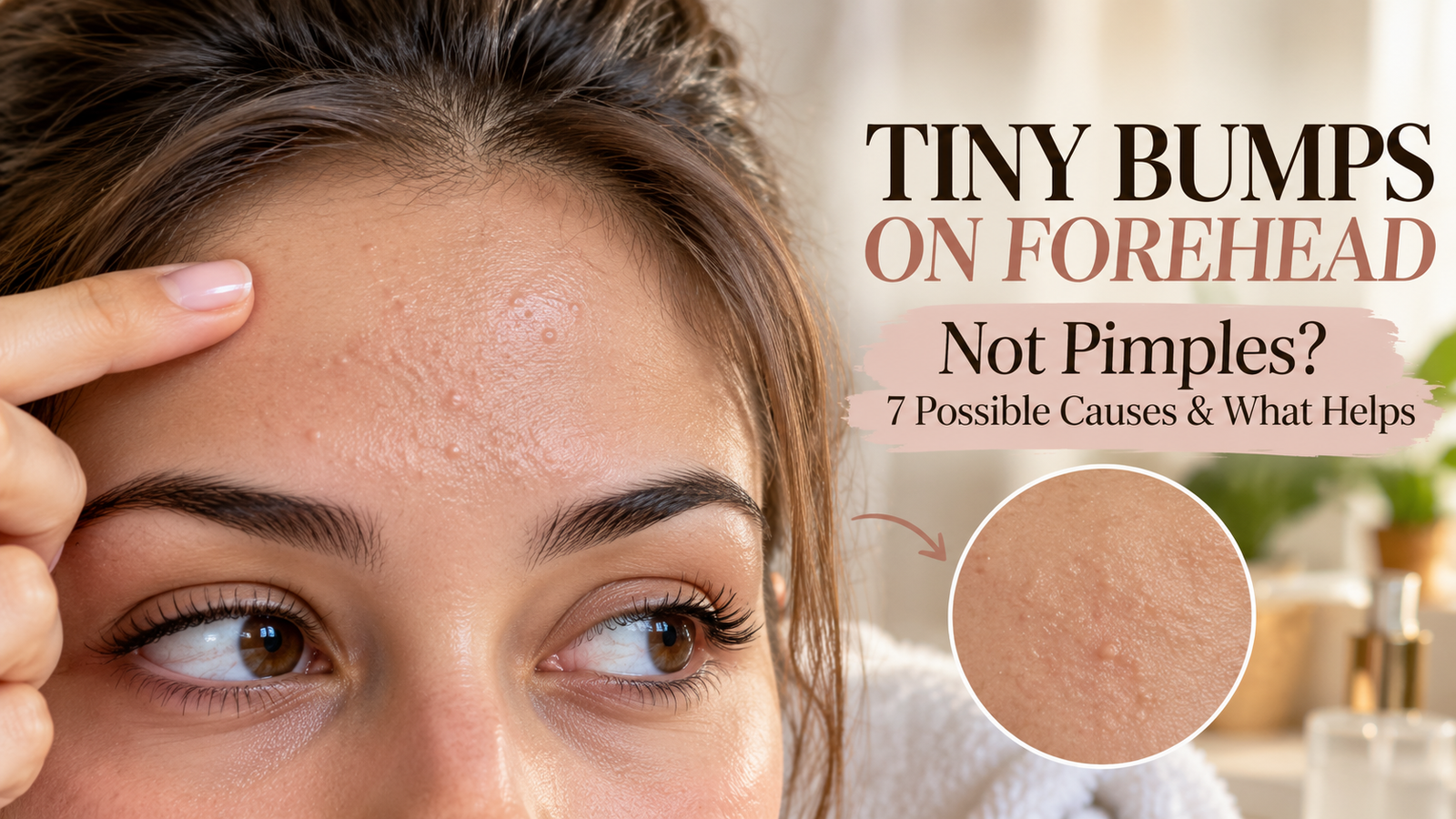
Tiny bumps on forehead can be frustrating, especially when they don’t look like typical pimples. You might notice small, skin-colored bumps across your forehead, rough texture near your hairline, or clusters of tiny bumps that never seem to go away.
Sometimes they appear overnight. Other times, they develop gradually and make your skin feel uneven even when you don’t have visible acne.
If you’ve been exfoliating, changing cleansers, or applying acne treatments without seeing improvement, there’s an important reason why: not every forehead bump is acne.
Tiny forehead bumps can have several causes, including clogged pores, irritation, folliculitis, milia, and certain skin conditions. Some look very similar, but they don’t all respond to the same skincare products.
In this guide, we’ll explore seven possible causes of tiny bumps on your forehead, what they may look and feel like, gentle skincare habits that can help, and when it’s best to see a dermatologist.
Why Do I Have Tiny Bumps on My Forehead?
Your forehead contains many oil-producing glands and hair follicles. Sweat, oil, skincare products, and hair products can all affect this area.
When small bumps appear, the underlying cause isn’t always obvious.
For example, closed comedones may look like tiny flesh-colored bumps, while folliculitis can create clusters of similar-looking spots around hair follicles. Irritation from a new skincare product can also cause roughness or small raised areas.
The appearance, location, and symptoms of your bumps may offer clues.
Pay attention to whether your bumps:
- Are skin-colored, white, or red
- Feel itchy, tender, or completely painless
- Appear mostly along your hairline
- Look almost identical in size
- Develop after using new skincare or hair products
- Become worse with sweating or heat
- Persist despite acne treatments
These details can help a dermatologist determine the cause. Appearance alone, however, isn’t enough for a reliable diagnosis.
7 Possible Causes of Tiny Bumps on Forehead
1. Closed Comedones (Clogged Pores)
Closed comedones are one of the most common explanations for small, skin-colored bumps on the forehead.
They develop when a hair follicle becomes blocked by oil and dead skin cells, forming a closed acne lesion beneath the skin’s surface.
What They May Look Like
- Small, flesh-colored or whitish bumps
- A slightly uneven or bumpy skin texture
- Little or no redness
- Multiple bumps clustered across the forehead
- Usually minimal itching
Unlike inflamed pimples, closed comedones often don’t have a red base or obvious pus-filled center.
What May Help
A gentle, noncomedogenic skincare routine is a good starting point.
Depending on your skin type and tolerance, acne treatments containing salicylic acid or a topical retinoid such as adapalene may help reduce clogged pores.
However, these ingredients can cause dryness or irritation, especially when used too frequently.
Start slowly, follow product directions, and avoid combining multiple strong treatments without guidance.
Important: Topical retinoids should generally be avoided during pregnancy or when trying to become pregnant unless a clinician advises otherwise.
Skineza Tip: If your forehead has many persistent, skin-colored bumps without itching, clogged pores may be one possibility—but don’t assume every bump is a comedone.
2. Malassezia Folliculitis (Often Called “Fungal Acne”)
Malassezia folliculitis is an inflammation of hair follicles associated with an overgrowth of Malassezia yeast, which normally lives on the skin.
Although people often call it fungal acne, it isn’t the same condition as acne vulgaris.
What It May Look Like
- Clusters of small, similar-looking bumps
- Red or skin-colored follicular papules
- Sometimes small pustules
- Itching, which may be noticeable
- Bumps on the forehead, hairline, chest, or back
Heat, sweating, and humid conditions can sometimes make symptoms more noticeable.
What May Help
Because Malassezia folliculitis is different from acne, standard acne treatments may not address the underlying cause.
A healthcare professional may recommend an appropriate antifungal treatment after evaluating the skin.
Avoid diagnosing yourself based on photos or social media descriptions. Other conditions can look very similar.
Skineza Tip: If your tiny forehead bumps are itchy, uniform in appearance, and worsen with sweating, consider asking a dermatologist whether folliculitis could be involved.
3. Hair Products Causing Acne Along the Hairline
Your haircare routine may be contributing to the bumps on your forehead.
Pomades, styling creams, hair oils, and some leave-in conditioners can transfer onto the skin around your forehead and hairline.
In some people, these products contribute to clogged pores and breakouts.
This is sometimes called pomade acne.
What It May Look Like
- Tiny bumps concentrated near the hairline
- Small whiteheads or closed comedones
- Breakouts around the temples
- Bumps where hair products regularly touch the skin
What May Help
- Keep heavy hair oils and styling products away from your forehead.
- Look for noncomedogenic hair and skincare products when possible.
- Wash your face gently after hair products come into contact with your skin.
- Clean pillowcases and items that collect hair product residue.
- Avoid letting oily bangs rest against your forehead for long periods.
You don’t necessarily need to stop using all your favorite hair products. Adjusting where and how you apply them may help.
Skineza Tip: If your bumps appear mainly along your hairline, review your haircare products before buying another acne serum.
4. Milia (Tiny Keratin-Filled Cysts)
Milia are small cysts that form when keratin becomes trapped beneath the surface of the skin.
They often appear around the eyes and cheeks, but they can also develop on the forehead.
Milia are not the same as whiteheads.
What They May Look Like
- Tiny, firm, white or yellowish bumps
- Smooth, dome-shaped spots
- Usually no redness or itching
- Bumps that don’t easily come to a head
- Persistent spots that remain in the same location
What May Help
Some milia resolve on their own, while others persist.
A dermatologist can evaluate persistent bumps and discuss appropriate treatment or professional removal.
Do not squeeze, pierce, or attempt to extract milia at home. This can damage the skin and increase the risk of infection or scarring.
Skineza Tip: If a bump feels firm, stays in one place, and doesn’t behave like acne, milia may be one possible explanation.
5. Irritant or Allergic Contact Dermatitis
Sometimes, tiny forehead bumps are a reaction to something touching your skin.
Skincare products, fragrances, hair dyes, shampoos, sunscreens, and other ingredients can trigger irritation or allergic contact dermatitis.
Irritant contact dermatitis occurs when a substance damages or irritates the skin. Allergic contact dermatitis involves an immune reaction to a particular substance.
What It May Look Like
- Small bumps or a rash
- Redness or discoloration
- Itching, burning, or stinging
- Dryness or flaking
- Symptoms that develop after exposure to a product
The appearance may vary depending on your skin tone and the type of reaction.
What May Help
If you suspect a new product is causing irritation:
- Stop using the suspected product.
- Simplify your routine to a gentle cleanser and fragrance-free moisturizer.
- Avoid exfoliating acids, scrubs, and unnecessary active ingredients while your skin is irritated.
- Seek medical advice if symptoms persist, spread, or worsen.
A dermatologist may recommend patch testing when allergic contact dermatitis is suspected.
Skineza Tip: If bumps appeared soon after introducing a new skincare or haircare product, irritation may be more likely than a sudden acne breakout.
6. Heat Rash (Miliaria)
Heat rash can develop when sweat becomes trapped in the skin, particularly during hot or humid weather.
The forehead may be affected, especially when sweat, headwear, or other factors contribute to overheating.
What It May Look Like
- Small, clustered bumps
- A prickly or itchy sensation
- Sometimes redness
- Bumps that develop during hot weather or after heavy sweating
- Improvement after the skin cools
What May Help
- Move to a cooler environment.
- Keep your skin comfortably cool and dry.
- Avoid heavy, occlusive products while the rash is active.
- Wear breathable clothing and avoid excessive heat exposure.
- Avoid scratching irritated areas.
If the rash persists, becomes painful, or shows signs of infection, seek medical care.
Skineza Tip: If your bumps appear after spending time in the heat and improve when your skin cools down, heat rash may be worth considering.
7. Seborrheic Dermatitis
Seborrheic dermatitis is a common inflammatory skin condition that can affect oily areas of the face and scalp.
It often causes flaking and irritation around the eyebrows, hairline, sides of the nose, and scalp.
Although it isn’t usually described as a collection of isolated acne-like bumps, inflammation and uneven texture can sometimes make the forehead appear bumpy.
What It May Look Like
- Flaky or scaly patches
- Redness or other discoloration
- Itching
- Greasy-looking scales
- Irritation near the eyebrows or hairline
What May Help
Treatment depends on the severity and location.
A dermatologist may recommend antifungal or anti-inflammatory products appropriate for facial skin.
Avoid applying strong medicated scalp products to your face unless their instructions or a healthcare professional specifically support that use.
Skineza Tip: If your forehead texture comes with persistent flaking around your eyebrows or scalp, seborrheic dermatitis may be one possible cause.
How to Tell Different Forehead Bumps Apart
Different conditions can produce similar-looking bumps, so this table is only a general guide—not a diagnostic test.
| Possible Cause | Common Appearance | Additional Clues |
|---|---|---|
| Closed comedones | Small, skin-colored bumps | Usually little itching |
| Malassezia folliculitis | Similar-sized follicular bumps | Often itchy; may worsen with sweating |
| Hair product-related acne | Small bumps near hairline | Contact with oils or styling products |
| Milia | Firm white or yellowish bumps | Often persistent and painless |
| Contact dermatitis | Bumps or rash with irritation | Burning, itching, or recent product exposure |
| Heat rash | Clusters of tiny bumps | Associated with heat and sweating |
| Seborrheic dermatitis | Flaky, irritated skin | Often affects scalp, eyebrows, and hairline |
If you’re unsure which description matches your skin, avoid trying several treatments at once.
A dermatologist can distinguish between conditions that may require very different approaches.
A Gentle Skincare Routine for Tiny Bumps on Forehead
If you’re dealing with tiny bumps on forehead areas, start by simplifying your skincare routine rather than adding multiple exfoliating products.
This approach can help minimize unnecessary irritation while you work out what may be contributing to the bumps.
Morning Routine
Step 1: Use a Gentle Cleanser
Choose a mild, fragrance-free cleanser that doesn’t leave your skin feeling tight or stripped.
If your skin is especially dry or sensitive, a lukewarm water rinse may be enough in the morning.
Step 2: Apply a Lightweight Moisturizer
Even oily or acne-prone skin can benefit from moisturizing.
Look for a product labeled noncomedogenic if you’re concerned about clogged pores.
Step 3: Apply Broad-Spectrum Sunscreen
Use a broad-spectrum sunscreen with SPF 30 or higher.
Choose a texture that feels comfortable and works well with your skin.
Reapply as directed, particularly during outdoor exposure.
Night Routine
Step 1: Cleanse Gently
Remove sunscreen, makeup, sweat, and daily buildup without scrubbing.
Step 2: Avoid Unnecessary Product Layering
If your skin is irritated or the cause of the bumps is unclear, keep your routine simple.
Don’t automatically add salicylic acid, retinol, benzoyl peroxide, and exfoliating toner all at once.
Step 3: Use an Appropriate Treatment Only When Needed
If a clinician identifies comedonal acne, an acne treatment may be useful.
If the bumps are caused by folliculitis, dermatitis, or another condition, the treatment may be different.
Step 4: Moisturize
Apply a gentle moisturizer to support your skin barrier.
Remember: A simple routine can help reduce irritation, but it won’t necessarily treat every cause of forehead bumps.
Should You Exfoliate Tiny Forehead Bumps?
Exfoliation is often recommended online for uneven skin texture, but it isn’t always the right solution.
For confirmed clogged pores, a product containing salicylic acid may help.
However, exfoliation may worsen irritation, contact dermatitis, or certain other skin conditions.
Avoid These Common Mistakes
- Scrubbing your forehead aggressively
- Using multiple exfoliating acids together
- Picking or squeezing tiny bumps
- Increasing treatment frequency whenever your skin looks worse
- Assuming every bump is caused by clogged pores
If your skin is itchy, burning, or inflamed, prioritize gentle care and seek an appropriate diagnosis.
Can Moisturizer Cause Tiny Bumps on Forehead?
Some skincare products may contribute to breakouts in acne-prone individuals, particularly if the formulation doesn’t suit their skin.
However, moisturizer itself isn’t automatically the problem.
Dryness and irritation can also make skin texture look more noticeable.
If you suspect a particular moisturizer:
- Review when the bumps first appeared.
- Consider whether you recently changed products.
- Stop using the suspected product if it’s irritating your skin.
- Choose a simple, fragrance-free alternative.
- Give your skin time to settle rather than switching products every day.
Products labeled noncomedogenic may be useful for acne-prone skin, although the label doesn’t guarantee that a product will work for everyone.
Why Are My Forehead Bumps Worse After Skincare?
If your forehead becomes bumpier after using a new product, several explanations are possible.
Irritation: An active ingredient may be too strong or used too frequently.
Contact dermatitis: Your skin may be reacting to an ingredient.
Clogged pores: A product may contribute to breakouts in your particular skin.
An unrelated condition: The bumps may not be caused by skincare at all.
People sometimes call any new breakout after starting skincare purging. However, not every new bump is a purge.
Skin purging is generally discussed in connection with ingredients that increase skin-cell turnover, such as certain retinoids and exfoliating acids.
A rash, itching, burning, or bumps after an unrelated product shouldn’t automatically be dismissed as purging.
When Should You See a Dermatologist?
Consider seeing a dermatologist if:
- The bumps persist or keep returning.
- They are very itchy or painful.
- Your skin becomes significantly inflamed.
- You develop pustules, crusting, or spreading redness.
- Over-the-counter acne products aren’t helping.
- You’re unsure whether the bumps are acne, folliculitis, or another condition.
- You notice scarring or significant changes in your skin.
Seek prompt medical attention for rapidly spreading redness, fever, severe pain, or signs of a serious infection.
Frequently Asked Questions
Why do I have tiny bumps on my forehead but no acne?
Small forehead bumps may be caused by closed comedones, milia, folliculitis, contact dermatitis, heat rash, or other skin conditions. A dermatologist can help identify the cause.
Are tiny skin-colored bumps on my forehead clogged pores?
They can be, but not always. Closed comedones often appear as small skin-colored bumps, while several other conditions can look similar.
Can hair oil cause tiny bumps on forehead skin?
Yes. Certain hair oils, pomades, and styling products can contribute to clogged pores around the forehead and hairline in some people.
Are itchy forehead bumps fungal acne?
Malassezia folliculitis can cause itchy, similar-looking bumps, but itching alone doesn’t confirm the diagnosis. Other conditions can also cause itching.
Can salicylic acid help tiny forehead bumps?
Salicylic acid may help when the bumps are caused by clogged pores. It may not help other causes and can irritate sensitive skin.
Should I squeeze tiny bumps on my forehead?
No. Squeezing or picking can cause inflammation, skin damage, and potentially scarring.
How long does it take for tiny forehead bumps to disappear?
It depends on the cause. Some temporary irritation or heat-related bumps may improve relatively quickly, while comedonal acne and other persistent conditions can take weeks or longer to improve with appropriate care.
Can sunscreen cause tiny forehead bumps?
Some sunscreen formulations may contribute to breakouts or irritation in certain people. However, sunscreen remains important for protecting your skin. Try a different suitable formulation rather than skipping sun protection.
Why do I get tiny bumps on my forehead after sweating?
Sweating and heat may contribute to heat rash or make some follicular conditions more noticeable. The exact cause depends on the appearance and accompanying symptoms.
Can a damaged skin barrier cause small bumps?
Irritated skin can develop rough texture, redness, and small raised areas. However, the term damaged skin barrier doesn’t identify a specific diagnosis, and persistent bumps may have another cause.
Final Thoughts
Tiny bumps on forehead skin aren’t always regular pimples, and treating every bump as acne can sometimes make the problem worse.
Closed comedones, hair product-related breakouts, folliculitis, milia, dermatitis, and heat rash can all affect the appearance and texture of your forehead.
The most helpful first step is to pay attention to your symptoms, review recent product changes, and keep your skincare routine gentle.
Avoid squeezing bumps or experimenting with multiple strong treatments at the same time.
If your bumps persist, itch, hurt, or don’t respond to gentle care, a dermatologist can help identify the cause and recommend the right treatment.
The goal isn’t to exfoliate every bump away. It’s to understand what your skin actually needs.
Medical note: This article is for general skincare education and does not replace professional diagnosis or treatment.