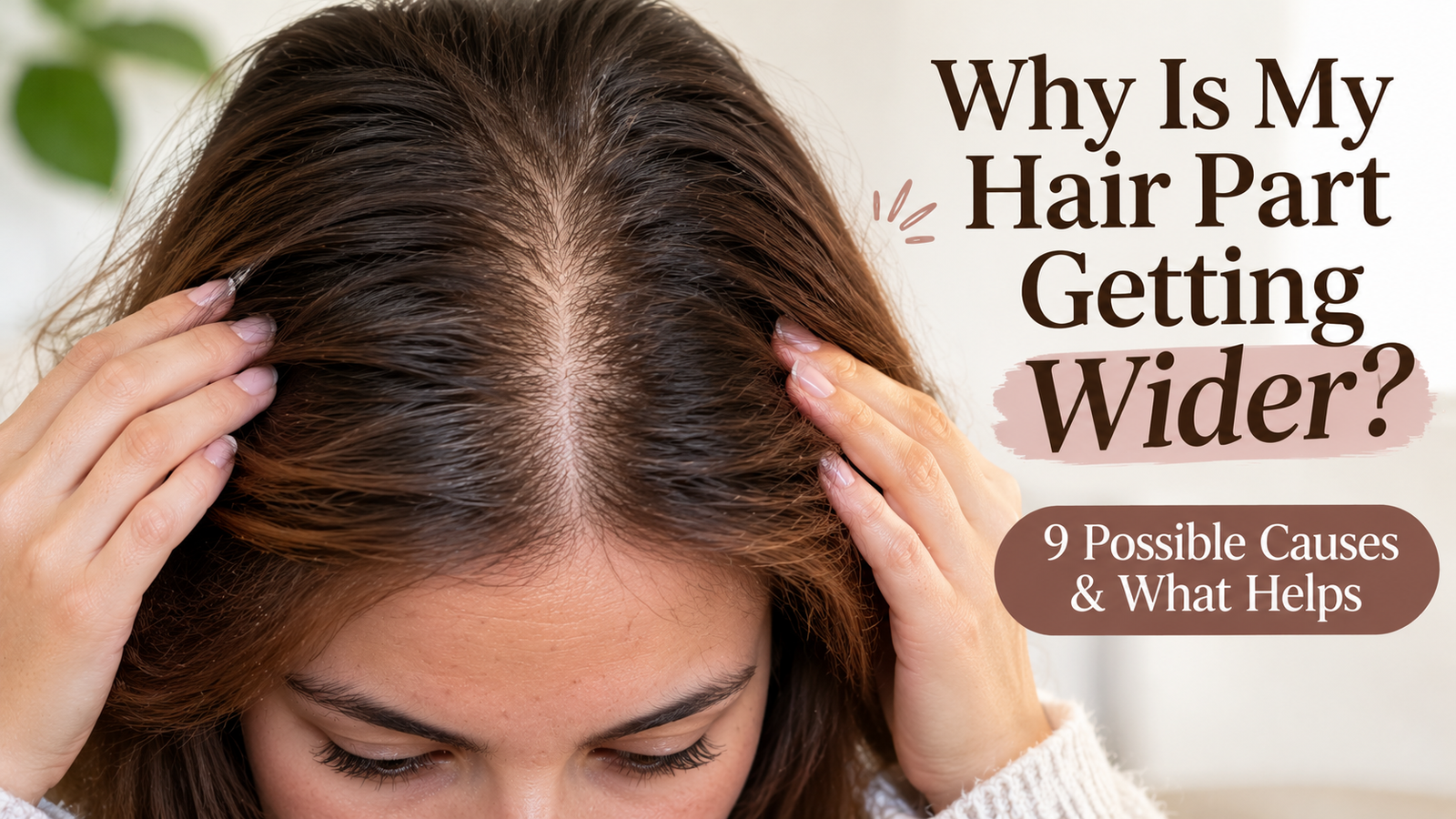
Have you recently looked in the mirror and noticed that your hair part seems wider than it used to be?
Maybe you can see more of your scalp when styling your hair, your center part looks less defined, or your ponytail doesn’t feel as thick as before.
If you’re wondering, “Why is my hair part getting wider?”, you’re not alone.
A widening hair part can be an early sign of hair thinning, particularly in women. However, it doesn’t automatically mean you’re experiencing permanent hair loss.
Changes in your hair part can happen for several reasons, including hereditary hair thinning, temporary shedding, hormonal changes, nutritional deficiencies, and certain scalp conditions.
Even the way you style your hair can make your part appear more noticeable.
The important thing is understanding whether your hair part has genuinely changed over time and what might be causing it.
In this guide, we’ll explore nine possible causes of a widening hair part, early signs of hair thinning, treatment options supported by medical evidence, and practical ways to make your hair look fuller.
What Does a Widening Hair Part Mean?
A widening hair part means that the visible line of scalp between sections of hair appears broader than it did previously.
For some women, the change happens gradually over months or years. For others, it becomes noticeable after a period of increased hair shedding.
You might notice:
- More scalp showing along your center part
- A part that appears wider near the crown
- Reduced hair density on top of your head
- A thinner ponytail
- Less volume at your roots
- More scalp visibility under bright lighting
- Hair that feels less full than it used to
A widening hair part can be associated with female pattern hair loss, but other conditions can produce similar changes.
Important: A naturally wide hair part isn’t necessarily a problem. What matters is whether your hair density or part width is changing compared with your usual appearance.
9 Possible Causes of a Widening Hair Part
1. Female Pattern Hair Loss
Female pattern hair loss, also called female pattern androgenetic alopecia, is one of the most common causes of gradual hair thinning in women.
It often affects the top of the scalp and can make the center part appear progressively wider.
Hair follicles gradually produce finer, shorter hairs, which reduces the overall appearance of density.
Common Signs
- A widening center part
- Gradual thinning over the crown
- Reduced volume on top of the head
- A more noticeable scalp
- A relatively preserved frontal hairline in many cases
Female pattern hair loss can begin before menopause and may become more noticeable with age.
Genetics and hormonal factors can contribute.
What May Help
A dermatologist can evaluate your scalp and discuss treatment options.
Topical minoxidil is an evidence-supported treatment for female pattern hair loss and is available in formulations intended for women.
It usually requires consistent use for several months before benefits can be assessed, and ongoing use is generally needed to maintain results.
Minoxidil isn’t appropriate for everyone, including people who are pregnant or breastfeeding unless specifically advised by their clinician.
Skineza Tip: If your center part has been gradually widening over time, consider getting evaluated early rather than waiting for substantial thinning.
2. Telogen Effluvium (Temporary Excessive Shedding)
Telogen effluvium is a type of hair shedding that can occur after physical or emotional stress on the body.
Normally, hair follicles cycle through growing, resting, and shedding phases.
With telogen effluvium, more hairs than usual enter the resting phase, leading to increased shedding.
Possible Triggers
- Significant illness or fever
- Surgery
- Major emotional stress
- Rapid weight loss
- Restrictive dieting
- Childbirth
- Certain medications
Shedding often becomes noticeable approximately two to three months after a triggering event.
Common Signs
- Increased hair shedding during washing
- More hair collecting in your brush
- Overall reduced hair density
- A thinner ponytail
- Greater scalp visibility
What May Help
When the underlying trigger resolves, hair shedding often improves over time.
However, recovery varies, and some people experience prolonged shedding.
A healthcare professional can help identify potential triggers and determine whether further evaluation is needed.
Skineza Tip: Think about whether you experienced an illness, major stress, or significant dietary change several months before noticing your hair thinning.
3. Hormonal Changes
Hormonal changes can affect hair growth and shedding.
Some women notice changes in hair density during periods of hormonal transition.
These may include:
- Postpartum hormonal changes
- Perimenopause and menopause
- Certain thyroid disorders
- Conditions associated with androgen changes, such as polycystic ovary syndrome (PCOS)
Hormonal changes don’t always cause hair loss, and the pattern depends on the underlying condition.
What May Help
If hair thinning occurs alongside irregular periods, unusual facial hair growth, fatigue, or other symptoms, speak with a healthcare professional.
Testing may be appropriate depending on your symptoms and medical history.
Skineza Tip: Avoid starting hormone supplements or hair-growth medications based only on online advice.
4. Iron Deficiency or Other Nutritional Problems
Adequate nutrition supports normal hair growth.
Iron deficiency, inadequate protein intake, and certain other nutritional problems can contribute to hair shedding in some people.
However, not everyone with a widening hair part has a vitamin deficiency.
Possible Clues
- Increased shedding
- Recent restrictive dieting
- Significant weight loss
- Low dietary protein intake
- Fatigue or other symptoms associated with an underlying deficiency
What May Help
A clinician may recommend blood tests based on your history and symptoms.
If a deficiency is identified, appropriate treatment may help address the underlying problem.
Avoid taking high-dose iron, zinc, selenium, or other supplements without a confirmed need. Excessive intake of certain nutrients can cause harm and may even contribute to hair loss.
Skineza Tip: A balanced diet is more useful than buying multiple hair-growth supplements without knowing whether you need them.
5. Tight Hairstyles and Traction Alopecia
Repeated tension on hair follicles can cause traction alopecia.
This type of hair loss is associated with hairstyles that consistently pull on the hair.
Examples include:
- Very tight ponytails
- Tight braids
- Heavy extensions
- Tightly secured buns
- Hairstyles that create constant pulling
Traction alopecia commonly affects the hairline and temples, but the pattern depends on where tension occurs.
What May Help
- Wear looser hairstyles.
- Avoid painful or tight braids.
- Reduce tension from extensions.
- Change hairstyles regularly.
- Seek dermatologic advice if thinning persists.
Long-standing traction alopecia can lead to permanent follicle damage, so addressing tension early matters.
Skineza Tip: If a hairstyle causes scalp pain, tenderness, or pulling, it is too tight.
6. Thyroid Conditions
The thyroid helps regulate many body processes, including those involved in hair growth.
Both underactive and overactive thyroid conditions can be associated with changes in hair density.
Other Symptoms May Include
- Unusual fatigue
- Changes in weight
- Feeling unusually cold or hot
- Changes in heart rate
- Dry skin
- Menstrual changes
These symptoms can have many causes and aren’t enough to diagnose a thyroid condition.
What May Help
If you notice hair thinning alongside other unexplained symptoms, consult a healthcare professional.
A thyroid blood test may be appropriate based on your medical history.
Skineza Tip: Don’t assume your thyroid is responsible for hair thinning without a medical evaluation.
7. Scalp Inflammation or Skin Conditions
Certain scalp conditions can contribute to shedding or affect hair growth.
Examples include inflammatory scalp disorders and some infections.
Common dandruff or seborrheic dermatitis doesn’t usually cause permanent hair loss by itself, but significant inflammation and scratching can contribute to temporary shedding or breakage.
Warning Signs
- Persistent scalp itching
- Redness or discoloration
- Pain or tenderness
- Heavy scaling
- Pustules
- Patchy hair loss
- Shiny or scarred-looking areas of scalp
What May Help
Seek dermatologic evaluation, particularly if hair loss is accompanied by pain, inflammation, or changes in scalp texture.
Some inflammatory hair-loss conditions can permanently damage follicles if untreated.
Skineza Tip: Hair thinning with scalp pain or inflammation deserves prompt attention rather than repeated home remedies.
8. Hair Breakage and Heat Damage
Sometimes your hair part appears wider because the hair around it is breaking rather than shedding from the root.
Frequent heat styling, chemical processing, and rough handling can weaken hair shafts.
Possible Signs
- Short broken hairs around your part
- Rough or brittle strands
- Split ends
- Uneven hair lengths
- Increased breakage during brushing
What May Help
- Reduce excessive heat styling.
- Use a heat protectant when appropriate.
- Handle wet hair gently.
- Avoid harsh chemical processing.
- Condition your hair regularly.
Haircare can reduce additional breakage, but it cannot permanently repair every form of structural damage to the hair shaft.
Skineza Tip: If you notice many short, uneven strands rather than full-length shed hairs, breakage may be contributing to the appearance of thinning.
9. Normal Hair Parting, Lighting, or Styling Changes
Not every wider-looking hair part indicates a medical problem.
Your scalp may become more visible because of:
- Wet or oily hair
- Bright overhead lighting
- A newly changed parting
- Hair lying flatter than usual
- Styling products that separate strands
- Naturally fine hair
These factors can make an existing part appear wider without an actual loss of hair density.
What May Help
Compare your hair under similar conditions.
Take photographs with the same lighting, hairstyle, and camera angle.
If your part continues to widen over time, consider a professional evaluation.
Skineza Tip: Comparing photographs taken under consistent conditions can be more useful than repeatedly checking your hair under different bathroom lights.
How to Tell If Your Hair Part Is Actually Getting Wider
A single mirror check isn’t always reliable.
If you’re concerned about a widening hair part, try monitoring changes over time.
Step 1: Take a Clear Photograph
Use natural or consistent indoor lighting.
Photograph your hair from above with your usual parting.
Step 2: Keep Your Hair in a Similar Condition
Compare dry hair with dry hair rather than comparing freshly washed hair with oily hair.
Step 3: Use the Same Parting
Changing your part can change how much scalp is visible.
Step 4: Compare Over Several Weeks
Look for a consistent change rather than judging a single photograph.
Step 5: Watch for Other Symptoms
Pay attention to increased shedding, scalp discomfort, or a thinner ponytail.
Photographs can help document changes, but they cannot diagnose the cause of hair loss.
Widening Hair Part vs. Normal Hair Part: What’s the Difference?
| Feature | Normal Hair Part | Possible Hair Thinning |
|---|---|---|
| Width | Relatively consistent over time | Gradually becomes wider |
| Scalp visibility | Similar to your usual appearance | Increasing visibility |
| Hair density | Generally stable | May appear reduced |
| Ponytail thickness | Usually unchanged | May decrease |
| Shedding | Within your usual pattern | May increase |
| Crown appearance | Stable | May become thinner |
A dermatologist may examine the scalp using magnification and recommend additional tests when needed.
Can a Widening Hair Part Grow Back?
Sometimes, yes—but it depends on the cause.
Temporary shedding caused by telogen effluvium may improve after the trigger resolves.
Hair thinning related to certain nutritional or medical problems may also improve when the underlying issue is addressed.
Female pattern hair loss generally requires ongoing management. Treatments such as minoxidil can help some people maintain or improve hair density, but results vary.
Scarring hair-loss conditions may cause irreversible follicle damage.
The most important factor is identifying the cause rather than assuming all hair thinning is reversible.
What Actually Helps a Widening Hair Part?
1. Get an Accurate Diagnosis
A widening hair part can have several causes.
A dermatologist can evaluate your hair-loss pattern, scalp condition, medical history, and possible contributing factors.
2. Discuss Evidence-Based Treatments
For female pattern hair loss, topical minoxidil is a commonly recommended option.
A dermatologist may discuss other treatments depending on your diagnosis, medical history, and pregnancy plans.
Avoid starting prescription medications without medical guidance.
3. Correct Identified Nutritional Deficiencies
If testing confirms a deficiency, appropriate treatment may support recovery.
Taking supplements without a deficiency isn’t a reliable hair-regrowth strategy.
4. Reduce Traction and Breakage
Choose gentle hairstyles and minimize unnecessary pulling.
Use conditioning products to help manage friction and breakage.
5. Manage Scalp Conditions
Persistent inflammation, itching, or scaling should be assessed and treated appropriately.
6. Be Patient With Hair Growth
Hair grows slowly, and changes in density can take months to become noticeable.
A realistic timeline depends on the diagnosis and treatment.
How to Make a Widening Hair Part Look Less Noticeable
While you’re investigating the cause, styling can help your hair appear fuller.
These techniques improve the appearance of volume but do not treat underlying hair loss.
Try a Soft Side Part
Moving your part slightly can help distribute hair differently and reduce visible scalp.
Use a Lightweight Volumizing Product
Root-lifting products may make hair appear fuller without weighing it down.
Avoid Heavy Oils at the Roots
Heavy products can separate strands and make the scalp more visible.
Consider Hair Fibers or Scalp Concealers
Cosmetic hair fibers and scalp powders can temporarily reduce the appearance of sparse areas.
Choose products that suit your scalp and discontinue use if irritation develops.
Choose a Fuller-Looking Haircut
Blunt ends and carefully placed layers may help fine hair look thicker.
Avoid excessive layering if it makes your ends appear sparse.
Can Hair Oil Fix a Widening Hair Part?
Hair oils can help condition the hair shaft, reduce friction, and improve the appearance of dry strands.
However, there isn’t strong evidence that ordinary cosmetic hair oils reliably reverse female pattern hair loss or restore hair follicles damaged by scarring conditions.
Some essential oils may also irritate the scalp, especially when used undiluted.
If your hair part is becoming wider, don’t rely on oiling alone.
Skineza Tip: Hair oil may improve how your hair feels, but treating hair loss requires understanding why the thinning is happening.
When Should You See a Dermatologist?
Consider scheduling an appointment if:
- Your center part is progressively widening.
- You notice significant or persistent shedding.
- Your ponytail is becoming noticeably thinner.
- You have new patchy hair loss.
- Your scalp is painful, inflamed, or heavily scaly.
- Hair loss begins suddenly.
- You have other symptoms that suggest a medical condition.
- Hair thinning is affecting your confidence or daily life.
Seek prompt evaluation for rapidly progressing hair loss, painful scalp inflammation, or signs of scarring.
Early diagnosis can be especially important for conditions that may cause permanent follicle damage.
Frequently Asked Questions
Why is my hair part getting wider all of a sudden?
Sudden changes may be associated with increased shedding, styling differences, or other causes. Telogen effluvium can become noticeable after illness, major stress, childbirth, or rapid weight loss. A healthcare professional can help determine the cause.
Is a widening hair part always a sign of female pattern hair loss?
No. Female pattern hair loss is one possible cause, but temporary shedding, medical conditions, and styling factors can also make your part appear wider.
Can stress make my hair part wider?
Significant physical or emotional stress can trigger telogen effluvium in some people, leading to increased shedding and reduced density.
Can a widening hair part grow back naturally?
Hair density may improve when temporary shedding resolves. However, regrowth depends on the underlying cause, and some forms of hair loss require medical treatment.
Does rosemary oil help a widening hair part?
Evidence for rosemary oil in treating hair loss is limited, and it shouldn’t be considered equivalent to established treatments. It may also irritate the scalp.
Is minoxidil good for a widening hair part?
Topical minoxidil is an evidence-supported treatment for female pattern hair loss. Whether it’s appropriate depends on the diagnosis and individual circumstances.
Can low iron cause a widening hair part?
Iron deficiency may contribute to hair shedding in some people. Testing and treatment should be guided by a healthcare professional.
Does changing my hair part prevent thinning?
Changing your part can alter the appearance of scalp visibility and may reduce repeated styling tension in certain areas. It doesn’t prevent hereditary hair loss.
Can menopause cause a wider hair part?
Hair thinning can become more noticeable around menopause, partly due to age-related and hormonal changes. Other causes should still be considered.
How long does it take to see hair regrowth?
It varies. Temporary shedding may improve over several months, while treatments for female pattern hair loss often require consistent use for several months before results can be assessed.
Final Thoughts
If you’ve been asking yourself, “Why is my hair part getting wider?”, the most important thing to understand is that a wider part can have several different explanations.
Female pattern hair loss, temporary shedding, hormonal changes, nutritional deficiencies, and certain scalp conditions can all affect hair density.
Sometimes, lighting or styling simply makes your scalp more noticeable.
Instead of immediately buying hair-growth oils or supplements, start by documenting the changes and paying attention to other symptoms.
If your part continues to widen, a dermatologist can help identify the cause and recommend appropriate treatment.
A widening hair part doesn’t always mean permanent hair loss—but understanding the cause early can make a meaningful difference.
Medical disclaimer: This article is for educational purposes only and is not a substitute for professional medical advice, diagnosis, or treatment.