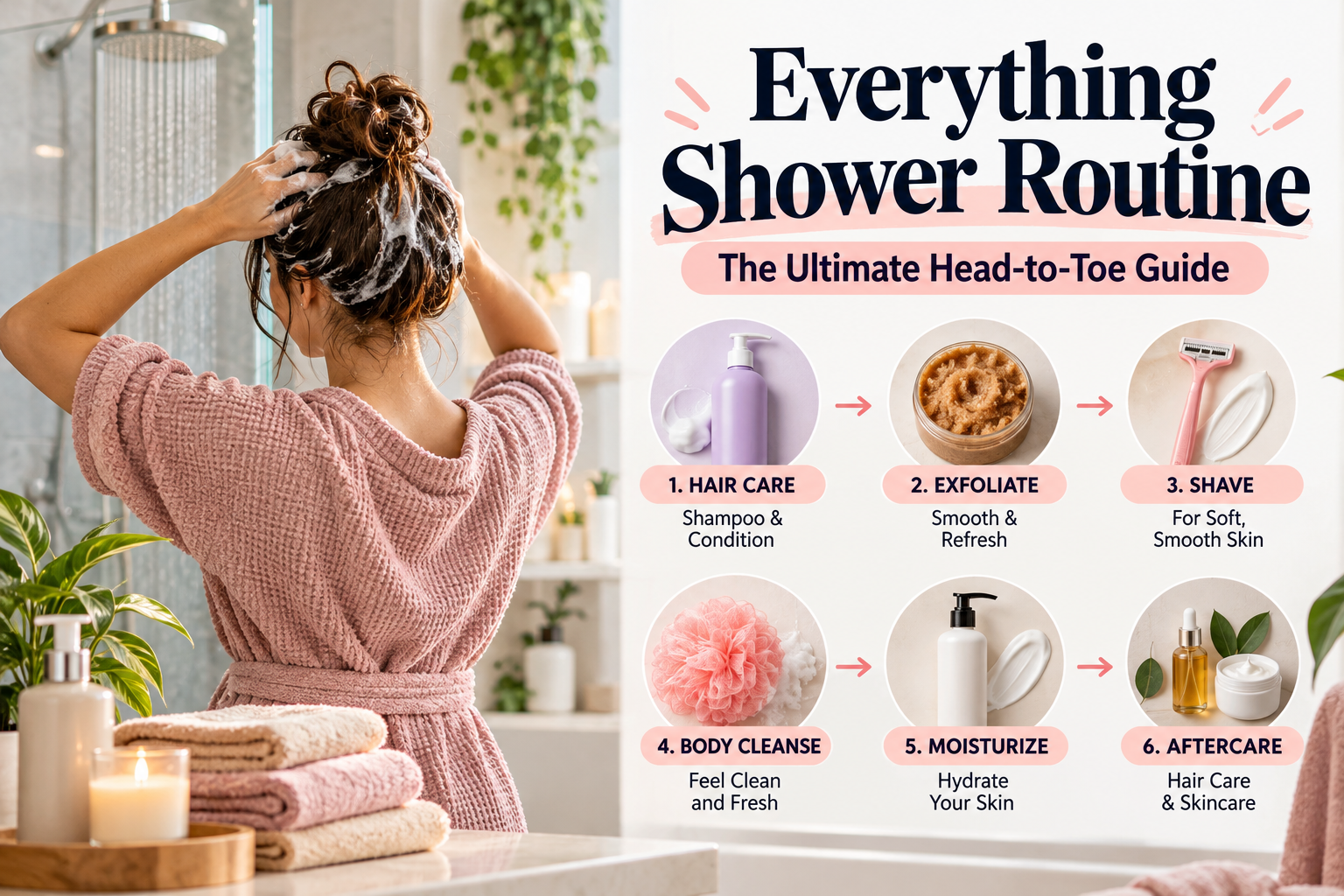
An everything shower routine is more than a quick shampoo-and-rinse. It’s a longer, head-to-toe self-care routine where you take care of your hair, scalp, body, shaving, exfoliation, and post-shower skincare all in one session.
You don’t need to do an everything shower every day. For many people, it’s an occasional reset when they have extra time and want to tackle several grooming and beauty-care steps at once.
But what should you do first—wash your hair, exfoliate, shave, or use body wash?
Below, we’ll break down the everything shower routine in the correct order, from pre-shower preparation to moisturizing your skin afterward.
What Is an Everything Shower?
Your everything shower routine can be customized depending on your hair type, skin concerns, shaving habits, and personal preferences.Depending on your needs, it might include:
- Pre-shower hair treatment
- Shampooing
- Conditioning or a hair mask
- Body cleansing
- Body exfoliation
- Shaving
- Foot care
- A final rinse
- Body moisturizer
- Hair leave-in products
- Facial skincare
Think of it as your regular shower with the optional extras you don’t necessarily have time for every day.
How Often Should You Take an Everything Shower?
There isn’t one schedule that works for everyone. How often you follow an everything shower routine depends on your lifestyle and how frequently your hair and body need each step.
Your ideal frequency depends on your:
- Hair type
- Scalp needs
- Skin type
- Exercise habits
- Shaving routine
- Products
- Personal preferences
You also don’t have to perform every step each time.
For example, you might exfoliate during one everything shower but skip it the next time if your skin feels dry or sensitive.
Everything Shower Routine in the Correct Order
Here’s a simple everything shower routine order you can customize for your hair and skin.
Step 1: Prepare Before Your Shower
Your routine can begin before you turn on the water.
Gather everything you’ll need so you’re not searching for products halfway through your shower.
Depending on your routine, that might include:
- Shampoo
- Conditioner
- Hair mask
- Body wash
- Exfoliating product
- Razor and shaving gel
- Clean towel
- Body lotion
- Hair leave-in treatment
- Facial skincare
This is also a good time to gently detangle your hair if that’s appropriate for your hair type.
Step 2: Apply a Pre-Shampoo Treatment if You Use One
Pre-shampoo treatments are optional.
Depending on your hair needs, you might use a pre-shampoo oil or treatment before washing.
Follow the directions for your specific product, particularly regarding how long it should remain on your hair.
If your hair becomes easily weighed down or oily, you may prefer to skip this step entirely.
Step 3: Start With Warm, Not Extremely Hot, Water
A steaming-hot shower may feel relaxing, but very hot water can contribute to skin dryness and irritation.
Use comfortably warm or lukewarm water instead.
This is particularly helpful if you already have dry or sensitive skin.
Step 4: Shampoo Your Scalp
Wet your hair thoroughly before applying shampoo.
Concentrate shampoo primarily on your scalp and roots, where oil, sweat, and product buildup tend to accumulate.
Massage gently with your fingertips rather than scratching aggressively with your nails.
When you rinse, the shampoo will travel through the lengths of your hair.
Some people may benefit from shampooing twice when there is substantial oil or product buildup, but double shampooing isn’t necessary for everyone.
Step 5: Apply Conditioner or a Hair Mask
After shampooing, apply conditioner mainly through your mid-lengths and ends unless your product says otherwise.
If you’re using a hair mask, this can be a convenient time to apply it.
Leave it on for the amount of time recommended on the label while you continue with other shower steps.
Avoid assuming that leaving a mask on much longer automatically produces better results.
Step 6: Cleanse Your Body
Next, wash your body with a gentle body cleanser.
Focus particularly on areas where sweat and odor tend to accumulate, such as:
- Underarms
- Feet
- Skin folds
- Groin area externally
You don’t need to aggressively scrub your entire body every time you shower.
Use your hands or a clean, gentle washcloth if you prefer.
If you’re prone to dryness, look for a cleanser that leaves your skin comfortable rather than tight or stripped.
Step 7: Exfoliate Your Body if Needed
Exfoliation can help remove excess dead skin cells and improve rough-looking texture. f you’re unsure which type of exfoliating acid to choose, read our AHA vs. BHA guide to understand how they work differently.
There are two common approaches:
Physical exfoliation: washcloths, gentle scrubs or exfoliating tools.
Chemical exfoliation: ingredients such as lactic acid, glycolic acid or salicylic acid.
You don’t necessarily need both at the same time.
Over-exfoliating can cause irritation, dryness and damage to your skin barrier.
If you have rough bumps associated with keratosis pilaris, gentle chemical exfoliation and moisturizing may be preferable to aggressive scrubbing. Exfoliation can be part of an everything shower routine, but it doesn’t need to be included every time you shower.
Step 8: Shave if You Want To
If shaving is part of your everything shower routine, doing it after your skin and hair have been exposed to warm water can help soften the hair.
Apply shaving cream or gel before shaving.
Use a clean, sharp razor and gentle pressure.
Try not to repeatedly pass the razor over the same area.
People prone to ingrown hairs or irritation may find shaving in the direction of hair growth gentler, although it may not provide as close a shave.
If shaving leaves dark dots or rough-looking follicles on your legs, see our guide to how to get rid of strawberry legs.
Step 9: Give Your Feet Some Attention
An everything shower can also be a convenient time for basic foot care.
Wash your feet, including between your toes.
If you have mild roughness, you can gently use an appropriate foot-care tool, but avoid aggressively removing thick or cracked skin.
Persistent cracks, pain, bleeding, or unusual changes should be evaluated by a healthcare professional.
Step 10: Rinse Your Conditioner or Hair Mask
Once your conditioner or mask has been on for the recommended amount of time, rinse it thoroughly.
Make sure product isn’t left sitting unnecessarily on your scalp, back, or shoulders.
If hair products tend to leave residue on your skin, you can do a quick final body rinse afterward.
Step 11: Do a Final Rinse
Rinse away any remaining cleanser, shaving product, exfoliant, conditioner, or hair mask.
You don’t need to finish with freezing-cold water to “close your pores.”
Pores don’t open and close like doors based on water temperature.
Simply use a comfortable temperature.
What to Do After an Everything Shower
Your routine shouldn’t end when you turn off the water.
Post-shower care can be especially important for maintaining comfortable, hydrated skin.
Step 12: Gently Pat Your Skin Dry
Avoid aggressively rubbing your skin with a towel.
Instead, gently pat away excess water.
Leaving your skin slightly damp can also make it a convenient time to apply moisturizer.
Step 13: Apply Body Lotion
Apply body lotion or cream after your shower.
Look for moisturizing ingredients such as:
- Ceramides
- Glycerin
- Hyaluronic acid
- Urea
- Squalane
If you have very dry skin, a richer body cream may feel more comfortable than a lightweight lotion. Ceramides can help support your skin’s natural barrier, so you may want to learn more about the benefits of ceramides for skin.
Step 14: Apply Body Oil if You Like
Body oil is optional.
If you enjoy using one, you can apply it after your moisturizer or use it according to the product directions.
Oil can help reduce water loss from the skin, but it doesn’t necessarily replace a moisturizer containing humectants and other hydrating ingredients.
Step 15: Apply Your Hair Products
Gently remove excess water from your hair.
Depending on your hair type, your post-shower routine might include:
- Leave-in conditioner
- Detangling spray
- Curl cream
- Hair serum
- Heat protectant
Avoid aggressive towel rubbing, which can increase friction and tangling.
If you’re going to use heated styling tools, apply an appropriate heat protectant according to its directions.
Step 16: Complete Your Facial Skincare Routine
Now you can move on to your face.
A simple routine might include:
Cleanser → Treatment → Moisturizer
During the daytime, finish with broad-spectrum sunscreen.
If you’re unsure about layering skincare, see our guide to the correct order to apply skincare products.
Everything Shower Checklist
Here’s the complete routine in an easy-to-save order:
BEFORE THE SHOWER
- Gather your products
- Detangle hair if appropriate
- Apply optional pre-shampoo treatment
IN THE SHOWER
- Wet your hair and skin
- Shampoo your scalp
- Apply conditioner or hair mask
- Wash your body
- Exfoliate if needed
- Shave if desired
- Clean your feet
- Rinse your conditioner or mask
- Final rinse
AFTER THE SHOWER
- Pat skin dry
- Apply body moisturizer
- Apply optional body oil
- Apply leave-in hair products
- Complete your facial skincare routine
Save this checklist for your next everything shower.
Should You Exfoliate Before or After Shaving?
In general, gentle exfoliation before shaving can help remove excess dead skin and may help prepare the area for shaving.
However, you don’t need aggressive exfoliation immediately before running a razor over your skin.
If you’re using a strong chemical exfoliant or have sensitive skin, separating exfoliation and shaving may reduce irritation.
This is especially important if you’re prone to:
- Razor burn
- Ingrown hairs
- Strawberry legs
- Dryness
- Sensitive skin
We’ll cover exfoliating before or after shaving in more detail in a separate Skineza guide.
Should You Wash Your Body Before or After Your Hair?
For an everything shower, washing your hair first can be practical.
Shampoo, conditioner and hair masks may run down your neck, shoulders, chest and back.
Cleansing your body afterward helps remove leftover hair-product residue.
If you’re using a hair mask for several minutes, however, you can cleanse your body while the mask sits and perform a quick final rinse after washing it out.
Everything Shower Routine for Dry Skin
If you have dry skin, keep your routine gentle.
Consider:
- Using lukewarm rather than very hot water
- Choosing a gentle cleanser
- Limiting aggressive exfoliation
- Using exfoliating acids carefully
- Applying moisturizer soon after showering
- Using a richer body cream when needed
Long, hot everything showers may feel luxurious but can leave some people’s skin feeling even drier.
Everything Shower Routine for Rough and Bumpy Skin
If you’re dealing with rough or bumpy body skin, resist the urge to scrub harder.
Conditions such as keratosis pilaris can create tiny rough bumps that won’t simply wash away.
Instead, gentle moisturizing and appropriately formulated products containing ingredients such as lactic acid, salicylic acid, or urea may help.
Read our complete guide to keratosis pilaris if you have persistent chicken-skin-like bumps.
Everything Shower Routine for Strawberry Legs
If strawberry legs are one of your concerns, pay particular attention to shaving and exfoliation.
A simple routine might look like:
Warm water → Gentle cleanse → Appropriate exfoliation → Shaving cream → Careful shave → Rinse → Moisturizer
Avoid harsh scrubbing or repeatedly shaving over the same spot.
Our Strawberry Legs guide explains the possible causes and 10 things that may help.
Common Everything Shower Mistakes
Using Water That’s Too Hot
Very hot water can worsen dryness for some people.
Scrubbing Too Hard
Your skin doesn’t need to feel “squeaky clean.”
Using Multiple Exfoliants Together
Combining a body scrub, exfoliating glove, glycolic acid, and salicylic acid isn’t automatically better.
Shaving With a Dull Razor
A dull razor can increase friction and irritation.
Skipping Moisturizer
Post-shower moisturizing is particularly useful if your skin feels dry or tight.
Using Too Many Products
An everything shower doesn’t mean you need 20 products.
Customize the routine to what your hair and skin actually need.
Do You Need an Everything Shower Every Day?
No.
Your regular shower can be much simpler.
For example:
Regular shower:
Hair wash when needed → Body cleanse → Rinse → Moisturize
Everything shower:
Hair treatment → Shampoo → Hair mask → Body cleanse → Exfoliation → Shaving → Foot care → Moisturizer → Hair care → Skincare
An everything shower is simply a convenient way to combine your longer grooming routine.
Frequently Asked Questions
What is an everything shower?
An everything shower is an extended head-to-toe shower routine that can include hair washing, conditioning, exfoliating, shaving, body cleansing, moisturizing, and other grooming steps.
What is the correct everything shower routine order?
A practical order is pre-shower hair care, shampoo, conditioner or hair mask, body cleansing, optional exfoliation, shaving, final rinse, body moisturizer, hair products, and facial skincare.
How often should I take an everything shower?
There is no universal schedule. How often you need one depends on your hair, skin, shaving routine, lifestyle, and personal preference.
Should I exfoliate before shaving?
Gentle exfoliation before shaving may help remove excess dead skin, but aggressive exfoliation immediately before shaving can irritate sensitive skin.
Do I use body scrub before or after body wash?
There isn’t a strict rule for every product. Generally, cleanse first and exfoliate afterward, but always follow the directions for your specific exfoliating product.
Should I moisturize after every shower?
Applying moisturizer after showering can be particularly helpful for dry skin because it helps reduce moisture loss and supports the skin barrier.
How long should an everything shower take?
There is no required duration. Take enough time to complete the steps you need without staying under hot water longer than necessary.
Final Thoughts
An everything shower routine doesn’t have to be complicated or involve a bathroom full of products.
The key is following a sensible head-to-toe order:
Hair → Body cleanse → Exfoliate → Shave → Rinse → Moisturize → Hair care → Skincare
Customize the steps based on your skin, hair, and grooming needs, and skip anything you don’t need.
Most importantly, don’t turn an everything shower into an over-exfoliation session. Gentle, consistent care is usually better than aggressively scrubbing your skin in pursuit of instant smoothness.