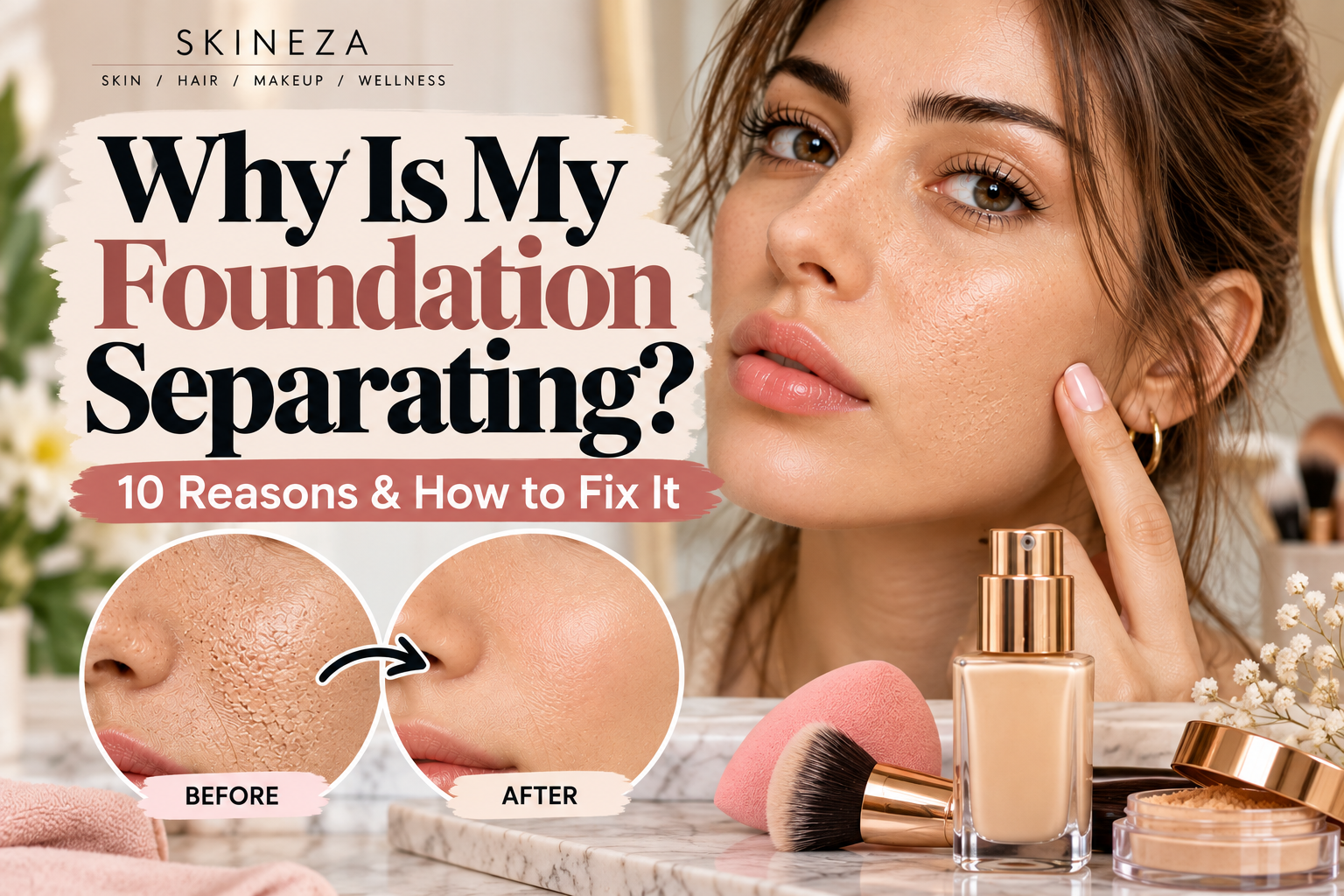
You apply your foundation in the morning and everything looks smooth. A few hours later, you notice it breaking apart around your nose, becoming patchy on your cheeks, or disappearing from oily areas.
So, why is my foundation separating?
Foundation can separate when your skincare, sunscreen, primer, foundation, powder, skin type, or application technique aren’t working well together. Excess oil, dry patches, too much product, and repeatedly touching up your makeup can also contribute.
The good news is that foundation separating doesn’t always mean you need to buy a new foundation. Sometimes a few small changes to your skin prep and application technique can make a noticeable difference.
Here are 10 common reasons foundation separates—and what you can do about each one.
What Does Foundation Separating Look Like?
Foundation separation happens when your base no longer looks smooth and even across the skin.
You may notice:
- Foundation breaking apart around your nose
- Patchy areas on your cheeks or chin
- Foundation disappearing from oily areas
- Small dots of product around pores
- Makeup gathering in lines
- Uneven or blotchy coverage
- Foundation sliding around your face
- Areas where your natural skin suddenly shows through
Foundation separation can sometimes look similar to cakey makeup, but they’re not exactly the same.
Cakey makeup tends to look thick, dry, or overly layered, while separated foundation often looks like the product is breaking apart or moving away from certain areas.
Why Is My Foundation Separating? 10 Common Reasons
1. Your Skin Is Producing Excess Oil
Oil is one of the most common reasons foundation can begin breaking apart throughout the day.
This is particularly noticeable around the:
- Nose
- Forehead
- Chin
- T-zone
As sebum accumulates, some foundation formulas may begin moving or separating.
How to Fix It
Start with skincare appropriate for your skin type.
Avoid applying unnecessarily heavy layers underneath your foundation.
If you become oily during the day, gently blot excess oil before adding more powder.
You may also prefer a lightweight or longer-wearing foundation formulated for oily or combination skin.
2. Your Skin Is Too Dry or Flaky
Foundation separation isn’t limited to oily skin.
Dry, flaky skin can also make foundation appear patchy because makeup may cling unevenly to rough areas.
How to Fix It
Apply an appropriate moisturizer before makeup and give it time to settle.
If your skin frequently feels tight or flaky even after moisturizing, addressing the underlying dryness may improve how your foundation looks.
Avoid aggressively scrubbing dry patches immediately before applying makeup.
3. You’re Applying Too Much Skincare Before Foundation
A complicated morning skincare routine isn’t always better for makeup.
Layering multiple:
- Serums
- Oils
- Moisturizers
- Sunscreens
- Primers
can sometimes make it more difficult for foundation to sit evenly.
How to Fix It
Try simplifying your pre-makeup routine.
For example:
Cleanser → Serum if needed → Moisturizer → Sunscreen → Makeup
You don’t need to use every skincare product you own underneath foundation.
4. You’re Not Letting Your Skincare Set
Applying foundation immediately after moisturizer or sunscreen can sometimes disturb the products underneath.
Your base may slide around instead of applying evenly.
How to Fix It
Give your skincare and sunscreen some time to settle before starting your makeup.
There isn’t one mandatory waiting time that works for every product. The goal is simply to let your skincare form an even layer rather than applying foundation while everything still feels excessively wet or slippery.
5. Your Primer and Foundation Aren’t Layering Well
People often hear that they must perfectly match “water-based” foundation with “water-based” primer or “silicone-based” foundation with silicone primer.
In reality, cosmetic formulations are more complicated than that. Many products contain combinations of water, silicones, oils, emulsifiers, film-forming ingredients, and other components.
Still, certain primer-foundation combinations simply don’t layer well together.
How to Fix It
If you’re experiencing foundation separation, test your foundation without primer.
Try:
Moisturizer → Sunscreen → Foundation
If your foundation suddenly performs better, the primer or the interaction between layers may have been contributing.
You can then experiment with a different primer if you actually need one.
6. You’re Applying Too Much Foundation
Applying more foundation doesn’t necessarily create better coverage.
A thick layer has more product available to move, crease, gather around pores, or separate throughout the day.
How to Fix It
Start with a small amount.
Apply a thin layer and blend it thoroughly.
Then add extra coverage only where necessary.
You can use concealer on individual blemishes or areas of discoloration instead of adding another full layer of foundation.
7. You’re Using Too Much Powder
Powder can help set foundation and manage shine, but excessive powder can create its own problems.
It may make certain areas appear dry, textured, heavy, or patchy.
How to Fix It
Powder strategically.
Instead of heavily powdering your entire face, concentrate on areas where your makeup tends to move.
For many people, that’s the:
- Forehead
- Nose
- Chin
- Under-eye area
Use a light layer and add more only if necessary.
8. Your Foundation Doesn’t Suit Your Skin or Environment
Foundation formulas behave differently depending on your skin and surroundings.
A rich, luminous foundation may move more easily on very oily skin, while an extremely matte formula may emphasize dry areas.
Heat and humidity can also affect how makeup wears.
How to Fix It
Consider your:
Skin type: dry, oily, combination, or normal.
Preferred finish: matte, natural, satin, or dewy.
Coverage: light, medium, or full.
Environment: hot, humid, dry, or cold.
You may find that one foundation works beautifully during winter but performs differently during a hot summer.
If you prefer lighter coverage, read our guide to Skin Tint vs. Foundation.
9. Your Application Technique Is Disturbing the Base
Aggressively rubbing foundation across your face can move the skincare and sunscreen underneath.
The same thing can happen when repeatedly going over an area with a brush or sponge.
How to Fix It
Apply foundation in thin sections.
Depending on the formula, you can experiment with:
A damp makeup sponge for a lighter, blended finish.
A foundation brush for controlled coverage.
Your fingers for certain lightweight foundations and skin tints.
Instead of continuously rubbing, try gentle blending, pressing, or stippling motions where appropriate.
10. You’re Touching Up Incorrectly
After several hours, you notice your nose getting shiny.
So you apply more foundation.
Then more powder.
Then another layer later.
Eventually, your makeup begins breaking apart.
How to Fix It
Don’t immediately add more makeup over excess oil.
Instead:
Step 1: Gently blot excess oil.
Step 2: Assess whether you actually need additional foundation.
Step 3: Blend any separated areas.
Step 4: Add a tiny amount of foundation or concealer only where coverage has disappeared.
Step 5: Apply a light amount of powder if necessary.
This helps avoid excessive product buildup.
Why Is My Foundation Separating on My Nose?
The nose is one of the most common areas for foundation separation.
That’s because it can have:
- Higher oil production
- More visible pores
- Frequent touching
- Movement around the nostrils
- Product buildup
You may get better results by applying less foundation around your nose.
Use a thin layer and gently press it into the skin.
Then apply a small amount of powder if needed.
Avoid repeatedly adding foundation and powder throughout the day.
Why Is My Foundation Separating Around My Mouth?
Foundation can also become uneven around the mouth and chin.
These areas move constantly when you:
- Talk
- Eat
- Drink
- Smile
Dryness can also be more noticeable around the mouth.
Use thin layers of foundation and avoid applying excessive powder to areas that already look dry.
Why Is My Foundation Separating on Dry Skin?
Dry skin can create an uneven surface for makeup.
If foundation catches on flaky areas, it can appear patchy or separated.
Before makeup:
- Cleanse gently.
- Apply moisturizer.
- Apply sunscreen.
- Allow your skincare to settle.
- Apply a thin layer of foundation.
If persistent dryness is the problem, fixing your skincare routine may be more useful than continuously changing foundation.
Why Is My Foundation Separating on Oily Skin?
If your skin produces significant oil throughout the day, foundation may gradually move or break apart.
Try:
Morning skincare:
Lightweight Moisturizer → Sunscreen
Makeup:
Optional Primer → Thin Foundation Layer → Strategic Powder
During the day, blot excess oil before adding powder.
Don’t try to eliminate all natural oil from your skin with harsh cleansers or excessive exfoliation.
Why Is My Foundation Separating Even With Primer?
Primer isn’t a guarantee against foundation separation.
The problem could still be:
- Excessive skincare underneath
- Your sunscreen
- Too much primer
- Too much foundation
- Excess oil
- Dry patches
- The primer-foundation combination
- Your application technique
Try applying your foundation without primer for one day.
If it wears better, you may not need primer—or that particular primer may not work well with your current routine.
Why Is My Foundation Separating After a Few Hours?
Foundation can look perfect immediately after application and change as the day progresses.
Several factors can contribute:
- Sebum production
- Sweat
- Heat
- Humidity
- Facial movement
- Touching your face
- Product buildup
- Long wear time
This doesn’t necessarily mean you applied your makeup incorrectly.
No foundation remains completely unchanged forever.
How to Fix Separated Foundation Without Starting Over
If your makeup is already separating, you don’t necessarily have to remove everything.
Step 1: Don’t Add More Powder Yet
Adding powder directly over separated makeup can sometimes make the area look heavier.
Step 2: Blot Excess Oil
If the area is oily, gently blot it first.
Step 3: Reblend the Foundation
Use a clean makeup sponge and gently press over the separated area.
This can redistribute existing product.
Step 4: Add a Tiny Amount of Product
If coverage has disappeared, apply a very small amount of foundation or concealer.
Focus only on the problem area.
Step 5: Set Lightly
If necessary, use a small amount of powder.
Avoid rebuilding several thick layers.
How to Stop Foundation From Separating
A simple routine often works better than an overloaded one.
Try this approach:
Step 1: Prepare Your Skin
Use skincare appropriate for your skin type.
Step 2: Moisturize
Even oily skin may benefit from an appropriate moisturizer.
Step 3: Apply Sunscreen
Use a broad-spectrum, water-resistant sunscreen with SPF 30 or higher.
Step 4: Let Your Skincare Settle
Don’t immediately cover very wet skincare with foundation.
Step 5: Use Primer Only If You Need It
Primer can be helpful, but it isn’t mandatory.
Step 6: Apply a Thin Layer of Foundation
Build coverage gradually.
Step 7: Conceal Strategically
Add concealer only where you need extra coverage.
Step 8: Powder Where Needed
You don’t necessarily need powder everywhere.
Foundation Separating vs. Cakey Foundation
These problems can look similar.
Foundation Separating
The foundation appears to break apart, move, become patchy, or disappear from certain areas.
Cakey Foundation
The makeup appears thick, dry, heavy, or excessively textured.
You can also experience both at the same time.
For example, your T-zone might separate because of excess oil while your cheeks look cakey because they’re dry.
If heaviness and texture are your main problem, read our guide on Why Does My Makeup Look Cakey?
Does Setting Spray Stop Foundation From Separating?
Setting spray may help improve makeup wear depending on the formula, but it won’t necessarily fix an underlying problem.
If your foundation is separating because of excessive product, incompatible layers, significant oiliness, or dry patches, setting spray alone may not solve it.
Think of setting spray as one optional part of your routine—not a substitute for good skin preparation and application.
Common Foundation Mistakes to Avoid
Avoid these common habits:
- Applying very thick layers
- Using too much primer
- Applying foundation over skincare that hasn’t settled
- Excessively powdering your face
- Aggressively rubbing foundation
- Adding powder directly over heavy oil
- Constantly touching your face
- Trying multiple new products simultaneously
Changing one thing at a time makes it easier to identify what’s causing the problem.
Frequently Asked Questions
Why is my foundation separating?
Foundation may separate because of excess oil, dry skin, too many skincare layers, incompatible product combinations, too much foundation or powder, or application technique.
How do I stop my foundation from separating?
Prepare your skin appropriately, allow skincare to settle, apply thin layers of foundation, powder strategically, and blot excess oil before touching up.
Why does my foundation separate around my nose?
The nose often produces more oil and has visible pores. Applying too much foundation or repeatedly touching and powdering the area can make separation more noticeable.
Why does my foundation separate even with primer?
Primer isn’t always necessary. Your primer may not layer well with your skincare, sunscreen, or foundation, or another part of your routine may be causing the separation.
Why does my foundation separate after a few hours?
Oil, sweat, heat, humidity, facial movement, and product buildup can all affect foundation as the day progresses.
Can dry skin make foundation separate?
Yes. Foundation may cling unevenly to dry or flaky areas, creating a patchy or separated appearance.
Can too much moisturizer make foundation separate?
Applying a heavy layer of moisturizer—or foundation before your skincare has settled—may affect how some foundations apply and wear.
Should I use powder if my foundation separates?
Powder can help control shine, but use it sparingly. If excess oil is present, blot first rather than immediately layering powder over it.
Final Thoughts
If you’ve been wondering “why is my foundation separating?”, don’t assume your foundation is automatically the problem.
The cause could be your skin preparation, sunscreen, primer, amount of foundation, powder, application technique, skin type, or even the weather.
Start by simplifying your routine.
Use appropriate skincare, let your products settle, apply foundation in thin layers, powder only where needed, and blot excess oil before touching up.
And if your foundation looks more thick and dry than separated, the problem may actually be cakey makeup rather than separation.
2 thoughts on “Why Is My Foundation Separating? 10 Reasons & How to Fix It”