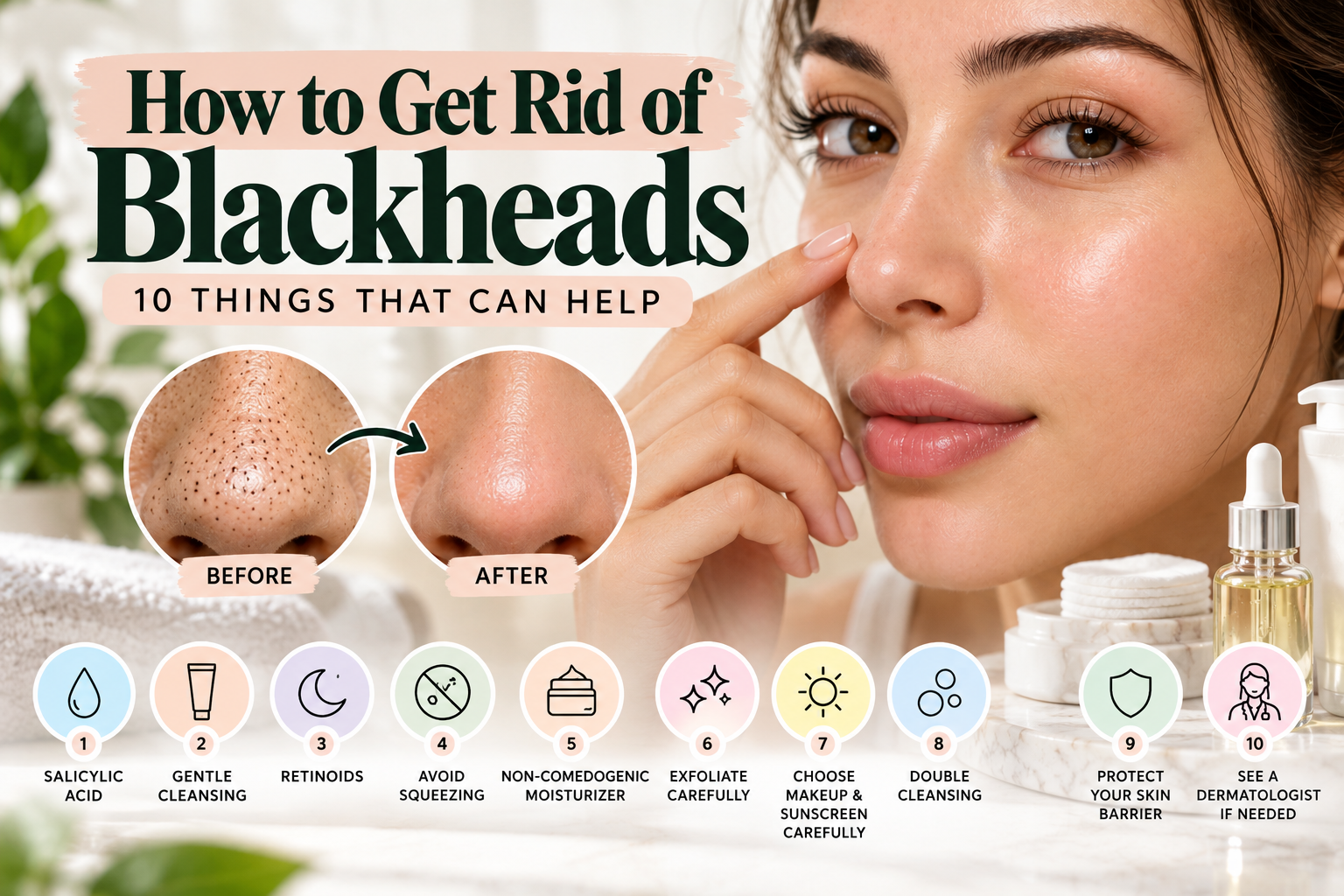
Blackheads are one of the most common skin concerns, especially around the nose, chin, and forehead. They may look like tiny dark dots, but they aren’t caused by dirt trapped inside your pores.
If you’re wondering how to get rid of blackheads, the key is using ingredients and skincare habits that help keep pores clear without aggressively squeezing, scrubbing, or stripping your skin.
Salicylic acid, retinoids, gentle cleansing, and consistent skincare may help reduce existing blackheads and make new ones less likely to form.
Below, we’ll cover what causes blackheads, how to remove blackheads safely, and 10 things that can help keep your pores looking clearer.
What Are Blackheads?
Blackheads are a type of acne lesion known as open comedones.
They develop when a pore becomes clogged with a mixture of:
- Sebum (skin oil)
- Dead skin cells
- Keratin and other debris
Unlike whiteheads, the top of a blackhead remains open.
When the material inside the pore is exposed to air, it oxidizes and becomes darker. That’s why blackheads appear black or dark brown.
The dark color does not mean your skin is dirty.
What Causes Blackheads?
Several factors can contribute to blackheads, including:
- Excess oil production
- Dead skin cell buildup
- Acne-prone skin
- Hormonal changes
- Certain cosmetics or skincare products
- Inadequate removal of makeup and sunscreen
- Genetics
Blackheads commonly develop on oilier areas of the face, particularly the nose, chin, and forehead. Blackheads are closely related to pore congestion. Learn more about how to get rid of clogged pores and the skincare ingredients that may help.
How to Get Rid of Blackheads: 10 Things That Can Help
1. Try Salicylic Acid
Salicylic acid is one of the most useful over-the-counter ingredients for blackheads.
It’s a beta hydroxy acid (BHA) that can help exfoliate within oily pores and reduce the buildup that contributes to clogged pores.
You can find salicylic acid in:
- Cleansers
- Toners
- Serums
- Leave-on exfoliants
- Acne treatments
If you’re new to salicylic acid, start gradually rather than using several salicylic acid products at once.
People with sensitive or dry skin may need less frequent use.
If you’d like to understand how BHA differs from other exfoliating acids, read our guide to AHA vs. BHA.
2. Cleanse Your Face Gently
A consistent cleansing routine can help remove excess oil, sunscreen, makeup, sweat, and other material from the skin’s surface.
However, washing your face repeatedly throughout the day won’t necessarily remove blackheads faster.
Over-cleansing can leave skin feeling dry and irritated.
For most people, cleansing in the morning and evening with a gentle cleanser is enough.
If you wear makeup or water-resistant sunscreen, make sure it is thoroughly removed at the end of the day.
3. Consider a Retinoid
Retinoids can help normalize skin-cell turnover and reduce the formation of comedonal acne, including blackheads and whiteheads.
Over-the-counter adapalene is one option used for acne in the U.S.
Retinoids can initially cause:
- Dryness
- Peeling
- Redness
- Irritation
Start according to product directions and avoid introducing several irritating active ingredients at the same time.
Retinoids should also be discussed with a healthcare professional if you’re pregnant, trying to become pregnant, or breastfeeding.
If you’re new to retinoids, our Retinol for Beginners guide explains how retinoids fit into a skincare routine.
4. Avoid Squeezing Blackheads
It can be tempting to squeeze a visible blackhead, especially one on your nose.
But repeatedly squeezing or picking at your skin can cause:
- Irritation
- Redness
- Skin damage
- Post-inflammatory discoloration
- Potential scarring
It may also fail to remove the entire blockage.
If you have stubborn blackheads that you want extracted, consider having the procedure performed by a qualified dermatologist or appropriately licensed skincare professional.
5. Use a Non-Comedogenic Moisturizer
Having oily or blackhead-prone skin doesn’t mean you should skip moisturizer.
Drying your skin aggressively isn’t an effective long-term strategy for controlling blackheads.
Instead, choose a moisturizer suitable for your skin type.
If you’re prone to clogged pores, you may prefer products labeled:
Non-comedogenic
This generally means the product is formulated with acne-prone skin in mind, although no label can guarantee that a product will work perfectly for every person.
6. Exfoliate Carefully
Exfoliation can help remove excess dead skin cells, but more exfoliation isn’t necessarily better.
Chemical exfoliants such as salicylic acid are often more useful for blackhead-prone skin than aggressive physical scrubs.
Avoid repeatedly combining multiple strong exfoliating products.
For example, using an exfoliating cleanser, acid toner, exfoliating serum, and facial scrub in the same routine may lead to irritation.
If you’re already dealing with congestion, read our guide on how to get rid of clogged pores.
7. Choose Makeup and Sunscreen Carefully
If you’re prone to blackheads, pay attention to how your skin responds to makeup, sunscreen, and other leave-on products.
Look for products designed for your skin type and consider non-comedogenic formulas if acne is a concern.
But don’t skip sunscreen because you’re worried about clogged pores.
Daily sun protection remains important.
Look for a broad-spectrum, water-resistant SPF 30 or higher that feels comfortable on your skin.
8. Try Double Cleansing When Necessary
Double cleansing can be useful if you regularly wear:
- Heavy makeup
- Long-wear foundation
- Water-resistant sunscreen
The first cleanse helps remove makeup and sunscreen, while the second cleanser cleans the skin.
However, you don’t have to double cleanse simply because you have blackheads.
If a single gentle cleanser effectively removes your products, that’s perfectly reasonable.
9. Protect Your Skin Barrier
Trying to eliminate blackheads too aggressively can leave your skin irritated.
Using too many acids, scrubs, masks, or acne treatments can compromise your skin barrier.
Signs of irritation may include:
- Burning
- Stinging
- Redness
- Flaking
- Tightness
- Increased sensitivity
If this happens, reduce irritating active ingredients and focus on gentle cleansing, moisturizing, and sun protection.
Our guide on how to repair a damaged skin barrier explains how to simplify your routine when your skin becomes irritated.
10. See a Dermatologist for Persistent Blackheads
Sometimes a good skincare routine isn’t enough.
If you have persistent or severe blackheads, inflammatory acne, painful breakouts, or scarring, consider seeing a board-certified dermatologist.
A dermatologist can determine whether you’re actually dealing with blackheads and recommend appropriate treatments.
They may also perform professional comedone extraction when appropriate.
How to Get Rid of Blackheads on Your Nose
The nose is one of the most common places to notice dark dots.
A simple routine for blackheads on the nose might include:
Morning:
Gentle Cleanser → Moisturizer → Sunscreen
Evening:
Cleanser → Salicylic Acid or Appropriate Acne Treatment → Moisturizer
Avoid squeezing your nose every day or aggressively using pore tools.
There’s another important point: not every dark dot on your nose is a blackhead.
Some may be sebaceous filaments.
Blackheads vs. Sebaceous Filaments
Blackheads and sebaceous filaments can look similar, particularly on the nose.
Blackheads are open comedones caused by clogged pores.
Sebaceous filaments are normal structures that help move sebum through the pore.
Sebaceous filaments commonly appear as small gray, yellowish, or skin-colored dots distributed relatively evenly across the nose.
You can sometimes make them less noticeable, but trying to permanently “remove” normal sebaceous filaments isn’t realistic because they naturally refill.
How to Get Rid of Blackheads on Your Chin
Blackheads can also appear around the chin.
The same general principles apply:
- Cleanse gently
- Consider salicylic acid
- Use appropriate acne treatments
- Moisturize
- Avoid picking
- Use sunscreen
If you’re experiencing inflammatory acne around the chin and jawline rather than just blackheads, the cause and treatment approach may be different.
Is Salicylic Acid Good for Blackheads?
Yes. Salicylic acid for blackheads is one of the most commonly recommended over-the-counter options.
Because salicylic acid is oil-soluble, it can work within oily pores and help reduce the buildup of dead skin cells.
However, it won’t permanently eliminate pores or prevent every future blackhead.
Consistency is more important than aggressive treatment.
Do Pore Strips Remove Blackheads?
Pore strips can temporarily remove some material from the surface of pores.
This can make the nose appear smoother immediately afterward.
However, pore strips don’t address the underlying factors that cause blackheads, so the effect is usually temporary.
They can also irritate some people’s skin.
A consistent skincare routine is generally more useful for long-term blackhead management.
Can You Permanently Get Rid of Blackheads?
There isn’t a realistic way to guarantee that you’ll permanently get rid of blackheads.
Your skin continuously produces oil and sheds dead skin cells.
The goal should be to:
- Reduce existing blackheads
- Keep pores clearer
- Reduce new comedones
- Maintain a healthy skin barrier
Blackheads can return if you’re naturally prone to them.
What Not to Do With Blackheads
Avoid trying every viral blackhead hack you see online.
In particular, be cautious with:
Harsh Facial Scrubs
Scrubbing harder doesn’t clean deeper into your pores and may irritate your skin.
Constant Squeezing
Repeated extraction can damage your skin.
DIY Baking Soda Treatments
Baking soda isn’t necessary for treating blackheads and may irritate your skin.
Lemon Juice
Applying lemon juice directly to your face can cause irritation and isn’t a good substitute for properly formulated skincare.
Overusing Acids
Using more exfoliating acid won’t necessarily give you clearer skin faster.
It may simply damage your skin barrier.
Simple Skincare Routine for Blackheads
You don’t need a complicated 10-step routine.
Morning
1. Gentle cleanser
Remove excess oil and sweat.
2. Moisturizer
Choose one appropriate for your skin type.
3. Sunscreen
Use broad-spectrum, water-resistant SPF 30 or higher.
Evening
1. Cleanser
Remove makeup, sunscreen, oil, and debris.
2. Blackhead treatment
Consider salicylic acid or an appropriate retinoid based on your skin needs.
3. Moisturizer
Finish with a moisturizer that supports your skin barrier.
Don’t introduce salicylic acid, retinoids, and several other strong actives all at once.
How Long Does It Take to Get Rid of Blackheads?
Blackheads generally won’t disappear overnight.
The time required depends on:
- How many blackheads you have
- Your skin type
- The treatment you’re using
- How consistently you use it
- Whether other forms of acne are present
Skincare treatments usually require consistent use before meaningful improvement becomes visible.
If your blackheads aren’t improving despite an appropriate routine, a dermatologist can help determine the next step.
Frequently Asked Questions
What is the best way to get rid of blackheads?
A gentle skincare routine combined with evidence-based acne ingredients such as salicylic acid or appropriate retinoids can help manage blackheads. The best approach depends on your skin and other acne concerns.
How do you remove blackheads from your nose?
Avoid aggressive squeezing. Salicylic acid, appropriate retinoids, gentle cleansing, and professional extraction when needed can help manage blackheads on the nose.
Does salicylic acid remove blackheads?
Salicylic acid can help reduce blackheads by exfoliating within oily pores and reducing the buildup that contributes to comedones.
Should you squeeze blackheads?
It’s generally better to avoid repeatedly squeezing blackheads yourself because it can irritate or damage the skin.
Why do my blackheads keep coming back?
Your skin naturally continues to produce oil and shed skin cells. If you’re prone to clogged pores, blackheads can recur even after they’ve improved.
Are blackheads caused by dirty skin?
No. Blackheads are caused by clogged pores, and their dark appearance comes from oxidation—not dirt.
Are the dots on my nose actually blackheads?
Not necessarily. Many small, evenly distributed dots on the nose are sebaceous filaments rather than true blackheads.
Final Thoughts
Learning how to get rid of blackheads doesn’t require harsh scrubbing, constant squeezing, or an overloaded skincare routine.
A consistent approach is usually better.
Gentle cleansing, salicylic acid for blackheads, an appropriate retinoid, moisturizer, and daily sunscreen can help keep pores clearer while protecting your skin barrier.
And remember: perfectly poreless skin isn’t a realistic goal. Pores are normal structures in healthy skin.
If your blackheads are persistent, severe, or accompanied by inflammatory acne or scarring, consider seeing a dermatologist for personalized treatment.