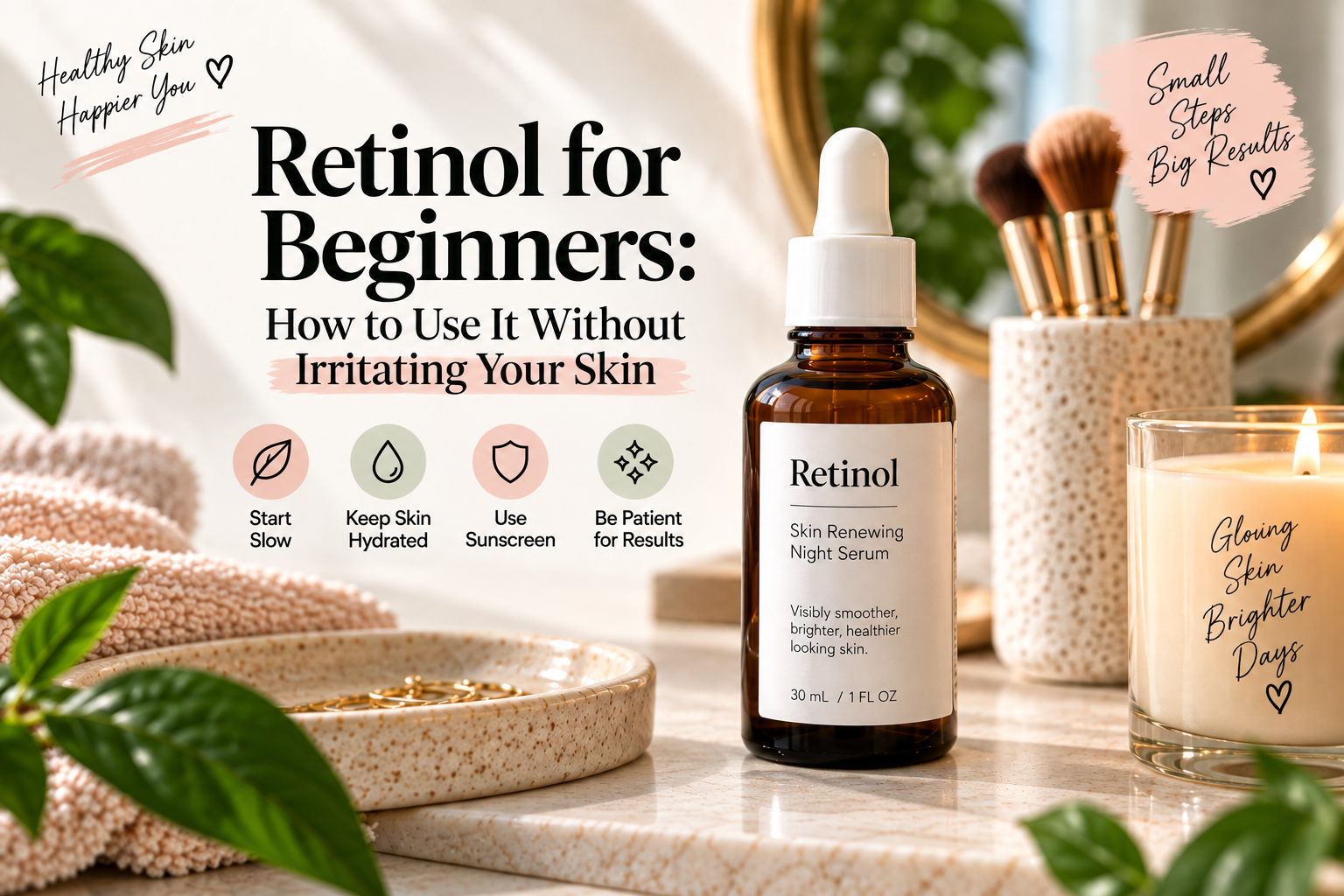
Retinol is one of the most talked-about skincare ingredients—and also one of the easiest to misuse.
If you’re new to retinol, you may have heard that it can help improve the appearance of fine lines, uneven skin tone, rough texture, and acne. You may have also heard stories about peeling, dryness, redness, and irritation.
Both can be true.
The key to retinol for beginners is starting slowly, using an appropriate amount, moisturizing well, and giving your skin time to adjust. Using more retinol or applying it more frequently doesn’t necessarily mean you’ll see better or faster results.
This beginner-friendly guide explains what retinol does, how to introduce it into your nighttime skincare routine, common mistakes to avoid, and how to reduce your risk of irritation.
What Is Retinol?
Retinol is a type of retinoid, a group of compounds derived from vitamin A.
Retinoids are commonly used in skincare because they can influence skin-cell turnover and other processes within the skin.
Retinol is available in many over-the-counter skincare products, including:
- Serums
- Creams
- Lotions
- Eye products
- Night treatments
Prescription retinoids, such as tretinoin, are different from cosmetic retinol products and are generally more potent.
If you’re a beginner, don’t assume that starting with the strongest retinoid will automatically give you the best experience.
What Does Retinol Do for Your Skin?
Retinol can be used for several different skin concerns.
1. Helps Improve the Appearance of Fine Lines
Retinoids are widely used in anti-aging skincare.
With consistent use, retinol may help improve the appearance of fine lines and other signs of photoaging.
However, don’t expect an overnight transformation.
Changes typically require consistent use over time.
2. Can Improve Skin Texture
If your skin looks rough or uneven, retinol may gradually help create a smoother-looking complexion.
Remember that perfectly texture-free skin isn’t realistic.
Pores, fine lines, and natural texture are normal features of healthy skin.
3. May Help With Uneven Skin Tone
Retinol may also help improve the appearance of certain types of discoloration and uneven-looking skin tone.
Sun protection is particularly important when you’re trying to improve pigmentation.
4. Can Help Acne-Prone Skin
Retinoids are commonly used as part of acne treatment.
However, over-the-counter cosmetic retinol isn’t necessarily equivalent to prescription or other acne-specific retinoids.
If you have persistent, painful, cystic, or scarring acne, consider consulting a dermatologist rather than relying solely on cosmetic products.
5. Supports Smoother-Looking Skin Over Time
Consistent retinol use can help improve the overall appearance of skin texture and tone.
The important word here is consistent.
Using retinol aggressively for one week and then stopping because your skin becomes irritated isn’t a good strategy.
Retinol for Beginners: How to Start
If you’re researching retinol for beginners, the most important rule is simple:
Start slowly.
Your skin doesn’t need to go from zero retinol to nightly use immediately.
Step 1: Choose a Beginner-Friendly Retinol
Retinol products come in different concentrations and formulations.
You may see products containing concentrations such as:
- 0.1%
- 0.2%
- 0.3%
- 0.5%
- 1%
The percentage alone doesn’t tell you everything about how irritating or effective a product will be because formulation matters.
For a beginner, choosing a lower-strength product can make it easier to introduce retinol gradually.
Don’t choose the strongest product simply because you think it will work faster.
Step 2: Patch Test Your Product
Before applying a new product all over your face, consider patch testing it on a small area first.
This won’t guarantee that you’ll never experience irritation, but it may help identify an obvious reaction.
Follow the manufacturer’s directions for your specific product.
Step 3: Use Retinol at Night
Retinol products are generally incorporated into a nighttime skincare routine.
A simple beginner routine could look like:
Cleanser → Retinol → Moisturizer
Depending on your skin and product formulation, you can also use moisturizer before retinol.
If you’re confused about layering products, read our guide to the correct order to apply skincare products.
Step 4: Apply Retinol to Dry Skin
After cleansing, gently pat your skin dry.
For people prone to irritation, allowing the skin to dry before applying retinol may help make the routine more comfortable.
Avoid aggressively rubbing your face with a towel.
Step 5: Use Only a Small Amount
More isn’t better.
For many facial retinoid products, approximately a pea-sized amount is enough for the entire face, although you should always follow the directions provided with your particular product.
Dot the product around your face and spread it into a thin layer.
Avoid piling on extra retinol over areas you’re trying to improve faster.
Step 6: Follow With Moisturizer
Moisturizer can be particularly helpful when introducing retinol.
Retinol can cause:
- Dryness
- Flaking
- Redness
- Tightness
- Stinging
- Irritation
Using an appropriate moisturizer helps support your skin barrier and may make retinol easier to tolerate.
If your skin is already irritated, read our guide on how to repair a damaged skin barrier before adding more active ingredients to your routine.
How Often Should Beginners Use Retinol?
Don’t feel pressured to use retinol every night.
A beginner might start with one or two nights per week, depending on the product instructions and individual skin tolerance.
For example:
Monday: Retinol
Tuesday: No retinol
Wednesday: No retinol
Thursday: Retinol
Friday: No retinol
Saturday: No retinol
Sunday: No retinol
If your skin remains comfortable over time, you may gradually increase the frequency according to your product’s directions and your skin’s response.
There is no prize for reaching nightly use.
If two or three applications per week work well for your skin, that’s perfectly reasonable.
What Is the Retinol Sandwich Method?
If you’re concerned about irritation, you’ve probably seen the retinol sandwich method on social media.
It generally looks like this:
Moisturizer → Retinol → Moisturizer
The idea is to buffer the retinol with moisturizer.
This may make retinoid use more tolerable for some people, although it can also alter how the product is delivered to the skin.
If you’re using a prescription retinoid, follow your prescriber’s directions rather than changing the application method based solely on social-media advice.
Where Should You Avoid Applying Retinol?
Be particularly careful around sensitive areas.
Unless your specific product is formulated and labeled for those areas, avoid getting retinol:
- Directly in or around the eyes
- On the lips
- Around the corners of the nose
- On broken or irritated skin
Wash your hands after applying the product.
What Can You Use With Retinol?
You don’t need a complicated routine.
For many beginners, a simple retinol night is better than combining several active ingredients.
Retinol + Niacinamide
Niacinamide can generally be incorporated into a routine that contains retinol.
Niacinamide is commonly used in barrier-supporting and moisturizing products, making it a useful companion ingredient for some people.
Read our complete guide to niacinamide for skin to understand where it can fit into your routine.
Retinol + Hyaluronic Acid
Hyaluronic acid is a humectant used in hydrating skincare products.
It can generally be used in a routine containing retinol.
You may not need a separate hyaluronic acid serum if your moisturizer already provides enough hydration.
Retinol + Ceramides
Ceramides are lipids naturally present in the skin barrier.
A moisturizer containing ceramides can be particularly useful if retinol leaves your skin feeling dry.
What Should Beginners Be Careful Mixing With Retinol?
This is where simplicity becomes useful.
Combining several potentially irritating products on the same night may increase your chance of experiencing irritation.
Be cautious when combining retinol with products such as:
- AHAs like glycolic acid
- BHAs like salicylic acid
- Strong exfoliating treatments
- Other retinoids
- Harsh scrubs
- Other irritating acne treatments
This doesn’t mean these ingredients can never exist in the same overall skincare routine.
The issue is whether your skin can tolerate the combination and whether you actually need all of them.
As a beginner, consider using retinol on its own treatment nights before experimenting with more complicated combinations.
Can You Use Vitamin C and Retinol?
Vitamin C and retinol can exist within the same overall skincare routine.
However, beginners don’t necessarily need to layer them together.
A simple approach is:
Morning: Vitamin C → Moisturizer → Sunscreen
Night: Retinol → Moisturizer
Separating active ingredients can make your routine easier to manage, particularly if your skin is sensitive.
Can You Use Niacinamide and Retinol Together?
Generally, yes.
Niacinamide and retinol don’t have a universal incompatibility that means they must always be separated.
For example:
Cleanser → Niacinamide → Retinol → Moisturizer
But you don’t need a separate niacinamide serum if your moisturizer already contains it.
Again, simple routines are often better for beginners.
Why Is Sunscreen Important When Using Retinol?
Sun protection should already be part of your morning skincare routine, but it becomes especially important when you’re using treatments intended to improve photoaging or uneven pigmentation.
Every morning, use a broad-spectrum sunscreen with SPF 30 or higher on exposed skin and follow its application and reapplication directions.
You can also support sun protection with:
- Shade
- Hats
- Protective clothing
- Sunglasses
Retinol isn’t a replacement for sunscreen, and sunscreen isn’t only necessary on your retinol nights.
It’s part of your morning routine.
What Is Retinol Purging?
You may have heard people say that worsening skin after starting retinol is simply “purging.”
Be careful with this assumption.
Some retinoids can initially change acne patterns as skin-cell turnover changes, but not every breakout, rash, or irritated reaction should automatically be called purging.
Significant:
- Burning
- Swelling
- Severe redness
- Persistent itching
- Blistering
- Pain
shouldn’t simply be ignored because someone online said your skin is “purging.”
If you’re experiencing a concerning reaction, stop using the product and seek professional advice when appropriate.
Common Retinol Mistakes Beginners Should Avoid
Mistake 1: Starting Every Night
Your skin may need time to adjust.
Beginning slowly can reduce unnecessary irritation.
Mistake 2: Using Too Much Product
Applying twice as much retinol doesn’t mean you’ll get results twice as fast.
Use the amount recommended by your product.
Mistake 3: Combining Too Many Actives
Starting retinol, glycolic acid, salicylic acid, and several serums simultaneously can make irritation more likely and make it difficult to identify the cause.
Mistake 4: Skipping Moisturizer
If retinol is drying your skin, moisturizer can be particularly important.
Choose a formulation appropriate for your skin type.
Mistake 5: Ignoring Sunscreen
A good nighttime retinol routine should be accompanied by sensible daytime sun protection.
Mistake 6: Increasing Strength Too Quickly
Don’t move from a beginner product to the strongest concentration simply because you’ve finished one bottle.
If your current routine is working well, stronger isn’t automatically necessary.
Mistake 7: Applying Retinol to Already-Irritated Skin
If your skin is burning, peeling significantly, or your barrier is compromised, adding more retinol may worsen the irritation.
Give your skin time to recover.
How Long Does Retinol Take to Work?
Retinol requires patience.
You shouldn’t expect meaningful changes after a few nights.
Depending on the concern and product, visible improvements may require weeks to months of consistent use.
Factors that can influence results include:
- Retinol formulation
- Concentration
- Frequency of use
- Your skin concern
- Your age
- Your overall skincare routine
- Sun exposure
- Consistency
Avoid increasing the amount simply because you’re impatient.
Skincare is a long-term process.
What If Retinol Makes Your Skin Dry or Flaky?
Some dryness and mild irritation can occur when introducing a retinoid.
If this happens, consider:
- Reducing how often you use it.
- Using a gentle cleanser.
- Applying a moisturizer regularly.
- Temporarily simplifying your routine.
- Avoiding unnecessary exfoliation.
- Giving your skin time to recover.
If irritation becomes significant or persistent, discontinue the product and consider speaking with a dermatologist.
Who Should Be Extra Careful With Retinoids?
Retinoids aren’t appropriate for everyone in every situation.
If you have a chronic skin condition, highly reactive skin, or are using prescription treatments, discuss introducing retinol with your dermatologist or healthcare professional.
Retinoids are generally avoided during pregnancy. If you’re pregnant, trying to become pregnant, or breastfeeding, ask your healthcare professional which skincare ingredients are appropriate for you.
Frequently Asked Questions
What Retinol Strength Should a Beginner Use?
There isn’t one perfect percentage for everyone.
Lower-strength formulations can be easier for beginners to introduce. The complete formulation and your skin’s tolerance matter in addition to the percentage.
Can I Use Retinol Every Night?
Some experienced users may tolerate frequent use, but beginners don’t need to start every night.
Begin gradually and follow your product’s directions.
Should I Moisturize After Retinol?
Yes, moisturizer can generally be used after retinol and may help reduce dryness and support the skin barrier.
Should I Apply Retinol Before or After Moisturizer?
Traditional layering often places a retinol treatment before moisturizer. People prone to irritation sometimes apply moisturizer first or use the sandwich method.
Follow the instructions for your specific product.
Can I Use Retinol Under My Eyes?
The eye area is particularly sensitive.
Only use retinol around the eyes if the product is specifically formulated and directed for that area, and avoid getting it into your eyes.
Can I Use Retinol in the Morning?
Retinol is generally incorporated into nighttime routines. Follow the instructions on your specific product and use sun protection during the day.
Is Retinol Good for Acne?
Retinoids can be useful for acne, but different retinoids have different evidence and uses. Persistent or severe acne deserves evaluation by a dermatologist.
At What Age Should You Start Retinol?
There isn’t one mandatory age at which everyone needs retinol.
Whether you should use it depends more on your skin concerns and goals than hitting a particular birthday.
Final Thoughts
Learning how to use retinol for beginners doesn’t have to mean building a complicated skincare routine.
Start with a suitable product, introduce it gradually, use only the recommended amount, moisturize appropriately, and protect your skin from the sun during the day.
Most importantly, don’t treat irritation as proof that retinol is working.
Your goal isn’t to make your skin peel as quickly as possible. It’s to create a routine you can tolerate consistently over time.
When used appropriately, retinol can be a useful addition to a skincare routine—but patience and consistency are more important than strength.