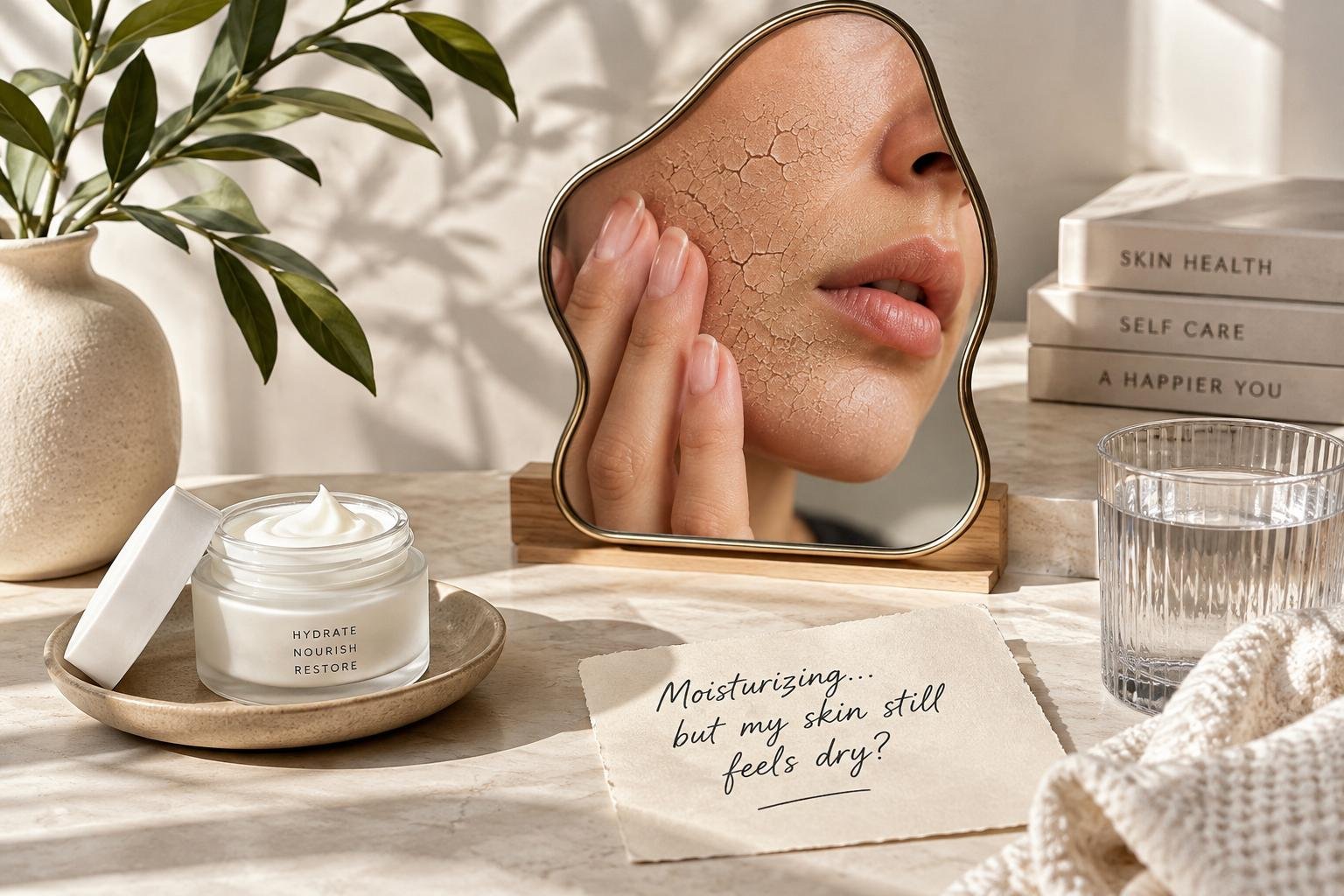
If your skin dry even after moisturizing, the problem may be your skincare routine rather than the amount of moisturizer you use.You apply moisturizer every morning and night, but your skin still feels tight, rough, flaky, or uncomfortable. It can be frustrating—especially when you feel like you’re already doing the obvious thing to fix dryness.
So, why is your skin so dry even after moisturizing?
The problem isn’t always that you need more moisturizer. Your cleanser may be too harsh, you may be over-exfoliating, your moisturizer may not provide enough barrier support, or environmental factors may be increasing water loss from your skin.
Sometimes persistent dryness can also be related to a skin condition that needs professional evaluation.
Below, we’ll look at nine common reasons your skin may still feel dry after moisturizing and what you can do to build a gentler, more effective skincare routine.
What Does Dry Skin Actually Mean?
Dry skin occurs when your skin doesn’t have enough water and/or lipids to maintain a comfortable, flexible surface.
Your outermost skin layer acts as part of a protective barrier that helps limit water loss and protects you from environmental irritants.
When this barrier isn’t functioning optimally, you may notice:
- Tightness
- Flaking
- Rough texture
- Itching
- Increased sensitivity
- Redness
- Fine lines appearing more noticeable
- Stinging when applying skincare products
Occasional dryness is common, especially during cold or dry weather.
However, persistent or severe dryness deserves more attention.
Why Is My Skin So Dry Even After Moisturizing?
If your skin is dry even after moisturizing, take a closer look at your cleanser, exfoliation habits, active ingredients, and moisturizer. Here are nine possible explanations. The American Academy of Dermatology also recommends several simple steps for relieving dry skin.”
1. Your Cleanser May Be Too Harsh
Your moisturizer isn’t the only product that matters.
A cleanser that leaves your face feeling extremely tight or “squeaky clean” may be removing more surface oils than your skin comfortably tolerates.
This can be especially noticeable if you’re cleansing frequently.
For dry skin, consider a gentle cleanser designed to clean without leaving the skin feeling stripped.
You generally don’t need aggressive scrubbing to properly cleanse your face.
What to Do
Look for a mild cleanser and use lukewarm rather than very hot water.
After cleansing, your skin should feel clean—not painfully tight.
2. You’re Waiting Too Long to Apply Moisturizer
How you apply moisturizer can matter.
Applying moisturizer while your skin is still slightly damp after cleansing or bathing can help trap some of that water at the skin’s surface.
You don’t need your face to be dripping wet.
Gently pat away excess water, then apply your moisturizer.
This simple change may make your routine more comfortable.
3. Your Moisturizer May Be Too Lightweight
A lightweight gel moisturizer can feel wonderful, but it may not provide enough support for very dry skin.
Moisturizers can contain different types of ingredients that perform different functions.
Humectants
These help attract and retain water.
Examples include:
- Glycerin
- Hyaluronic acid
- Urea
Emollients
These help smooth and soften the skin.
Examples may include:
- Squalane
- Fatty acids
- Certain plant oils
Occlusives
These help reduce water loss by forming a protective layer over the skin.
Examples include:
- Petrolatum
- Mineral oil
- Dimethicone
You don’t necessarily need to buy three different products.
A well-formulated cream can combine several types of moisturizing ingredients.
If your skin is extremely dry, a richer cream may feel more comfortable than a very light gel.
4. You May Be Over-Exfoliating
Exfoliation can make skin feel smoother, but more isn’t always better.
Using too many exfoliating products can leave your skin dry, sensitive, and irritated.
This can happen when you frequently combine products containing ingredients such as:
- Glycolic acid
- Lactic acid
- Salicylic acid
- Exfoliating toners
- Peels
- Facial scrubs
You may also unknowingly have exfoliating ingredients in several different products.
Signs You May Be Overdoing It
Watch for:
- Burning
- Increased redness
- Tightness
- Flaking
- Unusual sensitivity
- Products that suddenly sting
If this sounds familiar, consider simplifying your routine and temporarily reducing unnecessary exfoliation.
5. Your Skin Barrier May Be Compromised
If your skin remains dry despite moisturizing, your skin barrier may need attention.
Your skin barrier helps reduce excessive water loss and protects against external irritants.
When it’s disrupted, skin may become:
- Dry
- Flaky
- Sensitive
- Rough
- Tight
- Easily irritated
Common contributors include harsh cleansing, excessive exfoliation, environmental conditions, and overusing irritating skincare treatments.
If this sounds familiar, read our complete guide on how to repair a damaged skin barrier.
For a while, simpler may be better:
Gentle cleanser → Moisturizer → Sunscreen during the day
Give your skin a chance to recover before introducing several active ingredients again.
6. You’re Using Too Many Active Ingredients
Retinol, exfoliating acids, acne treatments, and other active products can be useful when used appropriately.
But using several at once can become irritating.
For example, someone might use:
Exfoliating cleanser → Acid toner → Treatment serum → Retinol
and then wonder why moisturizer isn’t solving the dryness.
The problem may not be your moisturizer.
It may be the overall routine.
If you’re new to vitamin A skincare, read our retinol for beginners guide before increasing how often you use it.
Introduce active ingredients gradually and pay attention to how your skin responds.
7. Hot Water May Be Making Dryness Worse
Long, hot showers may feel relaxing, but very hot water can contribute to dryness.
This doesn’t mean you need to take freezing showers.
Try using comfortably warm water and avoid unnecessarily long exposure to very hot water.
This applies to washing your face as well.
8. Your Environment May Be Drying Out Your Skin
Sometimes the problem isn’t inside your skincare cabinet.
Environmental conditions can influence how your skin feels.
Common contributors include:
- Cold weather
- Low humidity
- Indoor heating
- Air conditioning
- Wind
- Frequent washing
You may notice that a moisturizer that feels perfect during humid summer weather isn’t enough during winter.
Adjusting your routine seasonally is completely reasonable.
A humidifier may also help increase indoor humidity when the air is particularly dry, although it isn’t a replacement for appropriate skincare.
9. Your Dryness May Be More Than Simple Dry Skin
Persistent dry, itchy, inflamed, cracked, or painful skin isn’t always just a cosmetic problem.
Conditions such as eczema and other forms of dermatitis can cause significant dryness and irritation.
Certain medications and health conditions can also contribute to dry skin.
Consider seeing a dermatologist or healthcare professional if your dryness is:
- Severe
- Persistent
- Very itchy
- Painful
- Cracking or bleeding
- Associated with a rash
- Affecting a large area of your body
- Not improving with gentle skincare
Don’t keep adding stronger skincare products when the underlying issue may require medical evaluation.
How to Moisturize Dry Skin Correctly
If your moisturizer doesn’t seem to be working, try simplifying your technique.
Step 1: Cleanse Gently
Use a mild cleanser appropriate for your skin.
Avoid scrubbing aggressively.
Step 2: Leave Your Skin Slightly Damp
After cleansing, gently pat your skin.
Don’t wait until it feels completely dry and tight.
Step 3: Apply Hydrating Products If You Use Them
If your routine contains a hydrating serum, apply it according to the product’s directions.
You don’t necessarily need one.
A good moisturizer may be enough.
Step 4: Apply Moisturizer
Apply an appropriate amount across your face and neck.
For very dry skin, consider a richer cream containing ingredients such as glycerin, ceramides, or other barrier-supporting ingredients.
Step 5: Use Sunscreen in the Morning
Finish your morning skincare routine with a broad-spectrum sunscreen with SPF 30 or higher.
For the correct layering sequence, see our guide to the order to apply skincare products.
A Simple Morning Routine for Dry Skin
You don’t need ten products.
Try:
Gentle cleanser or rinse → Moisturizer → Sunscreen
If you use a hydrating serum:
Gentle cleanser → Hydrating serum → Moisturizer → Sunscreen
That’s enough for many people.
A Simple Night Routine for Dry Skin
At night:
Gentle cleanser → Moisturizer
If you use a treatment:
Gentle cleanser → Treatment → Moisturizer
However, if your skin is currently irritated, temporarily reducing active treatments may be more appropriate than adding additional products.
Ingredients to Look for in a Moisturizer for Dry Skin
Rather than choosing products based solely on marketing words such as “glowing” or “luxury,” look at the formulation.
Useful moisturizing ingredients can include:
Ceramides
Ceramides are lipids naturally found within the skin barrier.
They’re commonly included in barrier-supporting moisturizers.
Glycerin
Glycerin is a humectant that helps attract and retain water.
It’s found in many effective moisturizers.
Hyaluronic Acid
Hyaluronic acid is another popular humectant.
It can help hydrate the skin, but you don’t necessarily need a separate hyaluronic acid serum if it’s already present in your routine.
Squalane
Squalane is an emollient that can help soften and smooth dry-feeling skin.
Petrolatum
Petrolatum is a highly occlusive ingredient that can help reduce water loss.
It can be particularly useful for very dry areas, although it may feel too heavy for some people as an all-over facial product.
Can Niacinamide Help Dry Skin?
Niacinamide may support normal skin barrier function and is frequently included in moisturizers designed for dry or sensitive skin.
If you’re interested in the ingredient, read our guide to niacinamide for skin.
But don’t assume you need a separate niacinamide serum.
If your moisturizer already contains it, adding another product may be unnecessary.
Why Does My Skin Feel Tight After Moisturizing?
If your skin feels tight shortly after applying moisturizer, several things could be happening.
Your moisturizer may simply be too lightweight.
Alternatively, another product in your routine—such as your cleanser, exfoliant, retinoid, or acne treatment—could be contributing to dryness.
Try evaluating your entire routine, rather than immediately buying a different moisturizer.
Why Does My Skin Flake Even Though I Moisturize?
Flaking can occur when the skin is very dry or irritated.
It can also happen after introducing products such as retinoids or exfoliating acids.
Avoid trying to scrub every flake away.
Aggressive exfoliation can create even more irritation.
Instead, focus on gentle cleansing, adequate moisturizing, and reducing unnecessary irritating products.
Should You Apply Moisturizer More Than Once a Day?
Many people moisturize in the morning and at night.
You can also reapply moisturizer when needed, particularly to very dry areas.
How often you need it depends on your skin, environment, and product.
There isn’t a universal rule that everyone needs exactly two applications.
Common Dry-Skin Mistakes to Avoid
Using Extremely Hot Water
Use lukewarm or comfortably warm water instead.
Scrubbing Away Flakes
Scrubbing can worsen irritation.
Exfoliating Every Day
Dry skin doesn’t necessarily need frequent exfoliation.
Constantly Changing Products
If you’re introducing a new product every few days, it becomes difficult to know what’s helping or irritating your skin.
Using More Actives to Fix Irritation
If your barrier is already irritated, adding more acids or retinol can make things worse.
Assuming Expensive Means Better
A moisturizer doesn’t need to be luxurious to work well.
Look for a formulation appropriate for your skin.
Frequently Asked Questions
Why Is My Face So Dry Even When I Moisturize?
Possible reasons include a harsh cleanser, an overly lightweight moisturizer, over-exfoliation, retinoid use, low humidity, hot water, or a disrupted skin barrier.
Persistent dryness can also be associated with skin conditions, so seek professional advice if it doesn’t improve.
Should I Moisturize on Damp Skin?
Applying moisturizer to slightly damp skin after cleansing can help trap water at the skin’s surface.
Why Does My Moisturizer Work for Only a Few Hours?
Your moisturizer may not be rich enough for your current skin needs or environment.
A cream containing a combination of humectants, emollients, and occlusive ingredients may provide more lasting comfort.
Can Too Much Skincare Cause Dry Skin?
Yes.
Using several exfoliating or potentially irritating treatments can disrupt your skin barrier and lead to dryness and sensitivity.
Does Drinking More Water Fix Dry Skin?
Adequate hydration is important for overall health, but simply drinking large amounts of extra water isn’t a substitute for managing dry skin appropriately.
Your skincare routine and skin barrier still matter.
Is Hyaluronic Acid Enough for Dry Skin?
Not necessarily.
Hyaluronic acid is a humectant, but very dry skin may benefit from a moisturizer containing additional emollient and occlusive ingredients.
Can Retinol Make Skin Dry?
Yes. Dryness, flaking, and irritation are common when introducing retinoids, particularly if they’re used too frequently.
Final Thoughts
If you’ve been wondering, “Why is my skin so dry even after moisturizing?”, don’t immediately assume you need to apply more and more moisturizer.
Look at your entire routine.
Your cleanser may be stripping your skin, you may be exfoliating too frequently, your moisturizer may be too lightweight, or active ingredients such as retinol may be causing irritation.
When your skin is dry even after moisturizing, simplifying your routine and supporting your skin barrier may help.
Use a gentle cleanser, choose a moisturizer appropriate for dry skin, apply it while your skin is slightly damp, reduce unnecessary exfoliation, and use sunscreen during the day.
Most importantly, don’t ignore persistent or severe dryness.
If your skin remains painful, inflamed, intensely itchy, cracked, or doesn’t improve with gentle skincare, a dermatologist can help determine whether something beyond ordinary dry skin is responsible.