You start a new skincare product hoping for clearer, smoother skin. A few days later, new bumps and pimples appear.
Now you’re wondering: Is my skin purging, or is this product breaking me out?
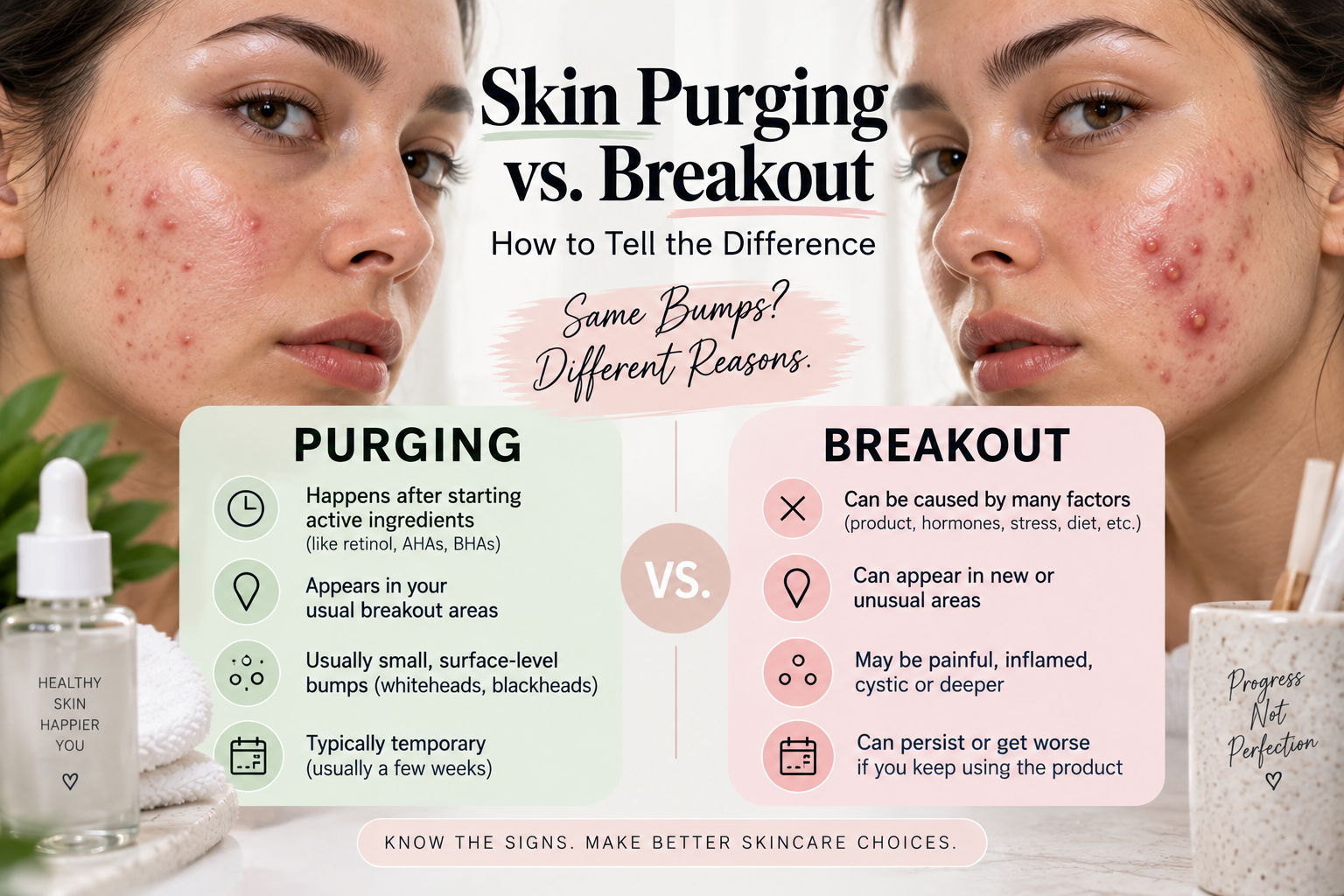
The skin purging vs. breakout question can be confusing because both can look similar at first. However, there are clues that may help you understand what’s happening, including the type of product you introduced, where the blemishes appear, how long they last, and whether you’re experiencing irritation.
It’s also important not to assume that every breakout after starting a new product is “purging.” Sometimes your skin simply doesn’t tolerate a product.
Here’s what you need to know.
What Is Skin Purging?
“Skin purging” is an informal term commonly used to describe a temporary increase in visible blemishes after introducing certain ingredients that affect skin-cell turnover.
As existing clogged pores come to the surface, you may temporarily notice more:
- Whiteheads
- Blackheads
- Small pimples
- Existing acne becoming more noticeable
Purging is most commonly discussed with ingredients that increase cell turnover or exfoliation.
However, not every new skincare product can realistically cause purging.
What Is a Regular Breakout?
A breakout occurs when pores become clogged and inflamed, leading to blemishes such as:
- Whiteheads
- Blackheads
- Papules
- Pustules
- Deeper acne lesions
Breakouts can happen for many reasons.
Possible factors include hormones, excess oil, certain skincare or cosmetic products, stress, friction, and underlying acne.
If a new product causes persistent breakouts, it doesn’t necessarily mean you should continue using it and “push through.”
Skin Purging vs. Breakout: 7 Key Differences
There’s no perfect at-home test that can always distinguish the two, but these seven clues can help.
1. Consider the Product You Just Started
This should be one of your first questions.
Purging is more plausible when you’ve introduced an ingredient that can increase cell turnover or exfoliation.
Examples may include:
- Retinoids
- AHAs such as glycolic acid
- BHAs such as salicylic acid
- Other exfoliating treatments
If you recently started a basic moisturizer or gentle hydrating serum and suddenly developed acne, calling it a “purge” may not make sense.
The product itself—or another change in your routine—may simply not agree with your skin.
2. Look at Where the Blemishes Appear
Another clue in the skin purging vs. breakout comparison is location.
Purging may appear in areas where you’re already prone to clogged pores or breakouts.
For example, if you normally develop acne around your chin and forehead, you might notice increased blemishes there after starting a retinoid.
Be more cautious if you’re suddenly developing persistent acne in areas where you rarely break out.
That doesn’t automatically prove the product is responsible, but it’s worth paying attention to.
3. Pay Attention to the Timing
If changes appear shortly after introducing an active ingredient, there may be a connection.
But timing alone isn’t enough to diagnose purging.
Hormonal changes, stress, menstrual cycles, other skincare products, makeup, lifestyle changes, and many other factors can affect acne.
This is why introducing one new skincare product at a time can be helpful.
If you start five new products simultaneously, identifying the cause of a reaction becomes much harder.
4. Watch How Individual Blemishes Behave
People often describe purging-related blemishes as appearing and resolving relatively quickly.
A regular breakout may continue producing new lesions or become progressively worse.
However, this isn’t a reliable diagnostic rule.
Acne can behave differently from person to person.
Rather than judging a single pimple, look at the overall pattern over time.
5. Check for Irritation
This is particularly important.
If you’re experiencing significant:
- Burning
- Stinging
- Itching
- Redness
- Swelling
- Cracking
- Severe peeling
- Pain
don’t automatically call it purging.
You may be experiencing irritation or a reaction to the product.
Your skin doesn’t need to burn for a treatment to be effective.
6. Consider How Long It Continues
A temporary worsening associated with introducing an active ingredient shouldn’t continue indefinitely.
Skin turnover occurs over weeks rather than days, and adjustment periods can vary depending on the ingredient and individual.
If your skin continues getting progressively worse, you’re developing significant irritation, or you’re seeing no improvement after several weeks, reassess the product rather than automatically assuming you need to “push through.”
A dermatologist can help if you’re uncertain.
7. Look at the Overall Pattern
Don’t focus only on the number of pimples.
Ask yourself:
- Did I recently start an active ingredient?
- Are the blemishes appearing where I normally break out?
- Is my skin otherwise comfortable?
- Are individual blemishes resolving?
- Is the overall situation gradually improving?
- Am I experiencing burning or significant irritation?
Looking at the full picture is more useful than relying on a single sign.
Skin Purging vs. Breakout Comparison
| Feature | Possible Purging | Regular Breakout/Reaction |
|---|---|---|
| New active product | Often | May or may not |
| Cell-turnover ingredient | More likely | Not required |
| Usual breakout areas | Often | Can appear anywhere |
| Significant burning | Not something to ignore | May indicate irritation |
| New blemishes | Can temporarily increase | Can continue or worsen |
| Duration | Should be temporary | May persist |
| What to do | Monitor carefully | Reassess routine/product |
This table is a guide—not a medical diagnostic tool.
Which Skincare Ingredients Can Cause Purging?
Not every skincare ingredient should be blamed for purging.
Retinoids
Retinoids affect skin-cell turnover and are among the ingredients most commonly associated with an initial worsening of acne.
If you’re just starting, read our Retinol for Beginners guide.
Starting slowly may help reduce irritation.
Salicylic Acid
Salicylic acid is a beta hydroxy acid commonly used for acne and clogged pores.
Because it exfoliates within pores, changes in breakouts can occur after introducing it.
However, irritation from excessive use shouldn’t simply be labeled purging.
Glycolic Acid
Glycolic acid is an alpha hydroxy acid that exfoliates the skin’s surface.
Introducing strong exfoliating products too frequently can cause irritation, so follow product directions and don’t assume peeling or burning is necessary.
Other Exfoliating Acids
Other AHAs and exfoliating treatments can influence the appearance of clogged pores.
Again, distinguish between temporary changes and obvious irritation.
Can Niacinamide Cause Skin Purging?
Niacinamide isn’t typically considered an ingredient that causes traditional purging because it doesn’t work by dramatically increasing skin-cell turnover in the same way as retinoids or exfoliating acids.
If you begin using a niacinamide product and develop new breakouts, consider the entire formulation, not just the niacinamide.
Your skin could be reacting to another ingredient in the product.
If you’re interested in using it, read our guide to niacinamide for skin.
Can Moisturizer Cause Purging?
A basic moisturizer generally isn’t expected to cause traditional skin purging.
If you develop new blemishes after changing moisturizer, possible explanations could include:
- Another ingredient in the formulation
- The texture not working well for your skin
- Coincidental hormonal acne
- Another product in your routine
- Irritation
- Other acne triggers
Don’t assume every reaction means your moisturizer is “detoxing” your skin.
Is Skin Purging a Sign That a Product Is Working?
Not necessarily.
This is an important misconception.
You do not need to experience purging for an active skincare product to be effective.
Some people may experience an initial increase in blemishes after introducing certain treatments, while others may not.
Clear skin without an initial breakout doesn’t mean the product isn’t working.
What Should You Do If You Think Your Skin Is Purging?
If you’ve introduced an appropriate active ingredient and your skin is otherwise tolerating it, avoid immediately adding several more products.
Keep your routine simple.
Morning
Gentle cleanser → Moisturizer → Sunscreen
Night
Gentle cleanser → Treatment → Moisturizer
If you’re unsure where everything belongs, see our correct order to apply skincare products.
Introduce Actives Slowly
If you’re using a retinol or exfoliating treatment, follow the product’s instructions.
Beginners often don’t need to use strong treatments every night.
Gradual introduction can make it easier to monitor how your skin responds.
Keep Your Skin Moisturized
Acne-prone skin still needs appropriate moisturization.
Drying your face out as much as possible isn’t necessarily the solution to acne.
Choose a moisturizer suitable for your skin type.
Don’t Add More Exfoliation
If you’re worried about new blemishes, your first instinct might be to exfoliate more aggressively.
That can backfire.
Excessive exfoliation may disrupt your skin barrier and increase redness, dryness, and irritation.
What Should You Do If It’s a Breakout?
If you suspect a new product is contributing to breakouts, consider temporarily stopping it and returning to a simpler routine.
Don’t replace it immediately with three new treatments.
Give yourself a chance to observe what happens.
If your acne is persistent or severe, professional treatment may be more effective than repeatedly experimenting with cosmetic products.
Purging vs. Damaged Skin Barrier
Purging and a damaged or irritated skin barrier are not the same thing.
A compromised barrier may cause:
- Burning
- Stinging
- Tightness
- Flaking
- Redness
- Increased sensitivity
- Roughness
If your skin suddenly becomes extremely sensitive and products that previously felt comfortable now sting, irritation may be more relevant than purging.
Read our guide on how to repair a damaged skin barrier.
How Long Does Skin Purging Last?
There’s no exact timeline that applies to everyone.
Skin-cell turnover takes time, so changes associated with introducing an active ingredient may play out over several weeks.
However, don’t use an arbitrary “purging timeline” as a reason to tolerate severe or worsening symptoms.
If your skin becomes progressively worse, significantly irritated, painful, or doesn’t improve, consider stopping the product and speaking with a dermatologist.
When Should You Stop Using a New Product?
Consider discontinuing a new product if you experience:
- Significant burning
- Severe itching
- Swelling
- Blistering
- Hives
- Painful irritation
- A rapidly spreading rash
- Severe peeling or cracking
- Breakouts that continue worsening
Seek urgent medical care for symptoms of a serious allergic reaction, such as difficulty breathing or significant facial or throat swelling.
How to Prevent Confusion When Starting New Skincare
One of the easiest ways to understand your skin is to change your routine slowly.
Introduce One New Product at a Time
This makes it easier to identify what’s helping or causing problems.
Take Progress Photos
Take photos under similar lighting every week or two.
This can be more useful than checking your face in the mirror several times per day.
Don’t Change Your Entire Routine
If you start an acne treatment, you probably don’t need a new cleanser, moisturizer, toner, exfoliant, and serum on the same day.
Keep Your Routine Consistent
Consistency makes patterns easier to identify.
Patch Test When Appropriate
Patch testing may help identify some reactions, although it cannot guarantee that a product won’t cause problems when used across your entire face.
Common Skin Purging Mistakes
Assuming Every Breakout Is Purging
This is probably the biggest mistake.
Only certain types of products make purging a plausible explanation.
Continuing Through Severe Irritation
Burning and painful inflammation aren’t achievements.
Your skincare routine shouldn’t feel like punishment.
Using More Product to Speed Things Up
More retinol or exfoliating acid doesn’t necessarily produce faster results.
It may simply produce more irritation.
Picking New Blemishes
Picking can worsen inflammation and increase the risk of marks or scarring.
Skipping Moisturizer
Acne-prone skin can still become dry and irritated.
Moisturizer can be an important part of a balanced routine.
Forgetting Sunscreen
Use broad-spectrum SPF 30 or higher during the day and follow the sunscreen’s directions for application and reapplication.
Frequently Asked Questions
How Do I Know if My Skin Is Purging or Breaking Out?
Consider what product you started, whether it affects cell turnover, where the blemishes are appearing, how long the changes continue, and whether you’re experiencing significant irritation.
No single sign can always distinguish the two.
Does Purging Cause Pimples Everywhere?
Purging is often described as occurring in areas where someone is already prone to clogged pores or acne.
New persistent blemishes in unusual areas may deserve closer attention.
Can Retinol Cause Purging?
Retinoids can be associated with an initial worsening of acne in some people.
However, severe irritation shouldn’t automatically be considered normal purging.
Can Niacinamide Cause Purging?
Traditional purging isn’t generally expected from niacinamide itself because it isn’t primarily a cell-turnover ingredient.
A reaction after starting a niacinamide product could be related to the overall formulation or another factor.
Should I Stop a Product if I’m Purging?
Not necessarily, provided the product is appropriate, your symptoms are mild, and you’re not experiencing significant irritation.
When in doubt—especially if symptoms are worsening—consult a dermatologist.
Does Everyone Purge When Starting Retinol?
No.
You don’t need to purge for retinol or another active treatment to work.
Can Purging Be Itchy?
Significant itching should make you consider irritation or another reaction rather than simply assuming it’s purging.
Final Thoughts
Understanding skin purging vs. breakout can help you make better decisions when introducing new skincare products.
The biggest clue is the product itself.
A temporary increase in blemishes is more plausible after introducing ingredients that affect cell turnover, such as retinoids or exfoliating acids. A simple moisturizer or hydrating serum isn’t expected to cause traditional purging.
Then look at the bigger picture: where the blemishes appear, how your skin feels, how long the changes continue, and whether things are improving or getting worse.
Most importantly, don’t treat severe irritation as something you simply have to endure.
Good skincare should support your skin—not turn every new product into a test of how much burning, peeling, or breaking out you can tolerate.