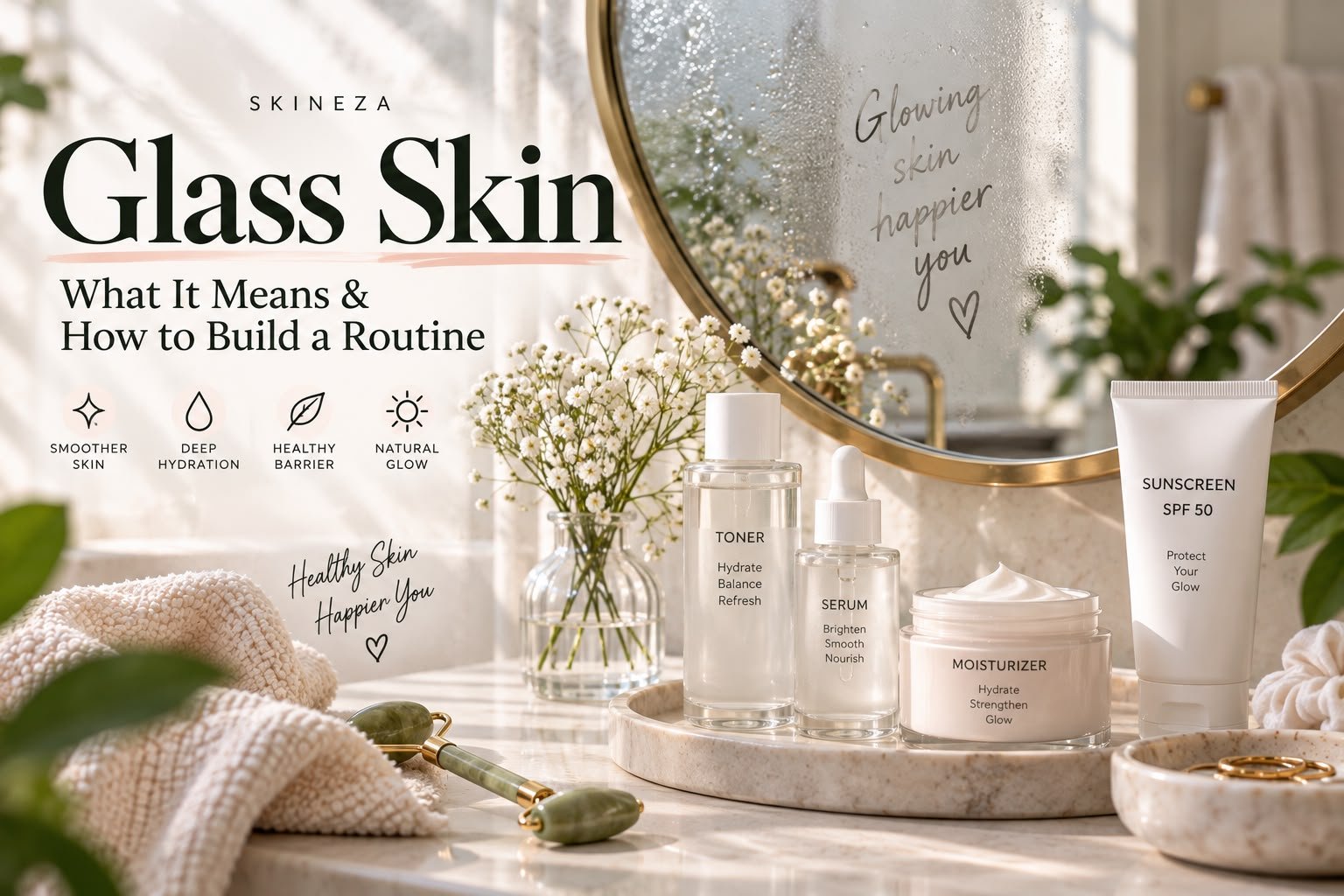
If you’ve spent any time looking at skincare trends on Pinterest, TikTok, or Instagram, you’ve probably come across the term glass skin.
The idea sounds almost too good to be true: skin that looks incredibly smooth, hydrated, luminous, and reflective—almost like glass.
But glass skin isn’t a specific skin type, and it doesn’t mean your face needs to be completely poreless or flawless.
The glass skin trend originated in Korean beauty and generally describes a complexion that looks deeply hydrated, smooth, healthy, and naturally radiant.
And you don’t necessarily need a complicated 10-step routine to work toward that appearance.
The foundation of a glass skin routine is surprisingly simple: gentle cleansing, hydration, moisturizing, appropriate treatments, and consistent sun protection.
Here’s how to build a realistic glass skin routine without overwhelming your skin.
What Is Glass Skin?
Glass skin is a beauty term used to describe skin that appears exceptionally smooth, clear, hydrated, and luminous.
Think of skin that looks:
- Plump and hydrated
- Smooth
- Naturally luminous
- Even-looking
- Fresh rather than greasy
- Healthy and comfortable
The goal shouldn’t be literally poreless skin.
Everyone has pores, texture, fine lines, and natural variations in their complexion.
Many glass-skin photos you see online may also involve professional lighting, makeup, filters, or image editing.
A healthier goal is to focus on hydrated, comfortable, radiant-looking skin rather than trying to achieve an unrealistic filtered appearance.
Where Did the Glass Skin Trend Come From?
Glass skin became internationally popular through the growing influence of Korean skincare and K-beauty.
Korean beauty routines often emphasize hydration, gentle layering, skin-barrier support, and prevention rather than relying only on heavy makeup to create a smooth complexion.
Traditional K-beauty routines are sometimes associated with many different steps.
However, you don’t need 10 products to create an effective skincare routine.
Your skin may actually respond better to a smaller number of carefully selected products.
What Makes Skin Look “Glassy”?
The glass-skin appearance usually comes from several factors working together.
Hydration
Well-hydrated skin often appears plumper and more luminous.
Smooth-Looking Texture
When the surface of your skin is comfortable and properly moisturized, light can reflect more evenly.
Healthy Skin Barrier
A well-functioning skin barrier helps limit excessive water loss and protects your skin from environmental irritants.
Even-Looking Skin Tone
Dark spots, redness, and uneven pigmentation can affect how uniform your complexion appears.
Sun Protection
Consistent sun protection helps reduce UV-related skin damage and is an important part of maintaining healthy-looking skin.
Glass Skin Routine: A Simple Step-by-Step Guide
You don’t need to copy every viral Korean skincare routine.
Start with the essentials and add optional products only when they address a specific concern.
Step 1: Start With Gentle Cleansing
Every good glass skin routine starts with cleansing.
The goal is to remove:
- Excess oil
- Sweat
- Makeup
- Sunscreen
- Environmental debris
without leaving your skin feeling stripped.
Choose a gentle cleanser appropriate for your skin type.
If your face feels extremely tight immediately after cleansing, your cleanser may be too harsh for your skin.
Use lukewarm rather than very hot water and avoid aggressively scrubbing your face.
Step 2: Double Cleanse When Necessary
Double cleansing is commonly associated with Korean skincare, but you don’t necessarily need to do it every morning and night.
At night, double cleansing can be useful if you’re wearing:
- Makeup
- Water-resistant sunscreen
- Heavy complexion products
The first cleanse typically helps dissolve makeup and sunscreen.
The second water-based cleanser removes remaining residue.
If one gentle cleanser effectively removes everything and your skin feels comfortable afterward, you may not need two.
Step 3: Add Hydration
Hydration is one of the biggest components of the glass-skin look.
This is where hydrating toners, essences, or serums may fit into your routine.
Look for ingredients commonly used in hydrating products, such as:
- Glycerin
- Hyaluronic acid
- Panthenol
- Beta-glucan
You don’t need all of these ingredients or several separate hydrating products.
A single well-formulated product may be enough.
Step 4: Use a Serum for Your Main Skin Concern
Serums aren’t mandatory, but they can be useful when you’re targeting a specific concern.
For example:
For uneven-looking skin tone:
Vitamin C or niacinamide may be useful options.
For hydration:
Look for humectant-rich formulas.
For oily-looking skin:
Niacinamide may be useful for some people.
For signs of photoaging:
A retinoid may be appropriate for some routines.
Avoid adding several active serums simply because they’re trending.
Choose products based on what your skin actually needs.
If you’re interested in niacinamide, read our complete guide to niacinamide for skin.
Step 5: Moisturize
Moisturizer is essential to a simple glass skin routine.
It helps support your skin barrier and reduce water loss.
Look for a moisturizer suited to your skin type.
Dry Skin
You may prefer a richer cream containing ingredients such as:
- Ceramides
- Glycerin
- Squalane
- Fatty acids
Oily Skin
You may prefer a lightweight lotion or gel-cream.
However, oily skin can still need moisturizer.
Combination Skin
A lightweight cream may work well across your face, or you can adjust the amount depending on the area.
If your skin remains uncomfortable despite moisturizing, see our guide on why your skin is dry even after moisturizing.
Step 6: Apply Sunscreen Every Morning
If you’re serious about maintaining healthy-looking skin, sunscreen shouldn’t be optional.
UV exposure contributes to:
- Uneven pigmentation
- Premature signs of skin aging
- Changes in skin texture
- Skin cancer risk
Use a broad-spectrum sunscreen with SPF 30 or higher on exposed skin and follow the product directions for application and reapplication.
The American Academy of Dermatology recommends broad-spectrum, water-resistant sunscreen with SPF 30 or higher when outdoors.
A luminous sunscreen can also contribute to the immediate appearance of glowing skin—but protection should remain the main priority.
Simple Morning Glass Skin Routine
Your morning routine doesn’t need to take 30 minutes.
Try:
1. Gentle cleanser or rinse
↓
2. Hydrating serum or essence — optional
↓
3. Targeted serum — optional
↓
4. Moisturizer
↓
5. Broad-spectrum SPF 30+
If you’re unsure about layering, read our guide to the correct order to apply skincare products.
Simple Night Glass Skin Routine
At night, focus on cleansing, treatment when needed, and hydration.
Try:
1. Makeup/sunscreen removal if needed
↓
2. Gentle cleanser
↓
3. Hydrating product — optional
↓
4. Treatment serum — optional
↓
5. Moisturizer
That’s enough for many people.
You don’t need seven serums before bed.
Can Retinol Help With a Glass Skin Routine?
Retinol can be useful for some people trying to improve the appearance of texture, uneven tone, and signs of photoaging.
However, retinol can also cause dryness and irritation—exactly the opposite of the hydrated appearance associated with glass skin—if you introduce it too aggressively.
Beginners should start gradually.
Read our retinol for beginners guide before adding it to your routine.
A simple retinol night might look like:
Cleanser → Retinol → Moisturizer
Don’t assume that using retinol every night will give you glass skin faster.
Can Niacinamide Help You Get Glass Skin?
Niacinamide is another ingredient commonly found in routines designed to support healthy-looking skin.
Depending on the formulation, niacinamide may help with:
- Skin barrier support
- Uneven-looking tone
- Appearance of excess oil
- Overall skin texture
It can also fit relatively easily into many routines.
However, niacinamide isn’t a magical “glass skin serum.”
Your overall routine matters more than any single ingredient.
What About Hyaluronic Acid?
Hyaluronic acid is a humectant, meaning it can help attract and retain water.
Because hydration contributes to a plump, luminous appearance, hyaluronic acid is commonly included in glass skin routines.
But you don’t necessarily need a separate hyaluronic acid serum.
It may already be present in your moisturizer, toner, or another skincare product.
Should You Exfoliate for Glass Skin?
Exfoliation can improve the appearance of rough surface texture, but over-exfoliation can damage your skin barrier and leave your face:
- Red
- Dry
- Tight
- Flaky
- Sensitive
- Irritated
That’s not glass skin.
Chemical exfoliants may contain ingredients such as:
- Glycolic acid
- Lactic acid
- Salicylic acid
How frequently you should exfoliate depends on the product, concentration, your skin, and the rest of your routine.
More frequent exfoliation doesn’t automatically mean smoother skin.
Glass Skin Routine for Dry Skin
If you have dry skin, prioritize hydration and barrier support.
A simple routine could be:
Morning
Gentle cleanser → Hydrating serum → Rich moisturizer → Sunscreen
Night
Gentle cleanser → Hydrating serum → Moisturizer
Consider ingredients such as glycerin, ceramides, squalane, and hyaluronic acid.
Avoid constantly exfoliating dry flakes.
That can make irritation worse.
Glass Skin Routine for Oily Skin
Having oily skin doesn’t mean you can’t achieve a luminous complexion.
The goal is healthy-looking radiance rather than excessive oiliness.
Try:
Morning
Gentle cleanser → Niacinamide, if desired → Lightweight moisturizer → Sunscreen
Night
Cleanser → Treatment, if needed → Lightweight moisturizer
Avoid trying to strip every bit of oil from your skin.
Sebum is a normal component of skin.
Glass Skin Routine for Acne-Prone Skin
If you’re acne-prone, don’t sacrifice acne management for a temporary glow.
Your routine should prioritize products that your skin tolerates.
A simple routine may include:
Morning:
Gentle cleanser → Moisturizer → Sunscreen
Night:
Cleanser → Appropriate acne treatment → Moisturizer
Additional hydrating products can be added if they work well for you.
Persistent, painful, cystic, or scarring acne deserves professional evaluation.
Glass Skin Routine for Sensitive Skin
If you have sensitive skin, simplicity is especially important.
You don’t need:
- Multiple exfoliating acids
- Several active serums
- Daily peels
- Strong scrubs
- Constantly changing products
Focus first on:
Gentle cleansing + moisturizer + sunscreen
Then introduce additional products individually.
This makes it easier to identify what your skin tolerates.
7 Common Glass Skin Mistakes
1. Using Too Many Products
A 10-step routine isn’t automatically better than a four-step routine.
More products also create more opportunities for irritation.
2. Over-Exfoliating
Trying to scrub or exfoliate your way to perfectly smooth skin can damage your barrier.
3. Chasing Poreless Skin
Pores are normal.
Real skin isn’t supposed to look like a completely smooth sheet of glass.
4. Skipping Moisturizer Because You Have Oily Skin
Oily skin can still benefit from an appropriate moisturizer.
Choose a texture you enjoy using.
5. Using Too Many Active Ingredients Together
Retinol + exfoliating acids + several brightening serums isn’t necessarily a shortcut to glowing skin.
It may simply lead to irritation.
6. Forgetting Sunscreen
Your nighttime routine can’t undo every effect of repeated unprotected UV exposure.
Make sunscreen part of your morning routine.
7. Expecting Results in One Week
Healthy-looking skin takes consistency.
Be skeptical of products promising dramatic permanent transformations in a few days.
How Long Does It Take to Get Glass Skin?
There isn’t a universal timeline.
You may notice increased hydration relatively quickly after improving your moisturizing routine.
Changes in uneven pigmentation, texture, or signs of photoaging can take much longer.
Your results depend on:
- Your starting skin condition
- Skin type
- Products
- Consistency
- Sun exposure
- Lifestyle
- Individual biology
Think in terms of weeks and months, not overnight transformations.
Do You Need Korean Skincare Products for Glass Skin?
No.
Glass skin became strongly associated with K-beauty, but you don’t have to use exclusively Korean products.
What matters is what the products do and whether they’re appropriate for your skin.
A simple routine containing a gentle cleanser, effective moisturizer, suitable treatment, and sunscreen can be built using products from many different brands and countries.
Can You Get Glass Skin Naturally?
Your skin’s natural appearance is influenced by many factors, including genetics, age, environment, hormones, and lifestyle.
Healthy habits can support your overall skin health.
These include:
- Getting adequate sleep
- Eating a balanced diet
- Avoiding smoking
- Protecting your skin from excessive UV exposure
- Managing skincare irritation
- Staying appropriately hydrated
However, don’t expect any single food, drink, supplement, or DIY mask to magically create glass skin.
Frequently Asked Questions
Is Glass Skin Actually Possible?
You can improve hydration, smoothness, and radiance, but literally poreless, perfectly reflective skin isn’t a realistic biological standard.
Aim for healthy-looking skin rather than filtered perfection.
What Is the Most Important Step for Glass Skin?
There isn’t one magical step.
Gentle cleansing, adequate moisturizing, appropriate treatments, and consistent sun protection work together.
Do I Need a 10-Step Korean Skincare Routine?
No.
A simple routine can be effective. Add extra steps only when they provide a clear benefit for your skin.
Can Oily Skin Have Glass Skin?
Yes. Oily skin can still look hydrated, smooth, and luminous.
Choose lightweight products that suit your skin.
Does Niacinamide Give You Glass Skin?
Niacinamide may support several characteristics associated with healthy-looking skin, but it isn’t a standalone solution.
Is Retinol Necessary for Glass Skin?
No.
Retinol can be useful for certain concerns, but you don’t need retinol specifically to have hydrated, radiant-looking skin.
Can I Get Glass Skin Without Exfoliating?
Yes.
Exfoliation can be useful for some people, but it’s not mandatory, particularly if your skin is sensitive or already irritated.
Final Thoughts
Glass skin isn’t about making your face literally look like glass.
It’s about creating a complexion that appears hydrated, smooth, comfortable, even-looking, and naturally radiant.
And you don’t need a bathroom cabinet filled with 20 products to work toward it.
Start with the fundamentals:
Cleanse gently. Hydrate. Moisturize. Protect your skin from the sun.
Then add targeted ingredients only when your skin actually needs them.
The best glass skin routine isn’t necessarily the longest or most expensive one.
It’s the routine you can follow consistently without irritating your skin.