Niacinamide has become one of the most popular ingredients in modern skincare—and for good reason. You can find it in everything from serums and moisturizers to cleansers and eye creams. When choosing niacinamide for skin, a higher concentration isn’t necessarily better. Starting with a moderate concentration may be more suitable, especially if you have sensitive skin.
But what does niacinamide actually do?
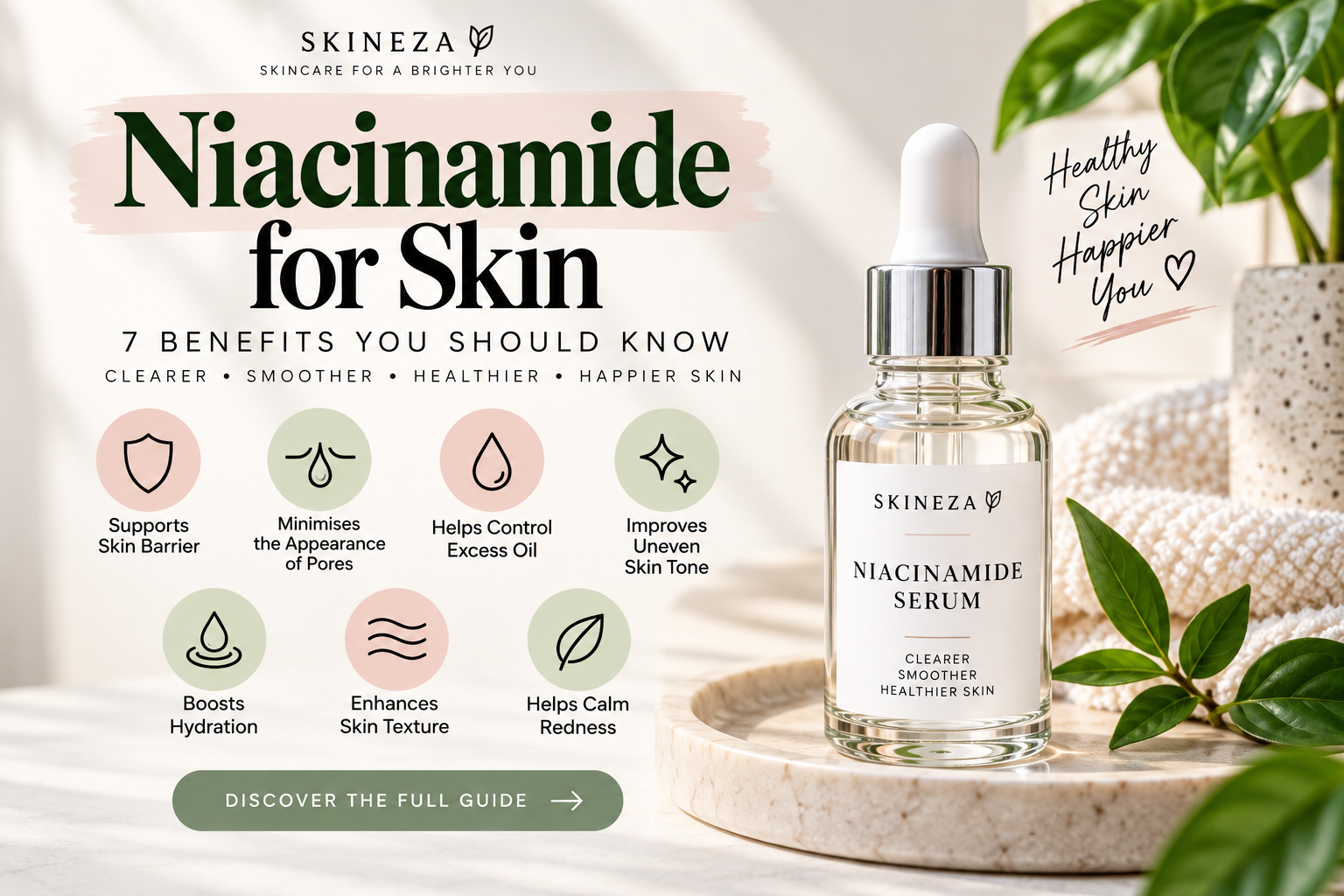
Niacinamide for skin can help support the skin barrier, improve the appearance of uneven skin tone, regulate the appearance of excess oil, and help skin look smoother and healthier.
Better yet, niacinamide is generally considered a versatile skincare ingredient that can fit into many different routines.
However, more isn’t always better. The concentration you choose, the other products in your routine, and how your individual skin responds all matter.
In this guide, we’ll explain what niacinamide is, its potential benefits, how to use it, and how to combine it with other popular skincare ingredients.
What Is Niacinamide?
Niacinamide, also called nicotinamide, is a form of vitamin B3.
In skincare, it is commonly included in products designed to support the skin barrier, improve skin appearance, and address concerns such as dryness, uneven tone, and excess oil.
Unlike an exfoliating acid, niacinamide doesn’t work by removing layers of dead skin cells.
Instead, it supports several processes within the skin, which is one reason it can be incorporated into many different types of skincare routines.
You may find niacinamide in:
- Serums
- Moisturizers
- Toners
- Cleansers
- Eye creams
- Sunscreens
You don’t necessarily need a dedicated niacinamide serum if you’re already using other products containing it.
7 Potential Benefits of Niacinamide for Skin
Let’s look at some of the reasons this ingredient has become so popular.
1. Supports the Skin Barrier
One of the most interesting benefits of niacinamide for skin is its role in supporting normal skin barrier function.
Your skin barrier helps limit water loss and protects your skin from environmental irritants.
When your barrier isn’t functioning well, your skin may feel dry, tight, rough, or sensitive.
Niacinamide may support the production of components important to the skin barrier, including ceramides.
If you’re currently dealing with dryness and irritation, read our guide on how to repair a damaged skin barrier.
2. May Help Improve the Appearance of Enlarged Pores
No skincare product can literally open and close your pores.
However, niacinamide may help improve their overall appearance in some people.
Keeping your skin balanced and controlling excess surface oil can make pores appear less noticeable.
It’s better to think in terms of reducing the appearance of pores rather than permanently shrinking them.
3. Can Help With the Appearance of Excess Oil
People with oily or combination skin often gravitate toward niacinamide.
Research suggests topical niacinamide may influence sebum production, although results depend on the formulation and individual skin.
That doesn’t mean your goal should be to remove all oil from your face.
Sebum is a natural part of healthy skin.
The goal is balanced-looking skin—not completely oil-free skin.
4. May Improve Uneven-Looking Skin Tone
Niacinamide is also commonly used in products targeting uneven-looking skin tone and dark spots.
It may help reduce the appearance of certain areas of hyperpigmentation over time.
However, don’t expect dramatic changes overnight.
Consistent sun protection is particularly important when addressing uneven pigmentation because UV exposure can contribute to darkening.
5. Helps Support Skin Hydration
Healthy-looking skin needs adequate hydration.
By supporting normal barrier function, niacinamide may indirectly help the skin retain moisture more effectively.
For dry skin, it can be combined with moisturizing ingredients such as:
- Glycerin
- Ceramides
- Hyaluronic acid
- Squalane
You don’t need all of these ingredients in separate products.
A well-formulated moisturizer can contain several of them.
6. May Help Improve Skin Texture
Consistent use of an appropriate niacinamide product may help skin look smoother and more even.
However, skin texture is normal.
Pores, tiny lines, and natural variations in your skin aren’t imperfections that need to be completely erased.
Be cautious of edited social-media images promising completely poreless skin.
7. May Help Calm the Appearance of Redness
Niacinamide is frequently included in products formulated for skin prone to visible redness or irritation.
Its barrier-supporting properties may make it useful in a gentle skincare routine.
However, persistent facial redness can have many causes, including skin conditions such as rosacea.
If your redness is significant, painful, persistent, or worsening, consider seeing a dermatologist.
How to Use Niacinamide in Your Skincare Routine
One advantage of niacinamide is its flexibility.
It can generally be used in either your morning or nighttime skincare routine, depending on the product.
A simple routine could look like this:
Morning
Cleanser → Niacinamide → Moisturizer → Sunscreen
Night
Cleanser → Niacinamide → Moisturizer
If you use multiple serums or treatments, product texture and formulation can affect application order.
For a complete layering guide, read our correct order to apply skincare products.
Should You Use Niacinamide in the Morning or at Night?
You can typically use niacinamide in the morning, at night, or both, provided your skin tolerates the product and you follow its directions.
There isn’t necessarily a benefit to using it as often as possible.
For beginners, using a new product once a day can make it easier to see how your skin responds.
If you’re using niacinamide in the morning, don’t treat it as a replacement for sunscreen.
Finish your morning routine with broad-spectrum SPF 30 or higher.
What Percentage of Niacinamide Should You Use?
This is where many people make skincare unnecessarily complicated.
You may see niacinamide serums advertised at concentrations such as:
- 2%
- 4%
- 5%
- 10%
- 15%
- 20%
A higher percentage doesn’t automatically mean better results.
Many skincare products use niacinamide at relatively modest concentrations, and evidence for certain benefits exists at concentrations around 2–5%.
Products containing 10% or more are widely available, but some people may find higher-concentration formulas irritating.
If you’re a beginner or have sensitive skin, you don’t necessarily need to start with the strongest product available.
How Often Should You Use Niacinamide?
How often you use niacinamide depends on:
- The product formulation
- Its concentration
- Your other skincare products
- Your skin type
- Your individual tolerance
Follow the directions provided with your specific product.
When introducing a new skincare product, starting gradually can make it easier to identify irritation.
If your skin becomes persistently red, itchy, swollen, or uncomfortable, stop using the product and reassess your routine.
Can You Use Niacinamide With Vitamin C?
Yes, niacinamide and vitamin C can generally be used in the same skincare routine.
You may have seen older advice online claiming that these two ingredients should never be combined.
That rule isn’t considered necessary for modern, properly formulated skincare products.
However, using several active products simultaneously can still irritate sensitive skin.
If your skin doesn’t tolerate the combination, you could use vitamin C in the morning and niacinamide at night.
Your skin’s response matters more than trying to use every popular ingredient together.
Can You Use Niacinamide With Retinol?
Niacinamide and retinoids can also be included in the same overall skincare routine.
In fact, a moisturizing product containing niacinamide may complement a routine that includes a retinoid.
However, retinoids can cause dryness and irritation, particularly when you first start using them.
If you’re new to retinol, introduce products gradually rather than beginning several new actives at once.
Can You Use Niacinamide With Hyaluronic Acid?
Yes.
Niacinamide and hyaluronic acid are commonly found together in skincare routines and even within the same product.
Hyaluronic acid primarily acts as a humectant, while niacinamide offers different potential benefits, including barrier support.
A routine might look like:
Cleanser → Hydrating serum → Niacinamide product → Moisturizer
But again, you don’t need separate serums for every ingredient.
Can You Use Niacinamide With Salicylic Acid?
Niacinamide and salicylic acid can be used within the same routine by people whose skin tolerates them.
Salicylic acid is a beta hydroxy acid commonly used in products for oily and acne-prone skin.
Because salicylic acid can sometimes cause dryness or irritation, beginners may prefer introducing one product at a time.
If using both together causes irritation, consider alternating them or using them at different times of day.
What Should You Not Mix With Niacinamide?
Despite what you may see in viral skincare charts, there isn’t a long universal list of ingredients that must never be mixed with niacinamide.
Niacinamide is relatively versatile.
The bigger issue is overall irritation.
For example, a routine containing multiple acids, retinoids, strong acne treatments, and several serums could irritate your skin even if each ingredient is individually compatible with niacinamide.
Instead of asking only:
“Can these two ingredients be mixed?”
Also ask:
“Does my skin actually need all of these products?”
Simple skincare is often easier to maintain.
Niacinamide for Oily Skin
Niacinamide can be particularly appealing if you have oily skin because of its potential effect on the appearance of excess sebum.
Consider a lightweight serum or moisturizer that doesn’t feel excessively heavy on your skin.
A basic oily-skin routine might include:
Morning: Gentle cleanser → Niacinamide → Lightweight moisturizer → Sunscreen
Night: Cleanser → Niacinamide → Moisturizer
Avoid aggressively stripping oil from your face with harsh cleansers.
That can leave skin feeling irritated and uncomfortable.
Niacinamide for Dry Skin
Dry skin can also benefit from niacinamide-containing products.
Instead of focusing only on a serum, consider a moisturizer containing niacinamide alongside ingredients such as ceramides, glycerin, or other emollients.
For dry skin, the moisturizing base of the product may be just as important as the niacinamide itself.
Niacinamide for Acne-Prone Skin
Niacinamide is frequently included in products marketed toward acne-prone skin.
Its potential effects on oiliness, visible redness, and barrier function can make it a useful supporting ingredient.
However, niacinamide isn’t a replacement for proven acne treatments when medical treatment is needed.
If you have persistent, painful, cystic, or scarring acne, consider seeing a dermatologist.
How Long Does Niacinamide Take to Work?
Skincare results take time.
You shouldn’t expect a niacinamide serum to transform your skin after one or two applications.
Depending on what you’re trying to improve, visible changes may require several weeks of consistent use.
Results also depend on:
- Product concentration
- Formulation
- Your skin concern
- Your overall skincare routine
- Consistency
- Sun protection
- Individual skin response
Take occasional photos under similar lighting if you want a more objective way to monitor changes.
Common Niacinamide Mistakes to Avoid
Even a versatile ingredient can be used poorly.
Using Too High a Concentration
Don’t assume 20% must be twice as effective as 10%.
Higher concentrations can sometimes increase irritation without providing a meaningful advantage for your particular concern.
Introducing Too Many Products Together
If you start niacinamide, retinol, vitamin C, and an exfoliating acid in the same week, you won’t know which product caused a reaction.
Introduce new products gradually.
Skipping Moisturizer
Niacinamide serum isn’t automatically a replacement for moisturizer.
If your skin needs additional moisture, follow with an appropriate moisturizer.
Skipping Sunscreen
If your goal is brighter, more even-looking skin, daily sun protection is especially important.
The American Academy of Dermatology recommends broad-spectrum, water-resistant sunscreen with an SPF of 30 or higher when outdoors.
Expecting Overnight Results
Good skincare is usually about consistency rather than dramatic overnight transformations.
Does Niacinamide Have Side Effects?
Many people tolerate topical niacinamide well, but any skincare product can potentially cause irritation or an allergic reaction.
Possible reactions may include:
- Redness
- Itching
- Burning
- Stinging
- Dryness
- Rash
The reaction may also come from another ingredient in the product rather than niacinamide itself.
Consider patch testing a new product, particularly if your skin is sensitive or you have a history of reactions.
Stop using a product if you develop significant irritation.
Seek medical attention for severe reactions, swelling, blistering, difficulty breathing, or other concerning symptoms.
Frequently Asked Questions About Niacinamide
Can I Use Niacinamide Every Day?
Many niacinamide products are formulated for daily use. Follow the instructions for your particular product and adjust based on how your skin responds.
Is 5% or 10% Niacinamide Better?
Higher isn’t automatically better.
A 5% formulation may provide benefits while being more comfortable for some people. The quality of the overall formulation also matters.
Does Niacinamide Brighten Skin?
Niacinamide may help improve the appearance of uneven skin tone and areas of hyperpigmentation over time.
It shouldn’t be marketed or used as a way to change your natural skin color.
Does Niacinamide Help With Pores?
Niacinamide may help make enlarged pores appear less noticeable, but it cannot permanently remove pores.
Pores are a normal part of your skin.
Can Beginners Use Niacinamide?
Yes. Niacinamide can be a beginner-friendly ingredient when used appropriately.
Consider starting with a straightforward formulation rather than immediately choosing the highest concentration available.
Do I Need Moisturizer After Niacinamide?
If you’re using a niacinamide serum, moisturizer will usually come afterward.
If your moisturizer already contains niacinamide, you may not need a separate serum.
Final Thoughts
Niacinamide for skin is popular because it can fit into many different skincare routines and may provide several useful benefits.
It can help support the skin barrier, improve the appearance of uneven tone and texture, support hydration, and potentially reduce the appearance of excess oil.
But you don’t need the strongest niacinamide serum or a complicated 10-step routine to benefit from it.
Start with a well-formulated product appropriate for your skin, introduce it gradually, moisturize when needed, and use sunscreen during the day.
Most importantly, pay attention to how your skin responds rather than following every skincare trend you see online. Overall, niacinamide for skin can be a useful addition to a simple skincare routine. It may help support the skin barrier, improve the appearance of uneven tone, and manage excess oil. Start with a suitable concentration, introduce it gradually, and pay attention to how your skin responds.
5 thoughts on “Niacinamide for Skin: Benefits, How to Use It & What Not to Mix”